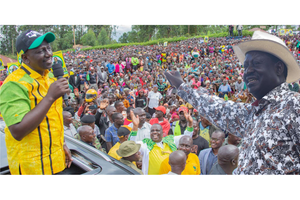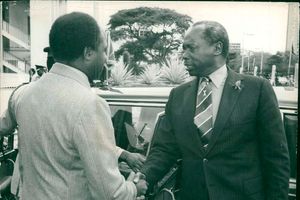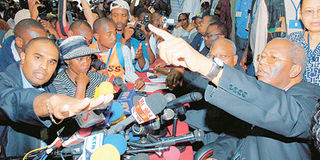
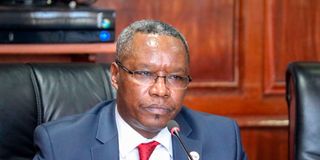
Mr Kivuitu before he announced that Mwai Kibaki had won the 2007 presidential election. ODM rejected the result sparking mayhem, deaths and destruction. Photo/FILE

In case you missed it, read part 1 of this serialisation here.
--------
The phone call came on a tense Sunday afternoon, December 30, 2007.
It was made to Nimrod Mbai, then a police sergeant attached to the security detail of government spokesman Alfred Mutua.
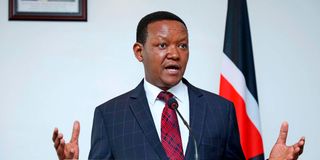
Alfred Mutua.
It was his day off, but the election crisis gripping the country had already turned the capital into a place of nervous anticipation, and they were informed to be on standby.
Mbai, currently the Kitui East MP, recalls that even before the call came, police units across Nairobi had been placed on high alert as events inside the national tallying centre at the Kenyatta International Convention Centre grew increasingly volatile.
“It was Sunday, and because of the elections, we were alert. Around 4 pm, Dr Mutua called me on a private line,” he said.
The line was known only to a handful of trusted contacts- the late president Mwai Kibaki, the then Head of Public Service Francis Muthaura and Mbai.
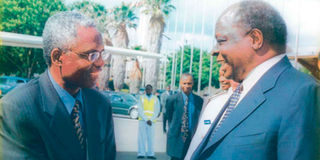
President Mwai Kibaki with then head of Public Service Francis Muthaura.
In that brief call, Mbai recounts that his boss, Dr Mutua, asked him to rush to the office, located on the third floor of KICC, with immediate effect.
When Mbai arrived, he found Mutua seated with another man whom he had never interacted with. The conversation that followed made it clear that events were moving quickly.
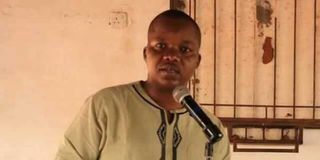
Kitui East MP Nimrod Mbithuka Mbai. He is a former police officer.
“I was told, you can see what is happening. We don’t know how the day will end, but we know Kibaki must remain president,” Mbai said.
The assignment given to Mbai was extraordinary.
Special access card
His task would be to remain on standby for a mission involving Samuel Kivuitu, the chairman of the Electoral Commission of Kenya. He was instructed that if violence broke out inside the tallying centre, he would be responsible for escorting Kivuitu out safely.
This assignment was not given to Mbai by chance; he was among the very few people at KICC who had a special access card that allowed him to walk through all parts of the Centre, and the government knew.
“I was told to prepare myself. I had to be ready to get him (Kivuitu) out if things got worse,” he said.
The preparations were unlike anything Mbai had experienced before.
“I have never been armed the way I was that day,” he said.
He was taken to a shooting range within Nairobi, where his firearm, a Ceska Pistol, was tested. The officer observing him, Mr Mbai recalled, was working at the then Criminal Investigations Department (CID), which is now the Directorate of Criminal Investigations (DCI).
“They tested my gun, and they were impressed. They gave me another gun, but I told them I was used to mine, but they insisted that I needed another gun in case mine jammed,” Mbai said.
The message was unmistakable: whatever was about to happen was expected to be dangerous.
Before accepting the job, Mbai insisted on meeting with Kivuitu and ensuring the commissioner knew him “so that when it was time to leave, the process would be smooth.”
The two met and agreed on a coded password that would trigger the extraction.
“We agreed the password would be the names of our villages. If I mentioned that word, he would know it was time to move,” he said.
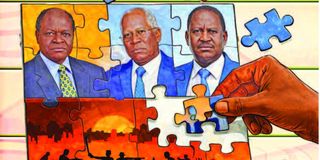
Former President Mwai Kibaki (left) Former Electoral Commission of Kenya chairman Samuel Kivuitu, and former Prime Minister Raila Odinga.
Inside KICC, the atmosphere was reaching breaking point.
Politicians from both the ODM- led by then Eldoret North MP, William Ruto- and the PNU – led by then Gichugu MP and Minister for Justice, Martha Karua, had crowded into the tallying hall. Arguments over constituency results were growing louder and increasingly hostile.
“I remember Martha Karua, William Ruto, and the late Mutula Kilonzo. They were on Kivuitu's case. Martha and Kilonzo were on Kibaki’s side. They were so serious with the details. Ruto and another guy—Peter Odoyo, an MP. They were much on the details on Kivuitu’s table. They went through every result and would counter-check what Kivuitu was saying,” Mbai recalled.
Electoral commissioners themselves were deeply divided over what they were witnessing.
Jack Tumwa said that the pattern of results arriving in the final hours had left many officials, including the Commission’s chairperson, deeply troubled.
“Results that came in as a bang shocked all of us. The graph just started rising, and Raila was losing. To us, it didn’t make sense,” he said.
The sudden surge of results from certain constituencies raised questions among the commissioners about whether the process was unfolding properly.
“We started wondering what exactly was happening. Really, there was something wrong. We were very suspicious,” Tumwa said.
As arguments raged inside the hall, the government was growing increasingly anxious about the delay in declaring the results.
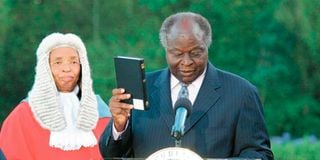
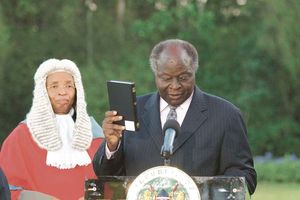
President Mwai Kibaki takes oath of office at State House in Nairobi on December 30, 2007 after being declared the winner of the disputed presidential election.
Dr Mutua, recounting the tense days while on national Television days after President Kibaki died in 2022, explained why Kibaki had to be sworn in with urgency.
“Our fear was that if Kibaki was declared the winner, Raila would get a judge to get an injunction stopping the swearing-in,” Mutua said.
At State House, discussions intensified over how to ensure the declaration was completed. Mutua decided to intervene directly in another way.
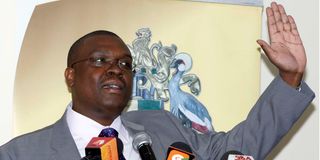
Philip Kisia.
He picked up the phone and called Philip Kisia, the managing director of KICC.
“I remember calling Philip Kisia and telling him we had to cut off the power,” Mutua said, adding,
“I told him, because I know how cameras work, to turn off the lights at KICC.”
Mr Kisia remembers the moment clearly.
“It is true that we spoke. He asked me to make certain decisions and requested that I switch off the power...It was a weighty decision…but I declined,” he recalled.
His decision did not augur well with senior government officials who were sitting with Mutua and the President. He received another call from Mutua, who then placed a minister on the line.
“He put a very powerful minister on the phone. They read a list of ministers who were sitting with Kibaki at that moment. I had to do it,” Kisia said.
The lights at the tallying centre were switched off. But not without difficulty, the then KICC boss recounts that nearly all his staff, including technicians and engineers, had all gone home. He had to go to the power room with a staff member named Ombati to switch off the lights.
For a brief moment, the vast hall inside KICC fell into darkness. Amid the confusion, the next phase of the plan moved quickly.
Mutua says the objective was to ensure Kivuitu could read the final results in a controlled environment where the declaration could be recorded without interruption.
“I called Waihenya and told him to send a camera person,” Mutua said.
Government officials
Waithaka Waihenya, then the editor-in-chief at the Kenya Broadcasting Corporation (KBC), remembers the intense pressure surrounding the broadcast of the election results. There were key figures who kept calling him- Minister Michuki, Muthaura, Mutua, and a senior military officer. They were with the President at State House.
Former Kenya Broadcasting Corporation Editor-in-Chief Waithaka Waihenya.
“Of all these people, Mutua was the one on my case. It was Mutua—not Muthaura, not the minister (Michuki). Mutua was operating from KICC and State House. Sometimes he would call me, and I would hear the President’s voice,” he said.
While government officials called him, the opposition also did not let him rest. At some point, he was threatened.
“One of them threatened me. He told me, “Waihenya, this thing is bigger than you; you'd better announce this.” I told him I would be happy to be a martyr, but there is no way I would do what was wrong. He told me my problem is that I had always behaved like a bishop,” he recalled.
The electoral commission chairman, the KBC boss, recounted, had become increasingly desperate to complete the process.
“I remember that Sunday, Kivuitu was actually cracking under pressure, and he announced, “I can announce these results from a ship, from the forest, from anywhere where KBC is.”
“When Kivuitu said that, calls started coming in from very senior people, whose names I will not mention. They asked me, “What capacity do you have? Can you announce these results from Aberdare Forest?” That was a very senior person,” he said.
Eventually, Kivuitu was taken into a room within KICC where a camera crew was waiting. But this took a lot of persuasion and coercion.
“It is Mutua who called Kivuitu and told him to go to that room, and I remember talking to Kivuitu as he walked to that room, and I told him, 'Chairman, stop the shenanigans; the cameras are running.” So, the moment when that was recorded, I knew. It only took a few minutes; he announced the results,” Waihenya said.
Kisia recalled that he played a role in Mutua speaking with Kivuitu because the ECK chairperson had refused to talk to the government spokesperson.
“Kivuitu refused to speak to Alfred Mutua. I remember him saying he would not speak to that “small boy,” and then the same powerful minister came back on the line and ordered me to order Kivuitu to announce the election results,” he recounted.
Chaos continued
When the KICC boss said he could not order Kivuitu, more calls kept coming.
“So, Mutua kept on insisting, and at some point, I was able to persuade the chairman to speak with Mutua, and they did talk. It was just after 6pm. They spoke in their mother tongue; I do not know what they said, but they spoke in Kikamba for about ten or so minutes, and thereafter, the chairman asked me for a desk. I do not know what he was told,” Kisia said.
But outside the room, chaos continued.
“Kivuitu started reading the results. The opposition realised and came to break the door,” Mutua said.
This account was corroborated by Kisia, who said that the opposition got wind that something was going on, and there was an attempt to break into the room where the ECK team was reading the results.
“I do not know where they got that intelligence from…When I realised that the chairman’s life was not safe, I evacuated him and relocated him to a safe place. I took him from where he should have read the results into a different room, and that I did without being prompted by anybody,” Kisia said.
Inside the room, however, the recording had already been secured.
“I made the decision that only the national broadcaster would record…It was to avoid people jostling for space,” Kisia said.
As Kisia managed the KICC situation, Mr Waihenya was receiving another set of orders involving the swearing-in ceremony.
“Before the election results were announced, I was ordered to take the OB Van to State House. I ordered the crew to go to State House and wait for the announcement and the inauguration of the president. That is all I could do,
“By then, I did not know the results, but I had been told to release the OB van to go to State House. Who are you to say no?” he posed.
Back in KICC, once the recording was complete, Mbai moved into position.
“A minute before the lights went off, I made sure Kivuitu saw me behind him,” Mbai said.
When the lights went out, Mbai stepped forward.
“I tapped him on the shoulder and said the password. He immediately understood. I also took a green file, which I was told was important, and it had to get to State House with Kivuitu. It was the file that had the results,” he said.
Mbai began guiding the elderly electoral commission chairman through a side exit away from the chaotic hall. The walk, which would have taken Mbai, an athlete officer, one minute, took four minutes.
“Kivuitu was elderly, and he told me to take him slowly. My work was the safety of “mzee” getting out of KICC,” Mbai said.
The brief descent of stairs and walking to the basement parking was enough for Mbai to take in the magnitude of what was actually happening to the country and his role in the entire ecosystem of the 2007 elections.
“It gets to a point where it is do or die. In the military, the most important training you will learn is “see before you are seen, kill before you are killed.” That will save your life or get you killed. If you see me before I see you and shoot me before I shoot you, you have won.
“This was war in my mind, and it was reminded to me by ten senior officers. “Nimrod, what did you learn in college?” I repeated it like ten times. I would tell them that I know the first thing is concealment; I should hide and not be seen. Then number two, I should see before I am seen. Then three, I have to kill before I am killed. That was that moment…This was reality,” he said.
The vehicle carrying Kivuitu sped through the streets of Nairobi toward State House. Dr Mutua was the driver, Mbai revealed. Had it not been his boss, the orders were that he was not to board the vehicle.
Once the vehicle hit the gates of KICC, it was immediately sandwiched between several other vehicles.
“Mutua knew the car to follow,” Mbai said.
Security vehicles cleared the road as they approached the heavily guarded State House compound.
At the gate, officers were already waiting.
“Kivuitu was taken inside,” Mbai said.
Inside State House, senior officials had gathered.
Many of them had been following events at KICC with growing anxiety. Mutua remembers walking into the room where President Kibaki was waiting.
“I told Kibaki what had happened, and then I sat at the corner,” Mutua said.
At the same time, Waihenya was beyond stretched; the calls coming kept getting more urgent. One of the KBC reporters handed him the tape at the office. It had the recording of Kivuitu announcing the results, and he knew his work was almost done.
“At that time, I think the government had realised we were under siege, and the GSU were all over my office. I could not even go to the toilet without these guys. I had to take the tape personally to the studio and cue it,
“At that time, Kibaki was on the line, and so were Muthaura and Mutua. My phone was ringing like six times simultaneously. I told Mutua, “Kivuitu had announced, and he asked me to read it to him. I was on speakerphone, and the senior military officer was also on the line.
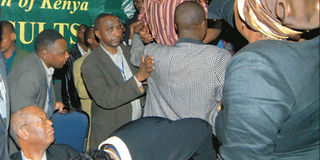
Former ECK boss the late Samuel Kivuitu (seated) looks on as a man protests the announcement of the results of the 2007 general elections at the KICC in December 2007.
“So I read, and I heard Kibaki, the President, saying, “Nataka kuiona kwa runinga hapo.” I told Mutua I am going to the studio, and in five minutes, it would be there. And it was announced, and they forgot to switch off the mics after the announcement, and I could hear what they were talking about,” he said.
When the tape was finally played on air, the long-awaited declaration was broadcast.
“When Waihenya was able to get it done, Kibaki was declared president on that tape,” Mutua said.
Inside State House, the mood changed instantly.
“Kibaki hugged me,” Mutua said.
Within minutes, preparations began for the swearing-in ceremony.
But outside the compound, the political temperature was rising rapidly. Across parts of the country, protests were already beginning.
The disputed declaration would soon plunge Kenya into one of the darkest chapters in its political history.
Nearly two decades later, the events of that day continue to haunt the country’s political memory.
In March 2025, veteran media owner SK Macharia made a striking admission during a public conversation about Kenya’s electoral history.
“We were told that Kibaki won in 2007, and we had complete data that it’s Raila who won the election…our data was showing Raila had won with 1.8m votes. I was picked from my house at night...all returning officers from Mt Kenya region were held somewhere and their return forms taken.
“I was taken to my office, found some people, I won’t mention their names, and we changed all those figures, and Kibaki won the election against him (Raila),” he said.
But Commissioner Kigano insists that the commission simply announced the results that were delivered to the national tallying centre by returning officers.
The Commission, he explained, had no authority to alter the figures submitted by returning officers.
“We had no control. What was brought in is what we took. You cannot change,” he said.
He maintains that accusations directed at the Electoral Commission itself were misplaced.
“The returning officers are the ones who conduct the tallying in the constituencies. If someone interfered with the figures, it would have been done there, not at the national centre,” he added.
In retrospect, Commissioner Tumwa believes the outcome was doctored.
“I believe Raila has been denied that chance to lead this country. Not because he has not been supported, but because he has been manipulated and thrown out in one way or another. Having listened to SK Macharia and having seen what happened at ECK, I think Raila Odinga would have won that seat,” he said.
Follow our WhatsApp channel for breaking news updates and more stories like this.