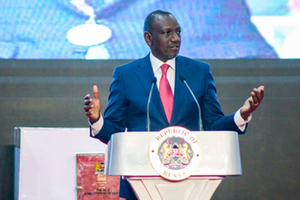
Several times, President William Ruto has challenged his competitors to produce an agenda – a manifesto – for Kenya. It seems like a reasonable demand to make the contest a democratic competition of ideas. But Ruto’s own journey to State House offers a more interesting starting point.
In 2022, he went around the country consulting Kenyans on their economic priorities. County economic charters were intended to capture local aspirations and feed into a national agenda. He signed a Women’s Charter, too. The promise was for citizens’ priorities to shape the programme of the incoming administration. The agenda would not descend from the candidate’s head, but emerge from conversations with the people whose lives the government would affect. Bottom-up.
As another election approaches, Kenyans have an opportunity to decide what comes next. Should the country renew its old priorities, revise them or begin again? What has changed in the lives of citizens, and what kind of future do they now want? These are questions for the public, not puzzles for politicians to solve before presenting their answers to an audience.
The old politics was quite simple. A leader developed a vision in seclusion with a few eggheads, then explained it to the country and asked for a mandate to implement it. The public were spectators expected to cheer, heckle and vote. The serious business of deciding what the country needed was left to those who had secured the keys to State House. Each new administration came bearing its own screeds of national salvation. The public was invited to admire the prose, poetry and brilliance.
The Constitution upends this arrangement. Article 1 declares that all sovereign power belongs to the people. Article 10 establishes participation of the people as a national value and principle of governance. Article 174 identifies the enhancement of people’s participation in the exercise of State power and in decisions affecting them among the objects of devolution. These clauses establish who owns the power and whose participation must give it meaning. Leaders are not merely required to listen before making decisions. The people have a right to help determine the purposes for which power is exercised. Yet participation is often reduced to an invitation to comment on decisions already imagined elsewhere.
Imagine a community discovering that a magnificent new State Lodge is to be built in its forest. The architects have drawn the plans, the engineers have assessed the site, the budget has been prepared and the President’s comfort provided for. The project has all the hallmarks of serious government business. The community, however, depends on the forest for water, livelihoods, medicinal plants and cultural heritage. Its members may decide that the forest is more valuable than a State Lodge. Experts can explain the costs and consequences, but they cannot decide on the community’s behalf what its forest is worth.
And this is the difference between leader-led development and a democracy in which people determine their own priorities. Citizens may choose different investments, different ways of living or a different understanding of prosperity. They may decide that a project celebrated as progress by the government is not progress for them.
The demand for an opposition agenda assumes that politicians must first decide what the country needs, then present their conclusions to a public expected to choose the most convincing sales pitch. Kenyans become consumers of political programmes rather than participants in determining their contents.
The assumption is particularly curious in a country whose Constitution locates sovereignty in the people. It treats citizens as too ignorant to identify their problems, too inexperienced to weigh competing priorities and too immature to make choices about their collective future.
Invite competing proposals
There is a constructive role for the opposition to play, but it might not begin by writing its manifesto. A national conversation that starts with local experience can bring residents, workers, farmers, traders, young people, women and professionals into deliberation about what matters and what should change. The opposition can make information accessible, invite competing proposals and help people understand the costs and consequences of different choices. Where priorities conflict, leaders can create room for negotiation rather than pretend that every demand can be met.
This is not to suggest that politicians should disappear from the process of setting the national agenda. They can contribute knowledge, challenge assumptions, explain constraints and help translate the priorities that emerge into policy and budgets.
Kenyans are quite capable of constructing the next political compact together. Its contents should emerge from deliberation, not be dictated by the ambitions of those seeking office. The resulting agenda may be untidy, contested and subject to revision. That is the nature of a democracy in which people are authors rather than spectators.
Ruto once sought a mandate through a process that asked Kenyans to help shape an agenda. The practice should become a permanent feature of democratic life.
The opposition does not need to produce an agenda on behalf of the people; it needs to help Kenyans decide what the next agenda should be.
The writer is board member of KHRC and writes in his individual capacity. @kwamchetsi; [email protected] .