Prof Kithaka wa Mberia is a renowned linguist and prolific author. He’s not only a professor at the University of Nairobi, but also a leading Kiswahili expert whose works are studied as set books and by language enthusiasts globally.
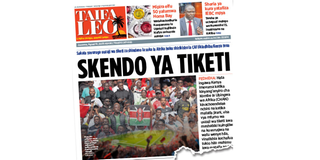
This is why his views on a recent Taifa Leo headline, Skendo Ya Tiketi, carry weight.
Commenting on this anglicisation of Kiswahili, which has also become a trend among Kiswahili tabloids in a neighbouring country, Prof Mberia had this to say: “We have to look at the issue at two levels. The first level is anglicisation as a natural process called borrowing, through which languages all over the world go. Linguists know why borrowing takes place.
The main reason is what is called the need motive; that is, a situation whereby a language has to express a new notion (entering the culture from outside) and yet it lacks a word for it.
That’s how words like government, parliament and attorney-general entered the English language from French.
“The second is the incompetence or laziness of the writer. This is the best lens through which to look at ‘skendo ya tiketi’. We already have a word for scandal in Kiswahili in the form of ‘kashfa’.
Consequently, there isn’t a good reason to borrow and adapt an English word for the concept. There isn’t a need motive! The borrowing and adaptation is uncalled for and arbitrary.
Someone who speaks Kiswahili as their mother language but does not understand English will not make sense of the out-of-the-blue ‘skendo ya tiketi’.
“This attitude by scribes is a terrible disservice to Kiswahili. What is written, especially in a respectable publication, is considered the norm or the standard.
Consequently, a school pupil or student seeing ‘skendo’ will assume that that usage is correct and, henceforth, use it.
This is detrimental to the integration and development of Kiswahili. By carrying that type of language, the paper becomes a liability.”
Recasting the professor’s point
English borrowed heavily from French centuries ago because it lacked words for emerging institutions and concepts. That is how languages grow.
But he argues that ‘skendo’ is not such a case. Kiswahili already has a perfectly serviceable word— ‘kashfa’. Using ‘skendo’ was, therefore, not an innovation but a lapse. It adds confusion, particularly for Kiswahili speakers who do not know English.
The greater concern is that newspapers set linguistic standards. What is printed in a national paper like Taifa Leo is absorbed as correct usage.
If careless hybrids creep in, they distort the language at scale. In effect, a respected paper risks undermining the very language it is meant to uphold.
Prof Mberia’s critique underscores the cultural and national responsibility of Taifa Leo. Unlike the tabloids in other countries, it is the only national daily published entirely in Kiswahili.
It is not just a news outlet; it is a custodian of language and culture. Readers turn to it not only for stories, but also to see how Kiswahili is properly written and used.
Creativity is welcome—Kiswahili is expressive and thrives on idioms, proverbs and wordplay. But creativity should enrich Kiswahili, not debase it.
There is a fine line between playfulness and carelessness, and in this case, the headline crossed it.
Broader national implications
Niche publications exist precisely to safeguard and promote areas that mainstream outlets may neglect.
Just as Le Monde defends the integrity of French, or El País protects Spanish, Taifa Leo has a duty to champion Kiswahili.
For many Kenyans—especially those who studied before Kiswahili was made compulsory under the 8-4-4 system—Taifa Leo has been a classroom in print. Its stories are relatable, and its language is accessible.
Urban children, caught between English at home and Sheng in the streets, also stand to benefit from a newspaper that models proper Kiswahili.
When Taifa Leo carries authentic, dignified Kiswahili, it builds both knowledge and confidence in the language.
The debate sparked by Prof Mberia points to a larger national concern: the place of Kiswahili in Kenya’s cultural identity and cohesion.
Kiswahili is not just another language; it is the national language of Kenya and an official language of the East African Community and the African Union. It binds Kenyans across ethnic and regional divides, offering a neutral, unifying medium of communication.
If Taifa Leo, the flagship Kiswahili daily, lowers its standards, it risks weakening the prestige of Kiswahili in public life. This, in turn, threatens Kenya’s long project of nation-building through language.
A weakened Kiswahili opens the door wider for linguistic fragmentation—between English, Sheng and mother tongues—at the very moment when Kiswahili is gaining international recognition, even at the United Nations level.
In short, the choices made in a single newspaper headline are not trivial. They ripple outward into classrooms, homes and the national psyche.
For Kiswahili to continue growing as a language of literature, politics, science and culture, Taifa Leo must lead by example.
This means resisting the temptation to mimic street slang or lazy hybrids, and instead leaning into the expressive power of Kiswahili itself—its idioms, metaphors and poetic rhythm.
Only then will Taifa Leo not just inform, but also inspire, educate and uphold the dignity of Kiswahili for generations.
Contact the Public Editor to raise ethical concerns or request a review of published material. Reach out: Email: [email protected] . Mobile Number: 0741978786. Twitter and linkedin: PublicEditorNMG