Happening Now: NTV KENYA LIVE | Senate Proceedings
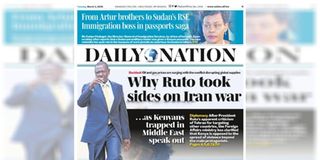
The cover page of the Daily Nation on Tuesday, March 3, 2026.

A simple answer to “why” should ordinarily begin with “because”. And if you promise to reveal the “why”, you should provide a reason in a straightforward, easy-to-understand way.
President William Ruto’s condemnation of Iran for attacking countries with United States military bases provoked numerous comments, both on social media and from commentators in print and broadcast.
Columnist Macharia Gaitho said the president was blaming the victim instead of focusing on the source of a conflict with grave repercussions for Kenya and the rest of the world.
He argued that, while the president was right in calling for de-escalation of the conflict, he should have demanded that US President Donald Trump and Israeli Prime Minister Benjamin Netanyahu cease their dangerous “military adventurism by halting without any delay unjustifiable attacks on Iranian sovereignty”.
Comments online mainly expressed shock that Kenya, which enjoys cordial relations with both Iran on one side and the US and Israel on the other, could call out only one side. The question most of them were asking was why? Why did the president release a one-sided statement? Why did he do this from the State House, even as the Ministry of Foreign Affairs was clearly sitting on the diplomatic fence? The other question they were asking was: What would be the likely repercussions of Kenya’s statement?
This is why a full-length photo of the president on the front page of the Daily Nation on March 3, accompanied by the headline “Why Ruto took sides on Iran war”, promised readers an exciting and revealing read. It is the ideal Day Two headline—going beyond the president’s statement (which had been widely circulated and covered on digital platforms and television the previous day) to take the story forward by way of an explanation. The headline was heeding readers’ constant calls to print media to move beyond reportage to interpretation, explanation and providing context.
Regrettably, the story itself is not much of a revelation.
First is the kicker: Diplomacy: After President Ruto’s apparent criticism of Tehran for targeting other countries, the Foreign Affairs ministry has clarified that Kenya is opposed to the spread of violence beyond the main protagonists. Does this reveal “Why Ruto took sides on the war?” No.
In fact, in the story on pages 4 and 5, the country is reported to be “insisting it is not taking sides but opposing the spread of violence beyond the main targets”. The story quotes Foreign Affairs Principal Secretary Korir Sing’oei as saying Nairobi was not backing any side in the war, but was only opposed to escalating violence. The headline on page 4 is more factual. It reads: “Kenya clarifies stance on US-Israel vs Iran conflict following Ruto statement”.
A history and international relations expert, Prof Macharia Munene, comments on the unfolding diplomatic situation, saying the president is “playing it safe”. He says: “This is a survival tactic. He wants to be in the good books of the US and Israel. He is playing (it) safe to endear himself to the US so that Trump can count Kenya as one of the countries that stood with it (the US) during this moment.”
Is Prof Munene’s quote the explainer that the main headline promises? Doubtful.
Could this have been a case of the right hand not knowing what the left was doing? Did the page one headline writer fail to read the story? Was there a gap between the editorial imagination (to take the story forward) and the content that was delivered?
Media experts warn editors to be wary of the use of “Why” as a Day Two “bait”, seeking to draw in a reader with a promise of fresh information. Instead, they advise, editors should build on stories by digging up information on new developments. There has to be a conscious effort to take stories forward, beyond conceiving a headline.
A headline that promises to reveal something, but fails to do so, is deceptive. A reader who bought the newspaper with a wish to understand why the president had reportedly taken sides feels cheated. Such a reader will not hesitate to vote with their feet—by walking away.
***
Was this a case of creativity gone rogue, or sloppiness intensified? One reader asked about the headline on the Alliance High School centenary celebrations story.
The headline—and howler of ‘Chief Principle’ ruined an uplifting story about a school with a reputation for excellence.
On this bastardisation of language, the Public Editor cannot agree more with this reader, as well as Mr Wambua Sammy, whose letter is reproduced here.
Dear Public Editor,
Let me state from the onset that, as a retired editor who still puts food on the table by working on acres of text, I will be the last person to throw a wet blanket over a clever headline.
Over the decades, Daily Nation readers have associated the Nation Media Group with professionalism, which, unfortunately, is certainly waning. A telling example of the creeping, and worrying, editorial laissez faire is a headline on www.nation.africa.
A story about Alliance High School centenary is headlined ‘I wentu Alliance’: Inside 100-year legacy of the fabled High School.
Whereas I am informed “I wentu” is Alliance alumni-speak for “I went to”, its tonal incongruency in a story about this academic bellwether couldn’t be missed by the discerning reader.
That the “wentu” is not explained in the story is, in itself, a glaring gap in contexualisation as is the failure to go past straight reporting. The reader would have liked to know the school's pioneering students.
Best regards, Wambua Sammy
Follow our WhatsApp channel for breaking news updates and more stories like this.
Contact the Public Editor to raise ethical concerns or request a review of published material. Reach out: Email: [email protected]. Mobile number: 0741978786.