Between 13 and 19 October, the monitoring service Delta Watchfloor counted 1,072 demonstrations, strikes, riots and other mass gatherings worldwide. From Paris, I watched 550,000 people march on October 17, according to the Interior ministry, many of them school pupils. In Serbia, a protest movement has now turned its organising into a parliamentary majority.
On October 25, the students who have marched since a railway canopy in Novi Sad collapsed and killed 16 people in November 2024 defeated Aleksandar Vučić’s party with about 53 per cent of the vote and roughly 140 of 250 seats, according to preliminary results. They did it without a single legacy politician at their head. Kenya’s Gen Z has been protesting since June 2024, faces a general election on August 10 , 2027, and has yet to build the machinery that made Belgrade possible.
The students began by taking their names off the ballot. Their list of 250 candidates included doctors, engineers, farmers, artists and professors chosen by the faculty assemblies they call plenums, and its rules barred anyone who had held executive or legislative power, including veterans of the opposition. When 85 plenums considered the rector of the University of Belgrade in September, 43 voted to exclude him, although he had backed the protests from the first week and was widely expected to lead the list. That process left every candidate’s place in the hands of 85 assemblies, where no party boss could buy it.
Anti-Finance Bill protest
The legacy opposition, which had spent a decade losing to Vučić, was presented with a choice it did not enjoy. The students refused places on the parties’ lists and asked the parties instead to stand aside and direct their voters to the Student List. After months of pressure, most of them did. Those that ran anyway fell below the 3 per cent threshold. The students courted the old opposition’s voters while denying its leaders any claim to head the movement, and a turnout of roughly 69 per cent, about 10 percentage points higher than in 2023, suggests the voters preferred it that way.
Students across the Balkans have run their politics through plenums for about two decades, the Belgrade political scientist Nebojša Vladisavljević told France 24, and Serbia’s students carried the method off campus by urging citizens to form local assemblies of their own, the zborovi, which spread across the country. By polling day, the movement had trained at least 16,000 people as official vote controllers. That afternoon, armoured police vehicles stood outside the presidency and withdrew after Vučić conceded. The following evening, a news anchor at Vojvodina’s public broadcaster opened the bulletin by apologising to viewers for years of silence and one-sided reporting, an apology some staff had fought for since January 2025.
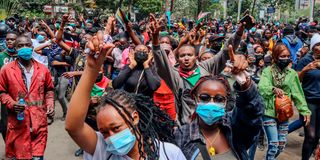
On June 25, 2024, young Kenyans breached Parliament, and the police answered with live fire. By June this year, IPOA reported that only three cases arising from the 62 deaths it recorded during the 2024 protests had reached court. The commanders, officers and officials responsible should remember that political protection can disappear with the government that provides it. The demand for accountability will always outlast those who expect power to shield them.
The Finance Bill was withdrawn, but more than two years later, a coordinated electoral structure capable of turning that sacrifice into seats has yet to emerge on the scale required. Legacy politicians treat Gen Z as a bloc to be harvested. In March, the electoral commission reported that Kenyans aged 35 and under made up only 32.65 per cent of new registrations, with those aged 18 to 20 registering least.
Disputed elections in Kenya
In Serbia, voters pick one list for the whole country, so a single list can win most of the seats in parliament. In Kenya, each of the 290 constituencies elects its own MP, and whoever gets the most votes wins. The Serbian method therefore has to be reimagined at the constituency level. A people’s assembly in each constituency could nominate, interrogate and vote on a single candidate chosen on merit and a clean record, with no adverse finding relating to public funds they have handled and a verifiable record of competence in their own field.
To earn the authority to speak for the constituency, each assembly would need published selection rules, transparent voting and full disclosure of campaign funding. It could then publish its reasons and demand that every other challenger to the incumbent stand down or explain why they should not. The same assemblies would recruit and train agents for every polling station, since disputed elections in Kenya have repeatedly turned on what happens to the result forms after the polls close.
The question for Kenya’s Gen Z is whether it intends to choose its candidates or wait to be chosen by them. Serbia’s students spent almost two years building assemblies before their list reached a ballot paper, and Kenya has a little over nine months. Every legacy politician promising to carry this generation’s anger into State House is relying on one condition: that the generation never organises well enough to decide who carries its anger into power. So far, that condition holds.