One police kiosk came within inches of collapse when instant fines were introduced for traffic offences. Two other lucrative kiosks, however, remain firmly open: alcohol and marijuana.
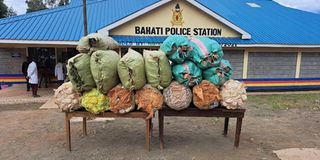
Liquor-related arrests alone account for nearly 30,000 cases a year—more than a third of police productivity. The other theatre of performance is the endless seizure of “stones” of bhang. Data demolishes many of the myths and half-truths that are common fare on marijuana in Kenya, but the evidence barely scratches the surface of the phenomenon.
The National Authority for the Campaign Against Alcohol and Drug Abuse (Nacada) estimates that slightly over half a million Kenyans aged 15–65 recurrently use marijuana.
An earlier survey by Nacada estimated that 193,430 young people aged 15–24 were using cannabis, giving the drug a 2.7 per cent prevalence among the youth population.
Those aged 25–35 registered a prevalence of 2.1 per cent, representing about 174,142 users. That survey also showed that cannabis use in Kenya increased by nearly 90 per cent between 2017 and 2022.
Marijuana use is no longer a fringe habit practised by a few shadowy characters in dark alleys. It is a habit knitted into everyday life. Kenya simply refuses to admit how familiar the smell has become. Marijuana is not rare; it is everywhere. It is used by workers, youth in rough and polite neighbourhoods alike—smoked or nibbled as cookies.
In Kenyan universities, hostels, estates, farms, construction sites and markets, the whiff of marijuana cuts across class lines. Despite relentless warnings, police crackdowns and religious moralising, young people are increasingly turning to marijuana to enable them to deal with the rough texture of life. The people most frequently arrested for marijuana offences are always the poorest segments of society.
Marijuana is deeply embedded in the country’s social and economic life. The country’s relationship with marijuana has defied the confines of law. Nairobi records the highest prevalence at 6.3 per cent, followed by Nyanza at 2.4 per cent and the Coast at 1.9 per cent. The geography of marijuana use tells a fascinating story. The epicentre of marijuana consumption is in the country’s most urbanised and economically dynamic regions.
Kenya is full of people who condemn marijuana loudly in public and encounter it quietly in private spaces. Marijuana may not be the most widely used substance in Kenya—coming in fourth after alcohol, tobacco and khat—but its rising prevalence should force society to confront difficult questions around unemployment, exhausting manual labour, urban stress, and the quiet culture of denial that surrounds substance use in Kenya.
At dawn in many rural areas, farmhands gather before heading to the shamba. Someone rolls a joint. A few puffs go round. Then the group disperses to spend the next eight hours bent over hoes in unforgiving sun. It is not a party drug—it is a work stimulant.
The same ritual unfolds in markets across the country. Long before the first customers arrive, porters who will spend the day hauling sacks of cabbages, onions and potatoes across muddy paths take a few quiet drags behind a stall before they begin lifting loads. At construction sites, this story repeats itself. Young men, who will spend hours carrying stones, mixing cement and climbing scaffolding, inhale a little smoke before the day begins. It dulls pain and lifts moods.
It turns backbreaking drudgery into an endurance test for the body. University students smoke it during the examination season to stay awake or calm nerves. Artists and musicians treat it as creative fuel. Manual labourers employ it to endure physical strain. Some professionals unwind with it privately after work.
For millions of working Kenyans, it is simply part of the informal toolkit for surviving brutal labour. Marijuana is not harmless. Like alcohol, it can be abused. Like khat, it can affect judgment and health. Like any drug, it can derail lives if consumed irresponsibly.
Young people use marijuana. Kenya has millions of unemployed or underemployed young people. Many drift between casual jobs, side hustles and long stretches of boredom. Others grind through exhausting manual labour for wages that barely buy a meal.
In those conditions, substances that provide temporary relief inevitably form habits.
Criminalising the users without confronting the circumstances that make the escape attractive is denial. Police arrested 2,386 people for possession of marijuana early last year, while 272 were booked for trafficking. The police do not wage war on marijuana. They wage war on the powerless people associated—and sometimes not associated—with it. It is the choice drug for the police to plant on uncooperative suspects.
Comparatively, alcohol fuels domestic violence, road carnage and public disorder, but it is legal and widely celebrated. Yet marijuana, which rarely triggers bar fights or drunken driving, is treated as a national security threat.
Police arrests for illicit alcohol and marijuana are about the performance of power and little to do with security. Shutting down these two policing kiosks would free the security services to pursue their actual mandate: protecting citizens rather than harassing them.
The writer is a board member of the Kenya Human Rights Commission and writes in his individual capacity; @kwamchetsi; [email protected]