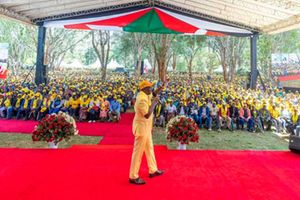
With Orange Democratic Movement staking claim to the deputy presidency and demanding a structured 2027 power-sharing framework, the negotiations with UDA are shaping into a tough political balancing act.
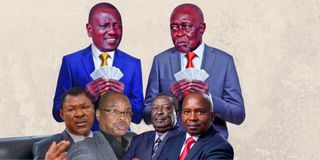
The planned ‘delicate’ talks between the ruling party and ODM now threaten to upend the political future of some of President Ruto’s closest 2022 allies, with Deputy President Kithure Kindiki , Prime Cabinet Secretary Musalia Mudavadi , and Speakers Moses Wetang’ula (National Assembly) and Amason Kingi (Senate) emerging as potential casualties in a looming 2027 power-sharing deal.
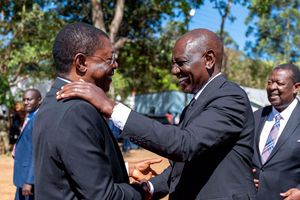
President William Ruto (left) confers with ODM party leader Oburu Oginga during the Piny Luo Festival in Senye Beach in Nyatike, Migori County on December 17, 2025.
Photo credit: Alex Odhiambo | Nation Media Group
However, some political strategists have cautioned that ceding key positions to accommodate ODM could prove a risky gamble for President Ruto, warning that such concessions may unsettle his core support base.
Instead, they argue, Dr Ruto should leverage ongoing multi-billion-shilling infrastructure projects in ODM strongholds to win over voters and ease pressure for high-level power-sharing concessions.
Nation has established that with the presidency firmly retained under UDA in any prospective coalition arrangement, the real battle is shifting to the layers beneath — the deputy presidency, parliamentary leadership, and control of powerful Cabinet dockets such as Interior, Treasury and Health.
Dr Oburu Oginga delivers his speech during ODM's Special Delegates Convention at Nairobi’s Jamhuri Grounds.
Photo credit: Bonface Bogita | Nation Media Group
“Some people misinterpreted my statement… that the deputy president post is our main target. That’s what we are aiming at,” Dr Oginga said during a recent party meeting in Mombasa, setting the stage for a direct confrontation with DP Kindiki.
The demand immediately places Prof Kindiki — a close ally of President Ruto and a key figure in consolidating Mt Kenya support after the fallout with Rigathi Gachagua — at the centre of a potential political storm.
Prof Kindiki has in recent days appeared to soften his tone, acknowledging that all positions of leadership, including that of deputy president, are “temporary,” amid ODM Party’s charge for his seat.
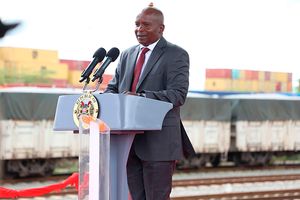
Deputy President Kithure Kindiki speaks during the Broad-Based Parliamentary Group meeting at Kenyatta International Convention Centre in Nairobi on March 10, 2026.
Photo credit: Wilfred Nyangaresi | Nation Media Group
The Deputy President struck a more conciliatory tone while addressing residents in Tigania West, Meru County, calling for unity and restraint.
“All leadership positions are temporary. I’m a leader, and there’s today and tomorrow,” he said.
In an apparent reference to Mr Gachagua, Prof Kindiki added: “I have forgiven my brother… I will not answer him because, as an elder of Njuri Ncheke, you cannot insult your brother.”
While Prof Kindiki has maintained a measured tone amid ODM Party’s push for his post, insisting that “the broad-based government is enough for all of us,” his allies have, however, taken a far more combative stance, warning ODM to keep off the DP seat.
National Assembly Minority Leader Junet Mohamed, who is also the ODM Director of Elections, has, however, struck a defiant tone, warning that the party would not compromise its political strength in any negotiations, hinting at their push for zoning.
“Anyone in this country who wants to negotiate with ODM, we will not negotiate on our parliamentary strength,” he said during the party’s NDC last Friday. “Anywhere we have an MCA, MP, Senator, Governor, Woman Rep, it will remain with ODM.”
His remarks underscored a growing assertiveness within the party as it positions itself ahead of future political contests.
“We have listened to some people speak a lot, but if you joke with us, we shall also present a presidential candidate—let’s meet on the battlefield,” he added. “Don’t threaten ODM. ODM zones are well known. So, our would-be partners, let’s respect each other. ODM is a major party.”
“Don’t joke with ODM because if they are angered, they can cause problems,” Mr Mohamed said, drawing cheers from the delegates.
This emerging standoff underscores a fundamental contradiction within the proposed alliance —ODM seeks parity and influence, while UDA must protect its core political base.
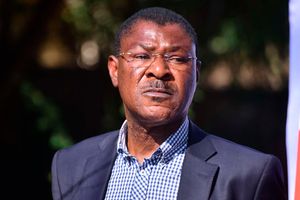
National Assembly Speaker Moses Wetang’ula.
Photo credit: File | Nation Media Group
Unlike Mr Mudavadi, whose position as Prime Cabinet Secretary is not constitutionally entrenched, insiders say that Mr Wetang’ula occupies a powerful office that could be used as a bargaining chip in coalition negotiations.
His troubles are compounded by his continued leadership of Ford Kenya, a party within the Kenya Kwanza Alliance.
Critics, including the late ODM leader Raila Odinga in the past, have accused him of bias — famously likening him to “a referee wearing the jersey of one team.”
“That perception, coupled with his refusal to dissolve or fold Ford Kenya into UDA, has reportedly placed him at odds with ongoing efforts by President Ruto to consolidate political parties under a single umbrella,” a highly placed source within the government confided in the Nation.
In a coalition where loyalty and uniformity are increasingly prized, Mr Wetang’ula’s dual role could prove costly.
For Mr Mudavadi, the challenge is more subtle but equally significant.
Once a party leader with independent bargaining power through ANC, the PCS now finds himself negotiating from within UDA after folding his party into the ruling outfit.
The move secured him a prestigious role as Prime Cabinet Secretary, but at a price — the loss of an independent political vehicle.
Analysts argue that this has weakened his leverage in high-level negotiations, effectively excluding him from the coalition bargaining table as an equal partner.
His allies have already felt the shift. Former ANC officials who were absorbed into UDA took up junior positions, a sign of diminished influence within the new political hierarchy.
Mr Mudavadi’s fate, therefore, insiders say, may not hinge on outright removal, but on gradual marginalisation as new power equations emerge.
As leader of the Pamoja African Alliance (PAA), Mr Kingi has already signalled his willingness to align fully with UDA, confirming that his party will not field candidates in 2027.
This strategic retreat effectively strengthens his standing within the ruling coalition, positioning him as a loyal insider rather than a negotiator with independent demands.
Yet, even this loyalty does not guarantee security.
In a high-stakes power-sharing arrangement with ODM, the Senate speakership — like its National Assembly counterpart — could still be subjected to renegotiation.
Mr Kingi’s advantage lies in his early alignment with UDA’s consolidation strategy, but the unpredictability of coalition politics means no seat is entirely safe.
Beyond individual offices, the looming negotiations are also expected to trigger intense competition for key Cabinet portfolios.
Dockets such as Interior, Treasury, Health, Defence and Foreign Affairs — which control security, public finances, health service delivery, defense and foreign relations — are seen as critical levers of political influence.
Currently, Interior, Health, Defence and Foreign Affairs are held by president Ruto’s allies — Kipchumba Murkomen, Aden Duale, Soipan Tuyaa and Mr Mudavadi, respectively, while Treasury is firmly under former ODM National Chairman John Mbadi.
ODM, through its chairperson Gladys Wanga, has already outlined its conditions — a formal coalition agreement, clear zoning of political territories, and the establishment of a high-level “Summit” to make key decisions, including Cabinet appointments.
This signals a shift from informal political arrangements to structured power-sharing, raising the stakes for all players involved.
“ODM expects to be treated as an equal partner, not a junior affiliate,” Ms Wanga told Nation, emphasising the party’s demand for a written agreement deposited with the Registrar of Political Parties.
For President Ruto, the unfolding scenario presents both an opportunity and a risk.
On one hand, bringing ODM into the fold could significantly strengthen his re-election prospects by expanding his political base into traditional opposition strongholds.
On the other hand, accommodating ODM’s demands without alienating his 2022 allies could prove politically perilous.
Political analyst Dismas Mokua warns that sacrificing any member of the original Kenya Kwanza team would send the wrong signal.
“The probability of President Ruto sacrificing a member of the 2022 winning team is almost zero,” he argues. “Such a move would suggest that he is prepared to serve only one term.”
According to Mr Mokua, disrupting the existing formation could damage President Ruto’s credibility and hand the opposition a powerful narrative — that he cannot be trusted to honour political agreements.
At the same time, the President appears to be deploying development as a parallel strategy to manage political expectations.
Massive infrastructure projects in ODM strongholds — including road networks and the extension of the Standard Gauge Railway — are seen as efforts to win grassroots support in regions that have historically backed the opposition.
This approach, analysts say, could reduce the need to concede too many high-level positions to ODM leaders, shifting the focus from elite bargaining to voter appeal.
From the Coast to Western Kenya, political heavyweights are engaged in supremacy battles that threaten to undermine cohesion.
The rivalry between UDA Secretary General Hassan Omar and Mining Cabinet Secretary Hassan Joho — a former ODM stalwart — exemplifies these tensions.
Their differences, rooted in past electoral contests and competing regional interests, have been reignited by speculation over the 2027 deputy presidency.
Such conflicts highlight the fragile nature of the broad-based arrangement, where former adversaries are now uneasy allies.
“As the 2027 election approaches, the question is no longer whether there will be casualties in the ODM-UDA negotiations, but who will bear the brunt,” argues advocate Chris Omore.
Prof Kindiki faces pressure from ODM’s DP ambitions, while Mr Wetang’ula risks losing his seat due to perceived party defiance.
On the other hand, Mr Mudavadi is grappling with diminished bargaining power following the dissolution of ANC, while Mr Kingi — despite appearing secure after agreeing not to field PAA candidates in 2027 — remains vulnerable to the shifting tides of coalition politics.
Ultimately, the outcome of the ODM-UDA talks will depend on President Ruto’s ability to strike a delicate balance between inclusion and loyalty.
Too many concessions, analysts warn, could fracture his base, while too few could alienate a crucial ally.
For the four men at the centre of this unfolding drama, the coming months will be decisive.
“In the ruthless calculus of Kenyan politics, survival is not guaranteed — and even the most powerful offices can become expendable in the pursuit of a broader electoral victory,” Mr Omore adds.
ODM, political analyst Mr Dismas Mokua says, “is a critical success factor for the new Ruto 2027 permutations and combinations.”
“This is why he has to remain sensitive and identify individual and community interests given the turbulence created by Rigathi Gachagua, the impeached deputy president.”
Mr Mokua adds: “?President Ruto’s deliberate move to invest in infrastructure growth and development in hitherto marginalized areas that include ODM strongholds is a testament to the import of ODM. The SGR and roads development to Western Kenya are useful in managing Luo, Abagusii and Luhya expectations. The man in the street in Western Kenya is happy with infrastructure growth and development.”