We like to say Kenya is a country of hustlers. And it’s almost true.
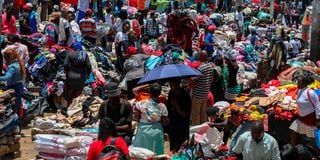
Step into Nairobi’s Gikomba, Toi Market, the area generally referred as River Road, or the clanging chaos of any Jua Kali shed, and you’ll feel it: resilience and resourcefulness.
Millions of Kenyans are making a way where none was designed for them. More than 16 million people (over 80 per cent of Kenya’s workforce) earn their living in the informal economy. That’s not a fringe. That’s the majority. It’s the backbone of our country and economy.
Yet somehow, we treat this majority like a shadow — unregistered, untaxed, unseen. And the question always comes back: Why haven’t we formalized the informal economy? Why don’t we embrace these traders, these artisans, and matatu crews as the core of our economy, and not its outcasts?
The hard truth is this: informality in Kenya isn’t an accident. It is a system. One built over decades, by history, by bad policy, and by governments that too often confuse regulation with extraction.
This system didn’t start yesterday. It’s the residue of a colonial economy that deliberately locked Africans out of industry. Post-independence, power and capital also flowed to formal elites, while everyone else was told to wait. Decades later, globalization piled on, pushing competition up and wages down, while millions of Kenyans were told to “innovate” their way out of poverty.
By 2023, the informal sector employed 83.5 per cent of the labour force, contributing nearly a third of Kenya’s Gross Domestic Product. Most are young, over 60 per cent of these are under 35, half of them women. They run micro-enterprises in trade, repair, services, and small manufacturing. But fewer than 20 per cent are registered businesses. Why? Because the system makes formalisation feel like a trap, not an upgrade.
And when they do try, the barriers multiply, almost exponentially. Registering a fully compliant business in Kenya can feel like applying for a visa. You’re expected to navigate unclear forms, visit government offices, pay multiple fees, and expose yourself to a severely unclear tax system that you already distrust.
The Kenya Revenue Authority’s attempts to tax informal businesses have consistently failed, not because people don’t want to pay taxes, but because the tradeoff doesn’t make sense. What protection do you get in return? What public service? What value?
And even if you do formalize, what’s the payoff? You’re still denied credit because you lack collateral or audited records. You’re locked out of tenders because you don’t have “compliance certificates.” You get taxed, but not protected.
So the logic is simple: why register, when the cost outweighs the benefit?
Buyers negotiate the price of travel bags at Gikomba market in Nairobi on August 13, 2023.
Photo credit: Lucy Wanjiru | Nation Media Group
This isn’t just about fear. It’s also about strategy. For many, staying informal is a rational response to a dysfunctional system. Neoliberal economists call these workers “heroic entrepreneurs.”
These workers are people who innovate despite the state, not because of it.
In Kenya, where 1 in 3 businesses expect to bribe officials just to operate, informality is more self-preservation, than it is a lack of industry. It’s freedom from endless paperwork, from audits, and from predatory enforcement. It’s a way to survive when formal employment only absorbs a fraction of the 800,000+ youth entering the job market each year. But this “freedom” comes at a huge price.
Informal workers don’t get social protection: no pension. no sick leave, no fallback. During the Covid-19 pandemic that broke out at the end of 2019 in Wuhan, China, before spreading to the rest of the world, relief bypassed them entirely. Most earn below the Sh24,000 tax threshold, so they don’t even qualify for tax cuts. Lockdowns gutted markets such as Gikomba and Wakulima, and vendors lost half their income, with no safety net.
Customers check out second-hand clothes in Gikomba market, Nairobi on March 12. The dollar shortage and its strengthening against the shilling have pushed up the cost prices of goods and services.
Photo credit: Dennis Onsongo | Nation Media Group
Without registration or credit history, they can’t scale. Can’t get loans. Can’t get into supermarkets or digital marketplaces. The World Bank points to poor marketing, bad distribution, and lack of access to finance as key reasons small firms often stagnate.
And let’s be honest: the winners of formalisation are often well-connected elites, not the young shoemaker or the mama mboga. Many formal businesses, especially in retail and manufacturing, are controlled by capital-rich families, often of elite descent. So even when informal workers attempt to play by the rules, the market isn’t level.
Kenya’s Vision 2030, the Hustler Fund, and even the Credit Guarantee Scheme all tried to fix this. But none address the root problem: formalisation is still designed around compliance, not inclusion. The Hustler Fund disburses micro-loans without fixing registration bottlenecks; the Credit Guarantee Scheme depends on commercial banks, who won’t touch small unregistered businesses; full registration and compliance is still centralised, expensive, and tied to tax systems that informal businesses and Kenyans in general actively distrust.
Unless we redesign the entire approach — simpler onboarding, mobile-based systems, decentralised services — formalisation will remain a fantasy.
We need registration tied to benefits, not burdens. Automate where possible. Bundle registration with licensing. Use local cooperatives as intermediaries.
But more importantly: consult the informal sector the same way we do formal unions. Include them in policy design, not just enforcement.
Think of the Jua Kali welder — no personal protective equipment, no insurance, no pension. Sparks fly from his tools as he builds furniture for Nairobi’s middle class. He’s not informal because he’s fundamentally unwilling. He’s informal because the system makes it unbearable to be anything else.
And yet, if we made formalisation feel like opportunity instead of punishment—credit, markets, protection, predictability—he’d register tomorrow. Most others also would. The question isn’t whether the informal sector can be formalized. The question is whether we’re willing to redesign the system to make that possible. Kenya’s silent majority is waiting to be seen.
So will we keep treating them as shadows? Or will we finally recognise them as much as key builders of this nation as anyone else? Their hustle is not the problem. It’s the foundation. It’s high time, however, that the state caught up.