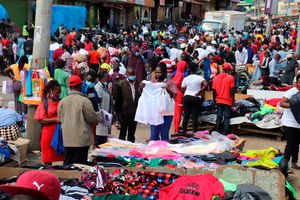
For decades, Gikomba Market in Nairobi City has woken before dawn.
By 5am, traders would already be offloading bales of second-hand clothes, arranging shoes in neat rows or pushing handcarts through narrow muddy alleys in a daily ritual that fed thousands of families.
By mid-morning, the market would be a sea of humanity with buyers haggling and hawkers calling out deals as and transporters weaved through impossible spaces.
Today, that rhythm has been broken.
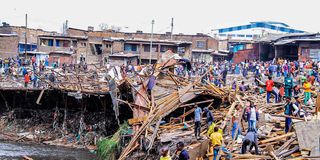
The demolition of sections of Gikomba Market on Tuesday has left thousands of traders stranded abruptly halting livelihoods that have defined generations. Many now sit amid the rubble, uncertain of what comes next.
“I have worked here for years. Everything I own comes from this place Now we have nothing. They told us to secure our goods, but they didn’t give us a proper place to take them,” said trader Patrick Mumo staring at what remained of his stall.
Located in Pumwani, Kamukunji sub-county, about four kilometres east of Nairobi’s Central Business District, Gikomba is not just a marketplace butit is an economic ecosystem.
Often described as one of Africa’s largest open-air markets, it draws over 200,000 people daily and supports an intricate web of traders, loaders, brokers, food vendors and transporters.
For a market that generates an estimated Sh80 million monthly in county revenue based on trader contributions alone the stakes are high. But even as promises of a modern market take shape, the present reality remains harsh.
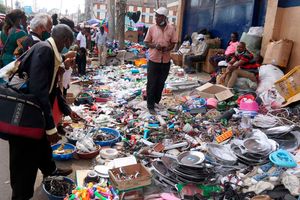
Traders selling second-hand clothes at Gikomba Market in Nairobi on February 18, 2024.
Photo credit: Lucy Wanjiru | Nation Media Group
Its origins date back to the 1950s when it began as a small informal trading centre near the Nairobi River.
Over time, it grew into the country’s heartbeat of mitumba (second-hand clothing), supplying retailers across Kenya and even neighbouring countries.
For years, Gikomba has been synonymous with congestion, poor drainage and frequent fires that would wipe out millions in destroyed goods overnight. Traders often rebuilt from ashes returning with a sense of resilience and this has become part of the market’s identity.
“It didn’t matter how many times fires came we always came back. This place is our life. ,” said another trader.
But behind the chaos lay deeper issues with persistent land dispute, claims of private ownership and alleged cartels controlling sections of the market created an environment of uncertainty. Fire outbreaks were often linked to these conflicts, fuelling suspicion among traders.
Traders rummage through the ruins as they try to salvage their belongings on March 31, 2026 after a section of Gikomba Market was demolished on Monday night by authorities.
Photo credit: Billy Ogada | Nation Media Group
The government has since declared the land public effectively ending ownership wrangles that have lingered for years. That decision paved the way for the latest move, the demolition and planned redevelopment.
More than 6,300 traders particularly those dealing in shoes were directly affected by the recent clearance on Tuesday. They have now been relocated to Kamukunji Grounds which is designated as a temporary holding site as construction begins.
Gikomba Market Association chairperson Kibathi Mbugua, speaking to the Nation , insists that the process has been consultative.
With the membership of the association standing at 100,000, this means that they roughly generate about Sh80 million every month to the county, hence playing a key role in the revenue generation.
“We came to an agreement with the multiagency team that we better push for another 20 meters so that the people on the other 30 meters and this 20 meters can be accommodated on the linear market, which will have three flours. We engaged the traders and agreed on a phased plan. Kamukunji Grounds is temporary. In about six months, they will return to a better Gikomba,” Mr Mbugua said.
For many traders, relocation means loss of customers, reduced sales and uncertainty. The informal networks that made Gikomba thrive of regular buyers, supply chains and foot traffic cannot simply be transferred overnight yet the government maintains that the demolition marks the beginning of long-overdue transformation.
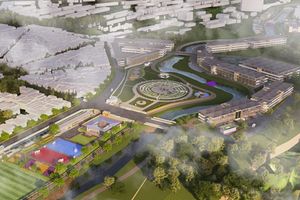
Artiste impression of Gikomba Market.
Photo credit: Pool
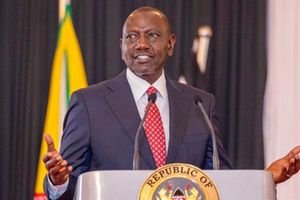
President William Ruto has promised to turn Gikomba into a modern trading hub, complete with permanent structures, proper drainage and organised spaces. Plans include a multi-storey market, beginning with a linear complex expected to accommodate about 5,000 traders in its first phase.
“There will be no more mud, no more sewage, no more fires. We are building a dignified environment for traders,” the President said.
The project estimated to cost billions of shillings will be implemented in phases to minimise disruption. Housing Principal Secretary Charles Hinga says the goal is not just infrastructure but dignity.
“This is about creating a safe, organised and modern space where traders can thrive,” he said.
For a market that generates an estimated Sh80 million monthly in county revenue based on trader contributions alone the stakes are high. But even as promises of a modern market take shape, the present reality remains harsh.
“If they build what they are promising, maybe it will be better. But for now, we are suffering,” said a trader.