We talk about the presidency as if it’s the sun and everything else just orbits around it. One individual. One State House. One centre of gravity. You’ll hear it everywhere: “Who is in power?” and the answer is always reduced to a name, not a system. Not Parliament. Not the Constitution. Just one man.
That obsession is not an accident. It’s how you manufacture a soft dictatorship inside a constitutional democracy.
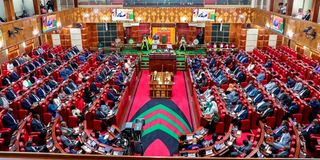
Our Constitution was written precisely to stop that. It was born out of the ashes of 2007/08, when elite games with power spilled into blood on the streets. The framers knew exactly what they were dealing with: a country that loves strongmen and a political class that will always test the limits of impunity. So they wrote a document that scattered power deliberately, made it messy on purpose, and placed Parliament at the centre of it all as the people’s shock absorber when the presidency goes rogue.
On paper, Parliament is not a choir. It’s not a cheering squad. It is the people’s fist on the table.
Article 1 is clear: all sovereign power belongs to the people. The arms of government are just rented offices for that power. Chapters 8, 9 and 10 lay it out: Executive, Legislature, Judiciary. Separate. Interdependent. Each supposed to keep the others honest.
Walked itself into captivity
Parliament, through the National Assembly and the Senate, was given the heaviest tools in the box. The National Assembly approves the budget, taxes you, controls how your money is spent, and can even impeach the president. The Senate guards devolution, allocates money to counties, and can send a governor home. Together, they control the purse. No money moves without them. They can summon, investigate, expose, and block anyone and anything.
The framers were not naïve. They anticipated that we might, in a moment of madness, elect an equally mad president. But they also assumed something else: that out of all 290 constituencies and 47 counties, at least half the people would send to Parliament men and women with enough spine to say “No” when State House overreaches.
Since 2010, when the constitution was promulgated, the institution that was supposed to tame the presidency has slowly turned into one of its departments. We now have a House where most members behave less like representatives of constituencies and more like interns desperate to impress the boss.
Coalition politics, “handshakes,” party capture, and raw transactional greed have done the rest. Presidents long ago figured out that they don’t have to fight Parliament. They just have to buy it. Strategically. A committee chair here. A trip there. A contract. A promise. Protection from prosecution.
Suddenly, the same MPs who were roaring on the campaign trail become mute in the chamber when it matters.
Look at how easily dangerous bills sail through. The same laws that triggered uprisings in 2024 were not imposed by presidential decree; they passed through Parliament, complete with live coverage and roll calls. Your MP pressed “Yes.” Then went on TV to blame “the government” as though they themselves were spectators.
Look at how national debt has ballooned. Every Eurobond, every loan, every grandiose project dripping with kickbacks — all of it needed parliamentary approval. There were committees. There were reports. There were hearings. There were chances to say no. They didn’t.
When Parliament is captured, the separation of powers becomes a theatre production. We pretend there are three arms of government, but in practice, one arm is overworked, one is stealing, and one is for sale. The tragic part is how deeply this lie has seeped into our political culture.
Ask your MP why they’re not doing anything about an issue, and you’ll often hear the same tired line: “You know, there’s nothing I can do.” That is a confession of dereliction of duty dressed up as helplessness.
Everything flows through Parliament. The laws that allow the police to beat you on the streets. The tax that wipes out your payslip before it hits your account. The budget that diverts money from your local clinic to some phantom dam that never gets built. The decision to look away when public officials loot without consequence.
And yet, Parliament is not intrinsically weak. It has simply chosen cowardice.
Bad leadership from above
We’ve seen flashes of what a real Parliament can do. Courts striking down the BBI process reminded the country that there are still institutions willing to read the Constitution as it was written, not as politicians wish it were. But the Judiciary is not designed to be your daily opposition to government overreach. That’s Parliament’s job.
So here’s the uncomfortable truth: our crisis is not just “bad leadership from above.” It’s also bad hiring decisions from below.
We voted along ethnic lines, sold our votes for handouts, applauded clowns and rewarded bullies. We treated the parliamentary seat as a prize for
“our person” rather than a contract for a watchdog. Then we acted surprised when they went to Nairobi and joined the feeding frenzy.
I believe 2027 is not just another election year. It is Parliament’s judgment day — and ours. The presidency will always attract ambitious men and women, most of them hungry for power. That’s human nature.
The real question is: will we finally send to Parliament people who are more loyal to the Constitution than to a phone call from State House?
That means interrogating candidates differently. Not, “What tribe are you?” but “How will you vote when State House wants to break the law?” Not,
“How much did you bring today?” but “Will you commit to voting independently of the executive?” Not, “Are you close to the president?” but “Are you prepared to oppose the president when he is wrong?”
We cannot protest our way out of a broken Parliament. Tear gas and hashtags are symptoms of a deeper failure: a House that abdicated its role long before the first stone was thrown.
But if we take Parliament seriously in 2027 — if we treat that ballot for MP and senator as the constitutional weapon it truly is — we can force a recalibration of power in this country without a single stone thrown.