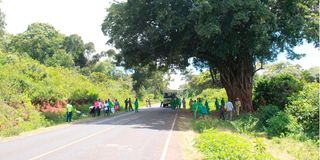
A section of Imenti forest at Nkunga. Residents, conservationists and politicians are protesting plans to excise up to 100 acres of forest land for construction of a State Lodge, airstrip and Golf Course.
Over the past few months, Kenyans have found ourselves defending one public natural space after another. From Mount Kenya to Ngong Forest, from Karura to Kakamega, from Ololua to Nairobi National Park, the pattern feels unsettlingly familiar. Proposals emerge. Boundaries shift. Excisions are suggested. Public concern rises, and with then the doubling down as though each legal challenge is merely an obstacle to be outlasted rather than a democratic voice to be heard. And through it all, we are left asking a question that grows louder with each passing season: why does it feel as though our forests, our parks, our wetlands, and every other shared natural space we hold sacred are under permanent siege?
At first glance, this appears to be a debate about land. But beneath the headlines lies something deeper and far more consequential: a growing crisis of trust. The public outrage that greets attempts to alter protected spaces is at once an environmental reaction as it is the response of a citizenry that increasingly fears decisions are being made about public assets without the meaningful involvement of the public itself. The concern is not only what is being done. It is how it is being done.
This matters because our Constitution recognised a profound truth that democracy does not end at the ballot box. Public participation is not a courtesy extended by the government; it is a constitutional obligation and a cornerstone of legitimate decision-making. It is the mechanism through which as citizens we become partners in shaping their future rather than spectators to decisions made on their behalf.
Yet too often, public participation has been reduced to public information. A notice is published. A meeting is held. A report is filed. The box is checked. But consultation and participation are not the same thing. Participation requires listening. It requires dialogue. It requires a willingness to be influenced by what is heard and reiteration of the proposals made. When that process is absent, or perceived to be absent, a trust deficit emerges. And trust, once eroded, is difficult to rebuild.
Healthy ecosystems
Perhaps this explains why every proposal affecting a forest, wetland, or public park now arrives under a cloud of suspicion. Citizens no longer evaluate only the merits of the proposal itself. They ask whether the process was fair. Whether alternatives were explored. Whether their voices genuinely mattered. Whether decisions were made in the public interest or presented to the public after they had already been made.
The irony is that at a time when climate change is intensifying droughts, floods, heatwaves, and biodiversity loss, we should be strengthening the institutions that allow us to act collectively. Nature-based solutions are among our most effective and affordable defenses. Forests regulate water, stabilize soils, cool cities, protect biodiversity, and support livelihoods. The science is increasingly clear.
The warnings are becoming louder. We know that healthy ecosystems are not a luxury but often the very infrastructure we need for survival. And yet, protecting ecosystems ultimately depends on something even more fundamental than environmental policy. It requires public trust. No country has perfected public participation. The process is often messy, slow, and contentious.
But around the world, some of the most durable conservation successes have emerged where communities were engaged early, listened to seriously, and treated as partners rather than obstacles. In countries such as Finland and Norway, public consultation on land-use decisions has become a critical ingredient in building legitimacy and reducing conflict. People are more willing to support difficult choices when they trust the process that produced them.
Forest and green spaces
Trust is not built when people always get the outcome they want. Trust is built when they believe they were heard, respected, and included. That may be the lesson hidden beneath Kenya’s forest and green spaces debates. The real battle is not only for forests, but also for faith in our institutions. The more citizens lose trust in decisions made on their behalf, the more every proposal becomes a confrontation.
The more trust is strengthened, the more we can tackle the difficult choices that climate resilience and sustainable development demand. Our forests deserve protection. But so too does the social contract that binds citizens to those entrusted to govern. Because when trust flourishes, participation flourishes. When participation flourishes, stewardship flourishes. And when stewardship flourishes, both democracy and nature stand a chance of thriving together.
Kenya stands at a crossroads that is about trees and soil, yes, but also about who we are as a people. Every forest cleared without genuine consent, every wetland excised behind closed doors, every public space quietly reclassified is both an environmental loss and a withdrawal from the account of public trust, and that account does not have unlimited reserves. But we are not without hope. The same passion that pours into our streets and courtrooms to defend Karura, Ngong, and Nairobi National Park is evidence of a citizenry that cares deeply, that is watching, and that refuses to be reduced to an audience. That energy is not an obstacle to governance; it is its greatest untapped resource. Imagine what becomes possible when that passion is met with genuine openness rather than institutional resistance.
Imagine conservation policies forged in partnership, climate solutions co-designed with communities, and public spaces protected not only by law but by the collective will of a people who feel ownership over them. The forests will endure if the trust endures. And the trust will endure only if we choose, deliberately and consistently, to govern as though every citizen’s voice is not a complication, but the very foundation upon which legitimate power is built.
Ms Mathai is the MD for Africa & Global Partnerships at the World Resources Institute and Chair of Wangari Maathai Foundation