Hello

Your subscription is almost coming to an end. Don’t miss out on the great content on Nation.Africa

Ready to continue your informative journey with us?

Hello

Your premium access has ended, but the best of Nation.Africa is still within reach. Renew now to unlock exclusive stories and in-depth features.

Reclaim your full access. Click below to renew.

William Ruto
Caption for the landscape image:

Africans must invest and grow Africa

Scroll down to read the article

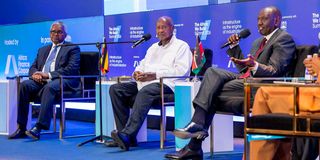
President William Ruto alongside his Ugandan counterpart Yoweri Museveni address the inaugural Africa We Build Summit in Nairobi. With them is the President of the Dangote Group, Aliko Dangote (left).

Photo credit: PCS

Have you noticed that lately Dr Aliko Dangote, Africa’s wealthiest man and one of the continent’s most audacious investors, has been sounding an alarm directed at us Africans? Almost every day I get one of the many videos doing the rounds. The last one got me. It was titled “Africa’s Wealthiest Have a Civic Duty, and Most of Them Aren't Living Up To It”. It is true that for years he was almost alone pouring billions into Africa when the prevailing wisdom among the global investor class was that the continent was too risky, too volatile, and too uncertain. But the message he is raising now cuts even deeper if you read between the lines, and it should stop every African leader, policymaker, and citizen in their tracks.

Africa sits on a fortune of over $1 trillion in pension money accumulated from the most sacred financial trust a society places in its institutions, the deferred wages of teachers, nurses, civil servants, and laborers who worked their entire lives on African soil. And yet, 99 per cent of the private equity money actually building the continent, our roads, hospitals, enterprises, and even infrastructure flows in from outside Africa. In fact, at the All Africa Pension Summit in Kampala last year, leaders did not mince words. They called it for what it is: a crisis of belief, not money.
It gets more interesting. Some African countries, by law, restrict how much pension money can leave. These countries are, perhaps even without saying so, protecting domestic money. But others allow investments of pension money abroad. But the issue in question here is not whether our pension money is leaving Kenya or not (and by the way, my research showed Kenya’s pension money does not leave. It is largely in Kenya). The question is what the money does at home. In many cases, our pension funds are financing government debt rather than building hospitals, roads, schools, factories, or funding entrepreneurs. The money is home, but it is not building!

Global financial architecture

Dangote’s red flags helped me realise that the real questions we should be asking are “why our domestic money is not helping finance our own green climate resilient growth?” and “how it is that a trillion dollars of African savings exits the continent and our own builders, entrepreneurs, and infrastructure developers rely on expensive foreign money that rushes in to fill a gap that African money could and should be closing itself.” Until the belief in mobilising domestic finances to power our development takes root in boardrooms, finance ministries, and pension fund committees across the continent we will struggle to shake off the dependency syndrome.

As we marked our 63rd year of self-governance in Kenya, we rightly demand reform in the global financial architecture. We challenge the IMF, the World Bank, and the asymmetries baked into a system not designed with Africa’s prosperity in mind. But Dangote holds up a mirror, and the reflection demands honesty (and engraving in every African finance ministry) “If you do not yourself invest your money here, why should others do so?”

Investing in the continent

Dangote has inspired many because he himself is a steadfast believer that Africans should invest in their own countries. He himself has walked this journey by investing in the continent. In the recent past, when he recognised that Nigeria, despite being a crude oil producer, imported refined products, he staked a majority of his wealth towards the construction of an oil refinery in Lagos. Many quiety mocked him. In April this year, because of the closure of the Strait of Hormuz due to the war in Iran, Dangote Refinery became the biggest single exporter of jet fuel in the world. It is no surprise therefore that Dangote is seeking to have a pan African Initial Public Offering listing of the oil refinery business. 

It is true that Dangote was blessed to be born into an entrepreneurial family, but it is also true that he has put an incredible amount of time and effort into investing in the continent and those investments are now bearing fruit. His story is a clarion call we can not afford to ignore: investing within our continent is one of the most powerful forces we possess to transform not just our own lives, but the very fabric of our communities.

The real opportunity, and obligation, is to channel African capital into the sectors that will actually power our continent’s future: clean energy, climate resilient infrastructure, agriculture, technology, and green climate-positive industries that create jobs, reduce imports, and generate wealth from the ground up. It will be impossible for our continent to arrive at prosperity without us ourselves investing. As we reflect on yesterday’s World Environment Day and 63 years of self-governance, may this truth finally take root: the future of Africa will absolutely involve partnerships with the rest of the world but the foundations must be laid by us Africans ourselves. The foreign investor will follow when the African investor leads. We must surely see our own continent as worthy of investments.

Ms Mathai is the MD for Africa & Global Partnerships at the World Resources Institute and Chair of Wangari Maathai Foundation