A committee to compile a list of people who qualify for appointment to boards of commercial State corporations? Unheard of in Kenya, where the practice has always been that those in power appoint their cronies and tribesmen to parastatal boards.
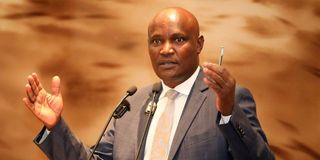
Yet this is exactly what Finance Cabinet Secretary John Mbadi did last week. In an announcement tucked into an obscure corner of the Kenya Gazette, Mbadi named what was dubbed a "search and selection panel" for board members of commercial State corporations.
Led by influential Treasury insider Mr Lawrence Kibet, the committee's main task is to identify individuals qualified for appointment to boards of commercial State corporations under the criteria set in the recently enacted Government Owned Enterprises Act (GOE Act, 2025).
In other words, if you currently sit on the board of a commercial State corporation and do not meet the new law's requirements, you will be forced out.
What are those requirements? There are several, but the provision most likely to unseat incumbents disqualifies anyone "who has been affiliated with a political party in the preceding five years" from sitting on a board. Crucially, the law defines affiliation broadly as "having an official connection to a governing body of a political party, or having identified with a party for the purpose of contesting elections."
For the first time, a sharper distinction has been drawn between ordinary State agencies and commercial State corporations. The new law applies only to entities such as power utilities, ports, airports, transport firms and financial institutions — enterprises expected to operate commercially while remaining publicly owned.
I foresee forced exits of election losers from several boards, particularly at Kenya Airports Authority, Kenya Ports Authority, Kenya Power, Consolidated Bank of Kenya, Industrial Development Bank, Kenya Seed Company and many others. The full list is published as an annex to the GOE Act 2025.
The early tremors are already visible. At KenGen, Chairman Alfred Agoi was pushed out at the company's annual general meeting on the grounds that he had contested and lost in the last election. Another board member, Rehema Hassan, who participated in the 2022 elections, was also removed at that meeting.
The logic is understandable. Someone who has recently sought office under a party banner may struggle to appear politically neutral in the boardroom. They may view a board seat as compensation for electoral defeat rather than a fiduciary responsibility, and carry campaign loyalties into commercial decision-making. Kenyans have seen this before: failed candidates appointed to plum boards, then using public corporations as extensions of factional politics. If the new law helps break that cycle, it deserves support.
A sensible eligibility rule can quickly become a selective purge tool. One faction's "political appointee" becomes another faction's untouchable insider. Disqualification may be applied aggressively to opponents while allies with similar histories are quietly shielded through technicalities, waivers or delayed enforcement. That would defeat the purpose entirely.
The objective must not be to replace one patronage network with another dressed in the language of reform. It must be to build genuinely independent, competent boards.
Three safeguards are essential. First, transparency: every vacancy, shortlist, qualification criterion and final appointment should be publicly disclosed. Sunlight is the best antidote to manipulation.
Second, consistency: if contesting an election disqualifies one person, the rule must apply equally to all, regardless of political proximity.
Third, merit: political neutrality alone is not competence. Kenya still needs directors with expertise in finance, law, engineering, logistics, risk management, technology and strategy. Emptying boards of politicians only to fill them with private-sector cronies would be no reform at all.
There is also a wider lesson here. Kenya's commercial State corporations sit on enormous value — land, infrastructure, monopoly positions, substantial balance sheets and significant revenue streams. Whoever controls the boards often influences contracts, capital expenditure and strategic assets. That is why board appointments are fought over so fiercely.
Boards are where fortunes are made or lost. A weak board enables inflated procurement, reckless borrowing, executive impunity and strategic drift. A strong board asks hard questions, protects assets, recruits capable management and insists on performance. In many State corporations, governance failure has cost taxpayers far more than outright theft.
We must remain vigilant. Good laws can be twisted by bad incentives. Governance reform can become a mask for political consolidation.
The true test will not be how many heads roll. It will be whether the new appointees are better than those removed — more competent, more independent and more accountable.