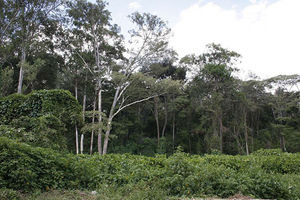
On May 14, the Senate passed the Amendment to the Forest Conservation and Management Bill, 2025. The Amendment makes several changes, including a new regulatory body to oversee the forestry sector, stronger penalties for offences, mandatory buffer zones around public forests, and financial frameworks to reward conservation. On the surface, you could be forgiven for thinking this is the reform Kenya’s forests have long needed.
But buried deep within the Bill is Section 15.
This single clause could unravel everything. Section 15 amends Section 56(2) of the principal Act, quietly adding two new “permitted uses” within public forests: easements for public roads and critical installations, and wayleaves for public utilities. This simply means roads, power lines, and pipelines could now be carved through Kenya’s most important water towers and forests, administered by the Kenya Forest Service alone, bypassing the constitutional and legal safeguards that have long been the last line of defense for these ecosystems. This is a constitutional crisis taking root before our very eyes.
Article 62(1)(g) was clear. It classified all government forests as public land and vested authority over that land exclusively in the National Land Commission (NLC). What this means is that granting easements and wayleaves is an interest in land, and that power and authority would belong to the NLC. And then, dear friends, it gets worse. Remember that sunny day back in August last year, when a court stood firm and rejected the government’s attempt to excise 51.64 hectares of Karura Forest for a road expansion, permitting only a fraction, 0.1233 hectares?
The courts and the law said no. Kenya’s forests survived that battle, but now the rules are being changed. The amendment seeks to permit the very practices ruled unlawful through legislation. Sadly, Kenya’s forests cannot vote or speak, but they breathe life into our country and beyond.
And here is where the irony deepens even more. Less than a week after the Senate passed the bill, Kenya stood in the United Nations General Assembly and voted “Yes”. We voted “Yes” to a landmark resolution endorsing the ICJ’s advisory opinion on states’ climate change obligations. “Yes” to a resolution calling on nations to meet their legal duties to climate justice. “Yes” alongside 140 other countries, to the principle that the rule of law must protect our planet. We, Kenya, raised our hand for the world’s forests. How can we champion climate justice on the world stage and sign away our own forests at home?
We cannot uphold international law in New York while dismantling environmental protections at home. The forests our delegates promised to protect are awaiting the President’s decision. The world is watching. So are the trees.
Thankfully, Kenyans are watching. Section 15 of the amendment passed despite objections, including from organisations dedicated to protecting our natural heritage such as the Green Belt Movement. At the heart of every objection is a basic truth: forest land is forest land.
Not one inch should be surrendered to roads, pipelines, or the insatiable appetite for building in forests. This green infrastructure we call forests are our life support system and we know what they give us from clean air, water, medicine and rain. They are biodiversity hotspots which recharge the underground water aquifers that keep millions of us alive, they stabilize soils, sustain livelihoods, and anchor entire communities to the land. In a country like ours already suffering from the weight of climate devastation, floods, and droughts, forests are a lifeline.
What makes this moment particularly painful is the pattern that brought us here. In recent years, we have watched with growing alarm as forest land has become an easy target. We have faced plans to carve a road through the Aberdare Forest, attempts to excise Karura for the expansion of Kiambu Road, and proposals to run a commuter railway through Ngong Forest. Each time, Kenyans went to court. Each time, they brought receipts, arguments, and the Constitution. And each time, they won. Our forests survived not because the government protected them, but because the people did. And so now, it seems, the strategy has changed. If you cannot win in court, change the law. This is a circumvention of the will of the people, dressed up in legislative language and rushed through Parliament before anyone could catch their breath. So, to every Kenyan reading this, please Write. Speak. Share.
Call your legislators. Name the contradiction publicly and loudly: that Kenya cannot stand in the UNGA and vote for climate justice and then come home and sign away our forests. That our leaders cannot champion the rule of law on the world stage while quietly undermining it at home. Hold that mirror up, and do not let them look away.
My mother, Professor Wangari Maathai, used to tell the story of the hummingbird, that tiny, tireless bird that carried one drop of water at a time to fight a raging forest fire, while the bigger animals stood and watched and said: what difference can one drop make? The hummingbird does not ask that question. It simply flies back and tries again. That is who we must be right now. Our forests are in trouble.
They cannot speak. But we can, and we must do all we can on their behalf. The President’s pen has not yet moved. Be the hummingbird.
Ms Mathai is MD for Africa & Global Partnerships at the World Resources Institute and Chair of the Wangari Maathai Foundation