This week marked a pivot as France launched a sweeping new partnership framework for Africa under the banner of Africa Forward. What started off as the France-Africa Summit, when first announced a few months ago, transformed into Africa Forward.
I remember thinking that the name change alone was a declaration. What began as the France-Africa Summit, with all the colonial weight that framing carries, was deliberately reborn as something different, something that places the continent not at the receiving end of a relationship but at its centre.
The old paradigm of donor and recipient is being formally challenged. In its place, a partnership of equals is being proposed, anchored in investment, innovation, and the unapologetic conviction that Africa’s moment is here. Whether the world is ready to believe that is, frankly, beside the point. The more urgent question is whether we are ready to demand it, to test it, and to hold every commitment made to account. The stakes are real as we know and the pledges are substantive.
Africa’s extraordinary moment
The choice of Nairobi as the stage for this relaunch, and not Paris is deliberate. I believe any gathering that turns up the volume on Africa’s extraordinary moment, and that dares to say “now” not “tomorrow” deserves to be celebrated. The deals struck, the African ingenuity displayed in art and culture, and the partnerships forged were inspiring.
Yet even as I soaked in the energy in Taifa Hall and beyond, a quiet question followed me through every corridor and conversation: is Kenya’s entrepreneurial policy and finance ecosystem ready to catch what is coming our way? That tension between the dazzle of the summit stage and the reality of “kwa ground” is worth sitting with honestly.
The conversations that filled Taifa Hall on May 11 ranged from realising cross-border payments through the Pan African Payment System (PAPSS) and fintech to digital trade, climate innovation, and the creative industries. They were driven by a generation that is confident, globally minded, and utterly determined to build African solutions for African problems.
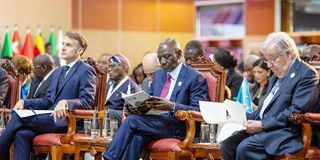
They gathered around the single, transformative idea that Africa’s future will not be built through aid but through talent, technology, entrepreneurship, and bold partnerships forged on equal footing. You walked in and were immediately confronted by the sheer genius of a generation that has not been waiting for summits to validate what it already knows it is capable of. President William Ruto stood before that room, demanding that systems of capital, infrastructure, and education be rebuilt to prepare people for the future instead of the past. Emmanuel Macron, in a moment that felt different from the past, acknowledged that the old relationship is finished and that what replaces it must be driven by African agency.
The PAPSS was also discussed in relation to a decades-old challenge. Currently, a Kenyan merchant paying a Zambian supplier must route the transaction through New York or London, settling in dollars or Euros. This results in significant losses to foreign correspondent banks, simply for trading with a neighbouring country. In some corridors, these costs can soar to 15-20 per cent. Africa was paying a tax to the world simply to talk to itself! PAPSS was built to end that. Now spanning 19 countries, over 150 commercial banks, and backed by the full endorsement of African Union Heads of State as the official payment platform for the African Continental Free Trade Agreement, it enables instant transactions directly in local currencies with no foreign intermediaries and no bleeding value offshore. At full scale, it is forecast to save the continent more than $5 billion annually in transaction costs, with Africa’s cross-border payments potential estimated at $1 trillion by 2035. That is African money, moving between African people, building African wealth, and on African terms, through African infrastructure, at last.
Kate Kallot, the founder and CEO of Amini AI, a Nairobi-based start-up making farming and environmental data accessible across Africa and emerging economies, was born in France and has her roots in Central African Republic. She built her career at the very core of AI, running NVIDIA’s emerging-markets business, before walking away from one of the most coveted jobs in tech to ask a question that in some ways followed her: what does it mean to build the future and leave your own people out of it? She moved to Nairobi and founded Amini AI. In 2023, the company raised $2 million in pre-seed funding, and at the summit announced a landmark strategic partnership with Foxconn and Bull to close the sovereign compute gap across Africa and the Global South.
When Kate Kallot spoke, she reminded young people that AI is an African frontier and we should not be passive consumers of it when we can lead. Our languages, communities, data, and centuries of lived experience and hard-won knowledge ought to be at the front lines of AI development. And that the next generation of builders who will shape how this technology thinks and who it serves must come from the continent that will host 1 in every 4 humans in 2050.
What is clear is that the ideas are here and the people are here. What remains in question is whether the systems that surround them, and that are expected to create an ecosystem of support for their businesses will lift them or crush them. This is because entrepreneurs do not succeed in a vacuum. They succeed because governments actively build the conditions for them to thrive, or they succeed in spite of governments that obstruct them, or they succeed because governments simply step aside and let them be. All three paths exist in Africa today, often in the same country, sometimes in the same city.
Ms Mathai is MD for Africa & Global Partnerships at the World Resources Institute and Chair of the Wangari Maathai Foundation.