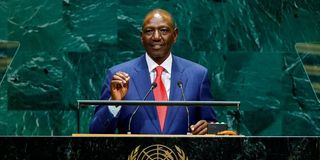
Every September, the world’s leaders descend like an invading alien force on Turtle Bay for the United Nations General Assembly. For us Kenyans, it has evolved into a unique ritual: President Ruto, in an immaculately tailored suit, surrounded by a forest of officials and security heavies, threading his way through Manhattan traffic brought to a standstill by motorcades bearing leaders, enroute to an aggressive confrontation with enough conference papers to reforest half the Amazon.
This year’s instalment, UNGA81, running from September 18 to 28, has a theme that reads more like a malaise diagnosis than a slogan: the world’s governments no longer trust one another, they don’t trust the institutions meant to referee them either, even as technology, climate change, war and shifting economic power move faster than any rulebook can keep up with.
That is a polite way of saying the globe is wobbling. Outgoing Secretary-General António Guterres set the tone in his opening address, naming three existential threats: rogue artificial intelligence, the climate crisis and deepening inequality, and calling for guardrails that keep AI transparent and human dignity intact, alongside de-escalation in Gaza and Ukraine. It was, in essence, a defence of the old multilateral faith: that shared rules still beat a situation where it is every state for itself and God for us all.
President Donald Trump kicked that argument in the face fairly fast - he spent more energy attacking the UN system, UNESCO and the Human Rights Council than laying out any coherent global strategy, a speech, as Council on Foreign Relations analysts noted, was notably thin on China and Europe. Read the two speeches side by side and you get the real theme of UNGA81: not climate, or AI, or peace, but the argument over whether the world still needs a referee at all.
The more important discussions, however, are happening not at the podium but on the sidelines. A panel on information integrity, featuring Wikimedia’s Bernadette Meehan and the UN’s Melissa Fleming, asked a question that sounds technical until you notice it touches everyone with a smartphone: whether AI systems can keep extracting value from open knowledge without paying anything back for it.
Africa’s case on this was framed by UNDP in this manner: who owns the AI infrastructure, who captures the value from Africa’s resources, data and talent, and who gets trusted by capital, and on what terms. That is a debate about the mechanics of AI, not a request for aid, and it is where Kenya has wisely chosen to plant its flag.
President Ruto landed in NYC with an unusually concrete pitch for a UN speech: the $17 billion, 700,000-barrel-a-day Dangote refinery planned for Lamu, promising more than 60,000 jobs; the National Infrastructure Fund with a plan to mobilise up to $40 billion without adding to public debt; and, alongside Finland’s Alexander Stubb, an AI Middle Powers Initiative meant to pool computing power, data and talent rather than simply rent someone else’s. Add the African Development Bank’s AI 10 Billion Initiative and a planned child-online-safety declaration, and Kenya is positioning itself more as a technology, trade and finance hub than as a supplicant on the lookout for the dole. This is good. This is very good.
But, can Kenya’s numbers carry this great pitch? Our public debt is Sh11.8 trillion, or 67.8 per cent of GDP, and the Treasury’s own strategy admits debt service will keep eating more than 18 per cent of revenue through 2028, money that cannot simultaneously be used to repay bondholders and build the refinery’s feeder roads. Nearly four in 10 Kenyans live below the poverty line, and roughly one million young people join the labour force every year looking for jobs that, too often, are not there. Transparency International still scores Kenya 30 out of 100 on corruption, a fact that will matter enormously to anyone deciding whether $40 billion in “unlocked” capital arrives as productive investment or disappears into the usual government procurement fog.
None of this is a reason for Kenya to stay home from New York. It shows that our ambitions are big, our frailties, bigger. It is a reason to be honest about what a good speech can, and cannot, do.
UNGA81 will not, by itself, refinance Kenya’s debt, create a single job, or recover a single stolen shilling. What it can do is open doors, to capital, to AI partnerships, to a seat at the table where the rules on data, trade and climate finance are being redrawn before Africa’s eyes rather than after. Those doors matter. But a door is only useful to the country that walks through it with its paperwork in order.
So is the meeting useful? Only if Nairobi treats this week’s applause as a deadline rather than a destination, if the refinery gets a contract before it gets a communiqué, if the infrastructure fund publishes its terms before it publishes its ambitions, and if the fight against corruption produces court dates, not just conference dates. The world is, certainly, listening to Kenya’s pitch. Walk the talk, boss.