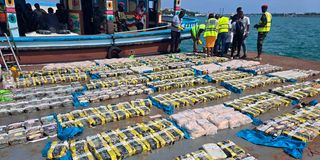
More than a tonne of methamphetamine valued at Sh8.2 billion was moved under heavy security through Mombasa, Thursday September 24, before being fed into a kiln and reduced to ash.
The operation turned the coastal city into a security zone as a heavily guarded convoy carrying the drugs travelled 21 kilometres from the Kenya Navy base in Mtongwe to Bamburi Cement Company, where the narcotics were destroyed.
Armed officers lined the route as other security teams escorted the consignment to the cement plant.
In one of the trucks were 53 gunny bags and a carton containing 1,039.15 kilogrammes of methamphetamine, a haul that had been locked away at the military base for nearly a year after being seized from a dhow deep in the Indian Ocean.
Multi-agency security team escorts Sh8.2bn meth haul for destruction
Before the drugs disappeared into the roaring flames, the court demanded one final accounting.
For hours, the accused persons, their lawyers, prosecutors, police officers, anti-narcotics personnel, Government Chemist experts and international law enforcement representatives gathered at the plant to confirm that what was to be destroyed was the same consignment seized from the accused men.
Government Chemist expert Dennis Owino Onyango tested random samples from 10 packages to establish their composition before the consignment was weighed.
The court then ordered the destruction after satisfying itself that the exhibits presented were the same narcotics seized from the accused men.
The bags were then fed into the kiln operating at 1,500 degrees Celsius, temperature that is high enough to ensure their destruction.
The disposal marked the culmination of nearly 11 months of legal and security procedures following the seizure of the drugs about 630 kilometres off the Kenyan coast.
Kenya Navy soldiers intercepted the dhow with a crew of six Iranians now facing drug trafficking charges at the Shanzu Magistrate’s Court.
Mr Jaseem Darzadeh Nia, Mr Nadeem Jadgal, Mr Hassan Baloch, Mr Raheem Baksh, Mr Imran Baloch and Mr Imtiyaz Daryay remain in custody.
Even as the drugs went up in flames, the court made clear that their destruction was not a finding of guilt.
Iranian nationals, from left: Imtiyaz Daryayi, Imran Baloch, Raheem Baksh, Hassan Baloch, Nadeem Jadgal and Jaseem Darzadeh Nia when they appeared before Shanzu court on January 12, 2026.
Photo credit: Brian Ocharo | Nation Media Group
The six men’s trial is ongoing. Earlier this month, the court ruled that they had a case to answer after prosecutors called 12 witnesses, including Kenya Navy personnel and several experts from the Government Chemist.
According to the prosecution, the six Iranians transported 1,036 kilogrammes of methamphetamine aboard MV Mashaallah, described as an unregistered and stateless vessel, before it was intercepted in international waters.
The said offence occurred between October 17 and 20, 2025, the court was informed. The vessel remains in Kenya Navy custody.
Bamburi Cement Company said its kilns are licensed and approved by the National Environment Management Authority for the safe destruction and co-processing of hazardous and non-hazardous waste.
Through its Geocycle Kenya operations, the company uses suitable waste as an alternative source of thermal energy in making cement.
It was not the first time the cement manufacturer’s kiln had been turned into an unlikely courtroom-endpoint for narcotics.
Last year, heroin and cocaine valued at more than Sh400 million was destroyed at the plant after the individuals behind the shipments were either sent to jail or died.
Yesterday’s operation carried a particularly significant legal dimension. The government was keen to demonstrate that the destruction of the drugs could be carried out without compromising the criminal case against the accused.
That concern stems partly from the fate of an earlier high profile narcotics case involving about 371 kilogrammes of heroin that was valued at more than Sh1.3 billion seized from MV Al Noor, also known as Amin Darya, in 2014.
On August 29, 2014, President Uhuru Kenyatta watched from a military helicopter as the Kenya Defence Forces personnel destroyed and sank the vessel off the coast of Mombasa after it had been intercepted by the navy.
According to government officials, the dramatic operation was intended to demonstrate Kenya’s determination in preventing its waters and the port of Mombasa from becoming transit routes for international drug traffickers.
However, the destruction of the vessel became a major issue in the criminal proceedings against its foreign crew.
Mombasa Law Courts.
Photo credit: File | Nation Media Group
The High Court in Mombasa had halted the destruction following an application by a lawyer, raising concerns over preservation of the ship as potential evidence.
The convictions were, however, overturned, with the High Court acquitting the remaining accused persons in 2025.
The judges cited legal shortcomings, including concerns over the destruction of the vessel before independent forensic examinations could be conducted and questions surrounding maritime jurisdiction.
The collapse of the case exposed the danger of dramatic anti-drug operations getting ahead of the evidence needed to secure convictions.
Government and security officials said yesterday’s operation was deliberately different. The drugs were first verified, sampled and weighed in the presence of the court and the concerned parties.
The accused and their lawyers were present, alongside prosecutors, police, anti-narcotics officers, Government Chemist experts and international law enforcement representatives.
Interior Cabinet Secretary Kipchumba Murkomen said the operation demonstrated the government’s determination to disrupt international drug-trafficking networks while ensuring criminal cases are supported by proper evidence and legal procedures.
“Today, we are sending a statement to drug users and barons. The government has made it clear that the assets of drug barons and traffickers will be seized and use the funds for rehabilitation and other drug preventive measures,” Mr Murkomen said.
The minister added that the war on drugs has been strengthened by the elevation of the Anti-Narcotics Department into the National Anti-Narcotics Bureau, increasing its personnel from about 200 to 405.
Mr Murkomen also pointed to cooperation with international organisations, including the United States Drug Enforcement Administration (DEA) and the United Nations Office on Drugs and Crime.
“The seizure, the legal process and ultimate destruction of the consignment is because of the cooperation between government agencies and international partners such as the DEA and the UN,” the Cabinet Secretary said.
The cooperation, he added, is significant because drug networks operate across borders and successful prosecution depends on evidence capable of surviving scrutiny in any court of law.