A notice by lecturers in public universities that they will down tools on Friday next week if the government does not commit to fund a new collective bargaining agreement (CBA) with them is the latest of troubles afflicting the sub-sector.
The Universities Academic Staff Union (UASU) submitted a demand proposal for the 2025 – 2029 CBA on February 3 2025 through the chair of the Inter-Public Universities Councils Consultative Forum (IPUCCF) but negotiations are yet to begin. The proposal was to form the basis for negotiations but the union has not received a counter-offer of their demands.
If the lecturers make good their threat to down tools, it will only add to a litany of problems afflicting public universities. The institutions collectively have a pending bill of Sh100 billion owed to various creditors and statutory agencies. The debt has ballooned from about Sh61 billion when the Kenya Kwanza government assumed power in 2022.
Students in the universities are also struggling with inadequate funding for their upkeep through the Higher Education Loans Board (HELB) and support for their tuition through the Universities Fund. A funding model introduced in 2023 and hailed as the panacea for the funding crisis in universities has failed to pull the institutions out of the doldrums and the government has proposed, yet, another model that is before the National Assembly for consideration and adoption.
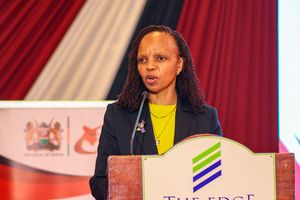
The Principal Secretary for Higher Education Dr Beatrice Inyangala told Nation yesterday that the government was in talks with UASU and relevant government authorities to avert a strike that would disrupt learning across all 39 public universities and seven constituent colleges.
“Yes, we are aware about the seven-day strike notice. We have been talking to UASU and we shall continue talking. And not just UASU, but also KUSU (Kenya Universities Staff Union) and KUDHEIHA (Kenya Union of Domestic, Hotels, Educational Institutions and Hospitals Workers). The last time we had a meeting with UASU, it was really cordial and they gave us thirty days to resolve the issues. So this seven-day [notice] is somewhat a surprise. We have not refused to make a commitment to fund the CBA. It is the Treasury that actually commits the resources, as all the money we get comes from Treasury,” she said.
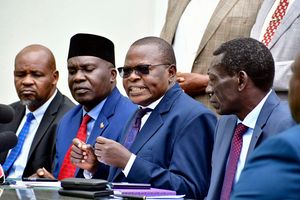
Universities Academic Staff Union (UASU) Secretary-General Dr Constantine Wasonga speaks during a press briefing at the union headquarters in Nairobi on September 24, 2026.
Photo credit: Bonface Bogita | Nation
However, UASU accuses the government of failing to commit to fund a new CBA. The two parties had a meeting on September 17 2026 but no deal has been struck yet.
“When we visited the Salaries and Remuneration Commission (SRC), they categorically told us that they could not issue the parameters for negotiations because the government had not committed to fund that CBA,” UASU secretary-general Dr Constantine Wasonga said yesterday.
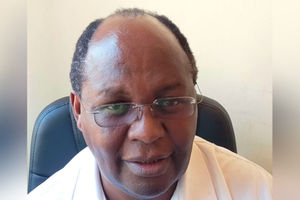
The chair of the IPUCCF Prof Daniel Mugendi said universities have not signed new CBAs with staff unions because they are still waiting for a funding commitment from the National Treasury. He added that universities have held several meetings with the Treasury and the relevant ministries, but no commitment has been made to provide the additional funds required to implement the agreements.
“For us to be able to sign the CBA, Treasury must commit. We don’t have a commitment yet from Treasury. Once we have the concurrence and commitment from Treasury to fund the CBAs, that is the only time we can sign the CBAs,” Prof Mugendi told the Nation .
He said that the financial health of universities has been affected by shortfalls in funding higher education and that the government has not been remitting all the money required to support students under the new arrangement, leaving universities with deficits.
“We have changed to the student-centred funding model. This means the way we used to receive money in the past, through capitation, has changed because money now follows the student. The issue is that the government is not able to remit all the money required for student funding; the scholarships and the HELB loans. So we already have deficits as we speak, even for this year,” he added.
Universities have warned that taking on additional salary obligations without a corresponding increase in funding could further strain their finances. Prof Mugendi said the universities are seeking a separate funding arrangement from National Treasury to meet the cost of CBAs, rather than having the money drawn from funds meant to support students.
“If we then have to fund the CBAs on top of that, it will be a big strain. The universities are already straining because they are not receiving all the money they need. So the discussion is whether this can be funded separately as a standalone item by Treasury, so that the CBAs can be funded independently of that arrangement. That is where the discussion is,” he said.
Students in public universities reported to campuses without money for their upkeep and the HELB only released the first disbursement a few days ago.
However, even as the government releases Sh16.3 billion in loans and scholarships, the students could receive less than the full government support envisaged under the student-centred funding model. Fresh budget figures show a combined funding gap of more than Sh72 billion facing the HELB and UF. The two agencies said they have so far released funds to both first-year and continuing students.
HELB chief executive officer Geoffrey Monari told the Nation that Sh3.4 billion had been disbursed to 194,411 first-time applicants, and that students who provided accurate M-Pesa or bank details have already received their money.
HELB has also disbursed Sh7.8 billion to continuing students, bringing its reported disbursements for the current cycle to Sh11.2 billion.
“All the students who gave accurate M-Pesa/bank details have received their funds except those who applied late, which we are processing on a daily basis,” Mr Monari said.
University of Nairobi students protest outside Anniversary Towers, which houses the Higher Education Loans Board offices, on February 3, 2025 over delayed disbursement of funds.
Photo credit: Evans Habil | Nation
The UF, which provides scholarships under the funding model, has separately released Sh5.1 billion for both new and continuing students.
The Fund's chief executive officer Dr Edwin Wanyonyi while speaking to the Daily Nation said Sh2.5 billion would be released next week, raising total disbursements to Sh7.6 billion.
“In total we have released Sh5.1b for both new and ongoing students. Next week, we’ll be releasing another Sh2.5b for new and ongoing students this will increase total to Sh7.6billion,” said Dr Wanyonyi.
However, budget estimates for the 2026/27 financial year show a much wider financing challenge. HELB has been allocated Sh56.3 billion against a requirement of Sh112.1 billion to support an estimated 1.38 million university students, leaving a Sh55.8 billion shortfall.
The allocation works out to about Sh40,694 per student, compared with an estimated requirement of Sh81,020, creating a funding gap of about Sh40,327 per student.
If the full requirement were to be met, the Sh56.3 billion allocation would cover the equivalent of only about 695,000 students, leaving nearly 689,000 of the projected 1.38 million beneficiaries without the full amount required.
The UF has a Sh16.26 billion deficit, after being allocated Sh31.1 billion against a requirement of Sh47.36 billion for scholarships. The allocation translates to about Sh141,827 per beneficiary, against an estimated requirement of Sh216,072, leaving an average gap of approximately Sh74,245 per student.
Combined, the two agencies therefore face a projected Sh72.06 billion funding gap based on the official budget requirements.
The funding deficit is expected to pile more pressure on existing obligations. According to the UF, pending scholarship commitments are projected to rise from Sh22.26 billion in the current financial year to Sh38.52 billion in 2026/27.
Yesterday, Dr Wasonga questioned the government's emerging market-based approach to university financing, saying UASU had not been presented with a formal policy document outlining how the proposed new model would work.
He said the union had been directed by some government officials to consider social media posts on the proposed funding model, including statements attributed to presidential economic advisor Dr David Ndii.
The union rejected the approach, saying it could not rely on social media declarations or interpret provisions of the proposed Tertiary Education, Placement and Funding Bill, 2026, which is yet to become law.
Uasu rejects Moi University's plan to declare 75 lecturers redundant, threatens strike
“Do we still have public universities or have they changed to market-based universities? If so, when and how did they change to market-based universities?” Dr Wasonga posed.
UASU wants the government to commit to funding the 2025–2029 CBA through the National Exchequer, conclude and implement the agreement, and retain the public-officer status of university lecturers.
It also wants the Tertiary Education, Placement and Funding, 2026, Bill to expressly safeguard the remuneration of academic staff through the Exchequer.
The union has warned that it will proceed with the strike unless the government addresses what it calls the “irreducible minimum” of its demands within the seven-day notice period.