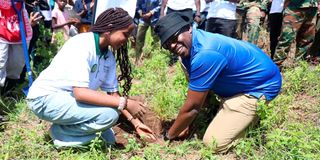
Nation Media Group Group Managing Director and CEO Geoffrey Odundo (right) plants a tree together with Karen Forte Environmental Conservation Foundation Founder Karen Kimani during the launch of the Kinale Forest Rehabilitation Initiative at Kinale Forest in Kiambu County on April 10, 2026.
Many of the countries we look to as models of development today are investing heavily in restoring the wetlands, forests and green spaces.
A green, climate-resilient growth pathway is increasingly the surest route to quality jobs and lasting prosperity, not a barrier to them.
In 1992, the world’s governments gathered in Rio de Janeiro for the UN Conference on Environment and Development. It was the largest gathering of Heads of State the planet had ever seen, convened in response to a decade of growing concern over early warnings of global warming, increasing deforestation, and the growing recognition that species were vanishing at a rate scientists were beginning to describe as a “mass extinction”.
Building on the idea of “sustainable development” introduced by the 1987 Brundtland Report, Rio marked a shift from earlier environmental diplomacy by recognising that no single country could solve these crises alone, and that environment and development had to be tackled together rather than as competing agendas. Out of those negotiations came three landmark agreements: the UN Framework Convention on Climate Change (UNFCCC), the Convention on Biological Diversity (CBD) and, a year later, the UN Convention to Combat Desertification (UNCCD), all built on the understanding that climate change, biodiversity loss and land degradation are three faces of one global crisis requiring a coordinated response.