Every day we seem to wake up to a new reason why the Strait of Hormuz should have topped our geography lessons.
We talked about The Strait and energy last time and today we turn our attention to food, and specifically, that chemical compound, urea, that determines how many of us eat.
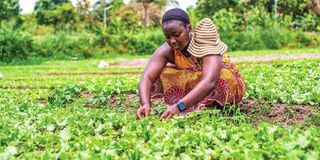
We do this because on Monday we marked World Rural Development Day under the theme “Financing the First Mile of Food Systems”. And for the avoidance of doubt, financing the first mile of food systems means directing inputs, credit, infrastructure, technology, and market access, to that starting point of production (the farm), rather than downstream stages like processing, distribution, or retail. This is where small-scale farmers, Indigenous peoples, women, youth, and local entrepreneurs produce much of the world’s food. So celebrating this day must be about strengthening the base of the food system which is soil and smallholder farmers.
Here’s an interesting twist. Africa uses less chemical fertilizer per hectare than almost anywhere else on Earth. It is a fraction of what farmers in Europe, the US, or China pour onto their fields. You’d think that would make the continent less exposed to a global urea shortage, not more. But that’s not the case. When you’re already farming such low volumes, there’s no cushion left to absorb a shock.
And that means just one bad month for urea supply could disrupt everything. And because so little of any chemical fertilizer used is produced locally, Africa is a price-taker in a market it doesn’t control. A war that disrupts Black Sea exports, a spike in natural gas prices that makes nitrogen synthesis more expensive, a shipping bottleneck halfway across the world, none of it originates on the continent, but all of it lands on African farmers first and hardest. They don’t have the subsidies that cushion European or American producers, so when urea prices double, they don’t quietly absorb the cost. They simply stop buying, and yields, already a third of the global average, fall further still.
As was made clear in the article by Yemi Osinbajo and James Mwangi in Business Africa News on May 27: Accelerating Africa’s own fertiliser production now will build agency and resilience to future shocks. In Africa, so many of us, especially those who grew up in their ancestral homes, have had the experience of planting seeds in their family garden or of tending to their livestock.
When we think of our own villages, memories of our own childhoods growing up come to mind or memories of visiting relatives during the festive season. In one way or another, we are connected to the rural parts of our countries whether we grew up or live there or whether it is where our food comes from.
The theme reminds us that the journey of food does not begin at the supermarket shelf, at the export zones, or even at the market stall. It begins much earlier. In fields tilled by farmers, on pastoral lands traversed by herders, and in fishing communities. Financing the first mile is about recognising that rural communities are the foundation upon which national food security and economic growth can be built.
What this means, therefore, is that attention should be turned to especially women who produce most of the food and yet do not own the land and are therefore shut out from the financial infrastructure that would help them build, and benefit more from, the value chains. The shocks that we face demand that we build local and regional supply chains because we will otherwise always rely on an external supply chain that can price you out anytime. A question to ask and ponder about is: what is the most important piece in world rural development and fixing food systems? Is it in inputs? Is it in yield? Is it in seed quality? The answer is that we need to focus on all of them.
For a long time, “rural” felt like a world far away. A place decisions were made about, rarely with. Policies affecting farmers were drafted in national capitals, often by people who had never walked a maize field or negotiated with a fertiliser dealer. When communities pushed back on being left out, the excuse was always logistics: rural areas were too remote, too disconnected, too far from banks and networks to be meaningfully included. That excuse no longer holds. Mobile connectivity now reaches deep into villages that had no signal a decade ago, and bank branches, or at least mobile money agents, are within reach of most rural communities.
The infrastructure gap that justified exclusion has largely closed. What hasn’t closed is the governance gap: the systems, institutions, and decision-making structures that would let this connectivity translate into real agency for farmers. Financing the first mile isn’t just about capital reaching the farm, it’s about power reaching it too. New forms of governance, built around the fact that rural communities can now be reached, heard, and included in real time, are what would turn that access into agency.
Ultimately when it comes to developing the first mile of food systems there is no silver bullet. It requires sustained investment across the agricultural value chain. Investments in healthy soils, quality seeds, affordable finance, modern infrastructure, extension services and access to markets. It means equipping farmers with the resources to produce more and with the knowledge to farm sustainably in a changing climate. If we are serious about growing our rural areas, we must strengthen every link that enables food to move from the farm to the table.
Ms Mathai is the MD for Africa & Global Partnerships at the World Resources Institute and Chair of Wangari Maathai Foundation