Kenya’s sisal export earnings jumped by 7 per cent to Sh5.73 billion in the 2024 production season, propelled by bigger orders in the main Nigerian market.
Data by the Agriculture and Food Authority (AFA) shows that Kenya exported 26,168 tonnes of sisal worth Sh5.73 billion in 2024, compared to 22,358.40 tonnes valued at Sh5.3 billion the previous year.
“In comparison to the year 2023, there was a 17 per cent increase in exports in 2024, mainly due to stabilisation of one of our main export markets of Nigeria, which had experienced challenges in their money markets, making it difficult for their traders to access US dollars from their official market in 2023,” the regulator said.
“Due to the same reason, the value of exports increased by 7 per cent from Sh5.3 billion to Sh5.7 billion,” AFA added.
Kenya exported sisal to 30 destinations in 2024, with Nigeria being the top market with a total of 11,945.50 tonnes purchased worth Sh2.64 billion, representing 46 per cent of the total fibre exports last year.
China was the second-largest importer of Kenyan sisal in 2024, taking up 2,624.60 tonnes worth Sh529,586,430.51, followed by Saudi Arabia, which bought 2,597.20 tonnes valued at Sh609,031,604.51.
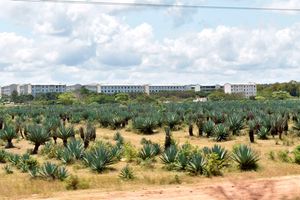
Sisal farming in Kenya. Data by the Agriculture and Food Authority (AFA) shows that Kenya exported 26,168 tonnes of sisal worth Sh5.73 billion in 2024
“In the year 2024, the average Free on Board price of sisal fibre was Sh220,755 per tonne (or $1,632.58 per tonne), or an equivalent of Sh220.76 per Kg. In comparison to 2023, there was a drop in average price from Sh240,822 per tonne to Sh220,755 per tonne, presenting an 8 per cent drop,” AFA said.
“This drop was attributed to the strengthening of the Kenyan shilling against the US dollar in the year 2024. The highest average price was registered in the month of February, while the lowest was in the month of August,” the regulator said.
Locally, sisal is used for making ropes, bags, carpets, baskets and furniture. Internationally, it is used in producing paper, ceiling boards, car bodies, clothes and even paper currency.
Sisal farming is carried out on a large scale in Taita Taveta, the largest producer by county, accounting for 35 per cent of total volumes.
Others are Kilifi, Baringo, Makueni, Kwale, Nakuru and Migori counties.
During the year 2024, Kenya’s total sisal fibre production was 30,893.44 tonnes (equivalent to 617,868.80 tonnes of green leaf) valued at Sh6,712,196,461.38. Out of this volume, the estate plantations produced the lion’s share of 96percent, while the remaining 4percent was produced by the smallholder growers.
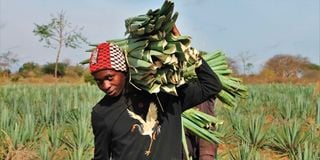
Rosina Mutono carries a bundle of sisal leaves at Maiani Village in Makueni County on July 18, 2022.
Photo credit: Pius Maundu | Nation Media Group
Records showed that the period of July – September 2024 had the highest production of fibre, while the lowest production was in February, March, and April.
In 2024, Taita Taveta County continued leading as the number one producer of sisal in the country, with a production of 9,462.90 tonnes, with an estimated value of Sh2.08 billion, an increase of 8 percent, in comparison to 8,789 tonnes in 2023.
Yasin Abdikadir, a businessman who operates a sisal factory at Matinga Township in Makueni County.
Photo credit: Pius Maundu | Nation Media Group
“The county happens to be the home of the largest sisal estate, Teita Estates in Mwatate, in addition to the Voi Point Estate Ltd in the periphery of Voi town. This was closely followed by Makueni County with a production of 7,347.65 tonnes,” the regulator said.
Kenya’s Sisal production has stabilised at an average of 30,000tonnes for the last five years.