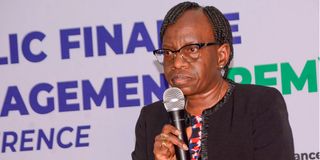
Auditor-General Nancy Gathungu has questioned use of a Sh19.6 billion meant for lending to prospective affordable home owners, saying she cannot access records on the financing scheme.
She said she is unable to track use of the loan issued by the World Bank’s International Bank for Reconstruction and Development (IBRD) to the Kenya Mortgage Refinance Company (KMRC), casting doubts on how the billions have been spent.
Gathungu says she has been unable to access records on repayments for the loan, which was signed almost seven years ago.
Kenya signed the EUR219 million (Sh33.1 billion at current exchange rate terms) loan with IBRD in December 2019 to finance expansion of access to affordable housing finance to targeted beneficiaries.
The project remained operational until June last year, and was intended for on-lending by KMRC to financial institutions, and eventually to potential home buyers.
“Records provided for audit revealed that disbursements amounting to EUR148,028,519 (Sh19,620,451,418) have been made to KMRC as at June 30, 2025, for on-lending to beneficiaries,” Ms Gathungu says in a new audit.
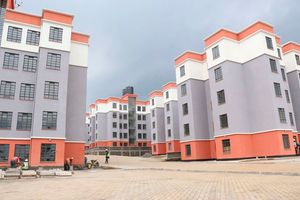
A section of the Affordable Housing Project in Mukuru, Nairobi on December 11, 2024.
Photo credit: Evans Habil | Nation Media Group
The audit reveals that the government negotiated a cancellation of EUR45 million in March 2024 and took over a EUR4.8 million (Sh725.8 million at current exchange rate terms) component involving technical assistance for the project.
The project consisted of support to KMRC as the principal lender and technical assistance, which the National Treasury and the Ministry of Land and Physical Planning took charge of.
The audit also notes that while a subsidiary loan agreement between the government and the KMRC in February 2020 required the company to repay the principal loan in 40 semi-annual instalments starting March 2024, repayment records have not been provided.
“This is because the financial statements of KMRC are not audited by the Auditor-General or a delegated auditor appointed in line with Section 23 of the Public Audit Act, 2015. In the circumstances, the accuracy and appropriate utilisation of Sh19,620,451,418 disbursed to KMRC for project implementation could not be confirmed,” Ms Gathungu said.
KMRC boss Johnstone Olteita, however, disputed the claims by Ms Gathungu on the loan utilisation.
“The funds have been used to refinance mortgages strictly in line with the governing agreements. KMRC has refinanced over 5,100 mortgages so far through various banks, saccos, and facilitated single-digit, fixed-rate, and longer-term loans, thereby enhancing affordability,” he told Nation.
Mr Olteita said that the Auditor-General visited KMRC in August 2025 and verified how the loan received from the National Treasury was deployed in mortgage refinancing.
In its 2024 annual report, KMRC reckons that the government issued it with Sh23.19 billion from two facilities, that of the IBRD and another by the African Development Bank (AfDB), by December 2024.
KMRC also notes that it had accumulated Sh2.53 billion in unpaid interests on the two loans by the end of 2024, which it planned to repay by the first principal repayment date.
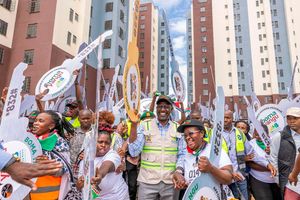
The Makasembo Housing Project in this photo taken on May 29, 2025.
Photo credit: Alex Odhiambo | Nation
“Borrowings from the Government as at 31 December 2024 amounted to Sh23,199,441,028. Interest payable of Sh2,531,760,032 (2023: Sh1,592,003,932) remained unpaid as at 31 December 2024,” KMRC says.
The company said it had EUR59.8 million (Sh9 billion in current exchange rate terms) in undrawn amounts from the IBRD facility by December 2024.
The audit also flags low absorption of the Sh725.8 million allocated for the technical assistance component, which was to be funded by Treasury, noting that just a quarter of the budget had been utilised by the end of the project period in June 2025.
“The project's overall performance information indicates that as at 30 June, 2025, EUR1,214,698 had been drawn, out of EUR4,800,000 allocated to the project component, representing 25 percent of the funds,” the audit says.
This put into jeopardy consulting and non-consulting services, training, and incremental operating costs that had been budgeted for the second component of the project, which the government took charge of in 2024.