Auditor-General Nancy Gathungu and Controller of Budget Margaret Nyakang’o have flagged Sh7.7 billion in commitment charges for loans tapped but not used over five years.
Ms Gathungu said the commitment fees relate to unused loans tapped between the 2020/21 and 2024/25 financial years for projects.
A commitment fee is payment that is charged by a lender for keeping a credit line open. The fee also secures a lender’s promise to provide the credit line on the agreed terms at specific dates, regardless of the conditions of the financial markets.
The fees were paid to international lenders to reserve funds that ministries failed to utilise, sparking concerns over Treasury’s poor debt management plans.
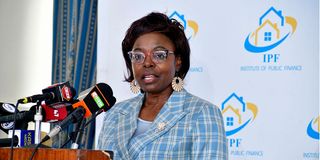
Auditor-General Nancy Gathungu.
Photo credit: Wilfred Nyangaresi | Nation Media Group
“Audits have identified payment of commitment fees on undrawn loans, indicating instances where borrowing commitments were undertaken before projects were sufficiently ready for implementation,” Ms Gathungu says in her report.
The amount paid in commitment fees and other charges is enough to cater for the education of 346,161 learners in senior school per term, at Sh22,244 per student, as per the government capitation policy.
The policy also has Sh15,042 allocated per learner in Junior Secondary School and Sh2,330 for a child in primary school.
According to Section 12 (2) of the Public Finance Management (PFM) Act, Treasury shall promote transparency, effective management and accountability of public finances.
“The National Treasury shall ensure proper management and control of, and accounting for, the finances of the national government and its entities to promote the efficient and effective use of budgetary resources at the national level,” the PFM Act states.
In a report, the National Assembly Committee on Public Debt and Privatisation warned that the continued accumulation of commitment fees on undrawn loans indicates low project readiness, slow disbursements and inefficiencies in loan execution.
To reduce the accumulation of the fees, the committee, whose chairperson is Balambala MP Abdi Shurie, wants Treasury to adopt and enforce performance-based benchmarks and disbursement readiness protocols.
“The government must ensure project readiness before contracting loans and track undisbursed funds to cancel idle loan tranches promptly,” reads the committee’s report.
“This will prevent accumulation of undrawn external loans, which continue to attract costly commitment fees.”
In her report to Parliament, the Controller of Budged also warned against continued accumulation and payment of commitment fees for undrawn loans.
Dr Nyakang’o said the tendency leads to the high cost of borrowing, “characterised by peak interest rates on government securities,” which has significantly raised interest payments.
“There is need to minimise commitment fees, penalties and other incidental borrowing as such charges do not contribute to the productive utilisation of borrowed funds,” Dr Nyakang’o said in her budget implementation review report.
She added that in the first six months of the 2025/26 financial year, the National Treasury undertook a liability management operation targeting the $1 billion issued in 2018, due 2028.
The government also spent $657.9 million (about Sh86.2 billion), to buy back $628.4 million (Sh82.3 billion), a premium of $23.57 million or Sh3.1 billion and accrued interest of $5.89 million (Sh0.77 billion).
“The transaction resulted in an additional cost of about ShSh3.86 billion above the principal amount,” the report by Dr Nyakang’o says.
The Controller of Budget has in the past recommended to MPs to consider proposing measures to strengthen parliamentary oversight throughout the entire public debt cycle – from borrowing and utilisation to debt servicing and repayment.