The High Court has ordered the Kenya Broadcasting Corporation (KBC) to settle a long-running debt exceeding Sh18 million owed to UK and Nigerian sports management firms, ruling that state agencies cannot evade court decrees by citing budgetary constraints.
The court issued an order compelling KBC Managing Director to pay Optima Sports Management International (UK) Limited and Optima Sports Management International (Nigeria) Limited over a breached sports rights contract dating back to 2008.
According to the ruling, government agencies and state corporations cannot refuse to honour valid court awards on grounds that funds were not budgeted for or approved in their annual financial estimates.
The court also ordered that a previous Sh5 million payment deposited by KBC as security in earlier proceedings be deducted from the final amount payable.
In its judgment, the court dismissed KBC’s argument that the claim was legally barred and rejected the broadcaster’s defence that payment depended on budgetary approvals and annual financial estimates.
“Budgetary constraints cannot be a bar to issuance of a mandamus order to compel performance of a public duty of settling decree of the court,” the court ruled.
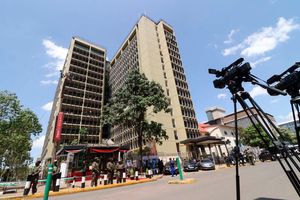
The entrance to the Kenya Broadcasting Corporation in Nairobi.
Photo credit: File | Nation
The dispute arose from consolidated commercial suits filed in 2009 after the two foreign companies accused KBC of breaching contractual obligations linked to sports management and broadcasting arrangements. The firms secured judgment in February 2020 after the court awarded them Euro120,000 together with interest and costs.
Court records show KBC later sought to stop enforcement of the decree pending appeal and obtained temporary stay orders after depositing Sh5 million as security. The broadcaster was later directed to deposit an additional Sh30 million in a joint interest-earning account operated by lawyers for both sides.
However, KBC failed to comply even after the amount was reduced to Sh10 million.
With no stay orders remaining in force, the firms successfully applied for release of the Sh5 million partial payment in October 2024 before filing fresh judicial review proceedings seeking to compel settlement of the outstanding balance.
KBC opposed the application, arguing that the matter had already been determined in earlier proceedings dismissed in January this year.
The broadcaster also argued that settlement of the decree depended on internal financial procedures, annual budget approvals and revenue availability under the Kenya Broadcasting Corporation Act.
But the court ruled that the earlier case had only been struck out on procedural grounds and was never determined on merit.
It found that the companies had properly obtained and served a certificate of order against the government, triggering KBC’s legal duty to settle the debt.
The court said Section 47 of the KBC Act shields the corporation’s assets from attachment but simultaneously imposes a statutory obligation on the managing director to pay valid court awards without delay.
“With such a bar to execution against its assets, a decree holder would be left with a barren decree against the Corporation with no other alternative mode of enforcing judgments,” the court said.
It added that a court order compelling payment remained the only effective way to enforce judgments against state corporations protected from normal seizure of assets.
The court also criticized KBC’s claim that it lacked revenue to settle the decree despite continuing operations.
The court said KBC had not demonstrated any serious effort to budget for or settle the debt despite the judgment being in force for more than six years.
“There is no evidence that the respondent has since 2020 not settled any other decree of this court because of budgetary constraints,” the court ruled.