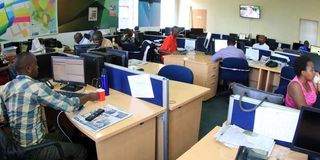
In a world where so much is happening day and night, where everyone—learned and illiterate—is hungry for news, one area stands out as the most reliable source of news: the newsroom. It is here that journalists are guided by their respective editors on what is expected of them.
The Nation Media Group (NMG) newsroom is one of the best places to continuously learn something new. It is here that all have an opportunity to learn from one another with ease.
The combination of experiences between younger and older generations makes the newsroom appear like a large family, with each member sitting next to a pot (computer) to prepare a meal based on agreed ingredients. Both print and electronic media have their own ways of reaching their consumers.
While the newsroom is currently occupied by more young people than the older generation, those who had an opportunity to work at the Old Nation were lucky to come to Canaan, as they used to call the Nation Centre, and are still there to date, have fond memories to share with the new generation.
Typewriters and plain papers with carbon papers in between were the most important tools used to produce a story. In those days, journalists covered any story they were able to. There were those who specialised in feature stories and those whose main interest was news coverage. However, if a news item came up and no news reporter was available, a feature writer would cover it as a form of social responsibility.
Everything was done manually, and once the editor was through with his pages, there was a section known as paste-up where clean copies were arranged in columns and fixed together using glue. The complete page would then be put into a machine that would make plates, which would eventually be rushed to the Industrial Area printing press. To neutralise the effect of the glue, those in the paste-up section were given milk.
Another important section was the darkroom, where black-and-white films were processed and contact sheets made to help editors select photos. There were no colour films to be processed in the darkroom.
A typewriter.
Photo credit: File | Nation Media Group
Once a story was published, there was a secretary to measure it using a ruler based on the number of columns. The longer the story, the more you were paid. Photos were paid for based on the number of columns they occupied.
Filing stories using a telephone booth was no joke. There was no privacy since telephone booths were public utilities, operating on a first-come, first-served basis. There was someone in the newsroom to receive your story as you shouted from a telephone booth. Jokes and laughter were not so common in the newsroom, as writers and editors seemed more preoccupied with their work.
Introduction of a modem facilitated communication between the Old Nation network and the internet enabled Nation to send printing materials directly to the press, thus eliminating the need to transport plates.
One day, something went wrong with the computer, and the only person trained to deal with computer matters was nowhere to be seen. There were no mobile phones. An urgent announcement was made through the Voice of Kenya (VOK) radio, which later changed to the Kenya Broadcasting Corporation (KBC), asking anyone who knew the man to inform him to report to the office immediately. Kenya had only one radio station and one TV station, both owned by the government and operating up to midnight. The computer expert finally surfaced later in the afternoon. The rest is history. More people had to be trained in computers, not just to avoid such a scenario but also as a way to embrace emerging technologies.
Apart from what journalists brought to the newsroom, there was a telex machine that ran 24 hours, bringing in local and international news. Local news mainly came from the Kenya News Agency (KNA), a department within the Ministry of Information and Broadcasting.
Breaking news was received differently from what we know today. In those days, there were no television sets spread across newsrooms as we see today. The 1.00 pm radio news was very important to all especially for Cabinet ministers whose sacking or transfer was announced.
Newsrooms used to receive breaking news around this time, although editors had contacts from various sources to feed them information. Breaking news often resulted in the production of a Special Edition of the daily newspaper, which would mostly sell out in Nairobi, targeting people leaving their workplaces for home.
Former Nation Group Managing Editor George Mbugguss (left) receives a present from his successor Wangethi Mwangi during a farewell cocktail party hosted for him on December 1, 1991 as Ms Irene Karanja
Photo credit: File | Nation Media Group
The best way to assess a journalist's performance in the newsroom was to go through a huge document the size of a police occurrence book (OB), where John Lawrence, the training editor, cut, pasted, and commented on all stories. He would do this every morning before journalists reported. Every journalist—whether employed or freelancing—had an opportunity to assess their daily contributions.
Nation Newspapers used to set competitions for young writers to gauge their writing ability. Winners would be presented with journalistic tools of the trade, as shown in the Saturday Nation of July 12, 2025—Today In History—where, in 1994, among other details in the caption, the then Nation Group Managing Editor, Mr George Mbugguss, presented Mr Basett Buyukah with a typewriter for his winning literary piece. Mr John Lawrence is on the left.
If there were presentations to be made to a winner in the newsroom today, the most likely gift would be a laptop or a tablet. These would take the role of a computer, while a portable device would replace the bulky typewriter.
With the expansion of NMG, the newsroom has also grown to a level where most journalists do not know one another by name but greet each other along the way as they go about their assignments. Except for those with common interests, most have no idea what others are working on.
Engaging young journalists in the newsroom on how journalism has evolved over the years highlights the need for brief discussions once in a while, where aspects of the past and the present state are discussed. Each generation has stories to tell. Some have witnessed it all and understand every stage of newsroom life.
As I take a short break from the computer and walk around to stretch and learn a few things from young journalists, I try to find out what they know about a typewriter. The first person I talk to is Fredrick Ooko, aged 27, a social media producer who deals with content for the NMG online audience.
Says Ooko, “I have never seen a typewriter nor used one. I joined the newsroom at a time when computers are in use. They have made our work easier and seamless.”
Velma Baraza, who says she is in her 30s, is a social media producer at NMG responsible for managing NTV’s social media pages, including the creation, curation, and distribution of content. She says:
“While I have never used a typewriter in my career, I learned about it at Daystar University. I would have liked to use one even briefly, just to get a feel of it. I thought it was a cool device when I saw it on TV.”
Jackson Ngari, 24, is a lifestyle reporter who writes for both the Daily Nation and Business Daily . A graduate of Rongo University, where he studied communication and journalism, he says he has only heard about typewriters and has never used or seen one in real life.
Says Ngari, “My understanding comes from stories shared by veteran journalists and from seeing them in books and movies. I imagine them as early versions of computers, where journalists manually typed out their stories, one key at a time. It is fascinating to think how far newsroom technology has come since then.”
Ngari’s role as a lifestyle reporter involves sourcing, pitching, and writing stories that reflect the best of lifestyle journalism, including human-interest profiles and stories that resonate with Gen Z.
He adds, “My work is multimedia, published in print and online, and often accompanied by video or audio. I usually carry my own laptop to the office, although we also have desktop computers. And yes, pitching stories to editors is a key part of the process today. I am not sure if that was common practice back then.”
The transformation of the NMG newsroom from analogue to digital has improved content and introduced new formats to meet local and global demands. The combination has made it easier for both sides to share ideas that are effectively implemented.
The newsroom is the nerve centre that determines many activities within and beyond management. A story generated from the newsroom can easily guide a keen sales executive to a business opportunity that was previously unknown. Revenue was generated this way during the Old Nation days—and it still can be. It is from the newsroom that the nation (country) and the world at large get to know what is happening.
Continuous supply of good stories, being cheerful even when things appear overwhelming, seeking guidance when unsure, and having something to laugh about once in a while make life better in the newsroom we have come to appreciate.