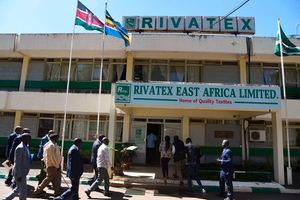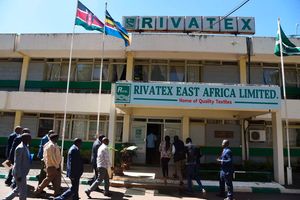
Rivatex East Africa Limited in Eldoret City in this picture taken on January 13, 2023.

The management of the financially troubled New Rivatex East Africa Limited has officially changed hands following the completion of a Joint Asset Verification Exercise.
This comes two months after the Eldoret-based textile firm was handed over to a new non-strategic investor to modernise equipment, expand markets for cotton farmers and boost apparel exports.
Arise Integrated Industrial Platforms (Arise IIP) Limited has now assumed control of the factory after signing the joint verification report with the previous management.
The handover process was overseen by Acting Managing Director Stanley Bett after the government transferred the company to the investor. Arise IIP also operates major textile processing plants in Togo and Benin, among other African countries.
Job losses
Under the new arrangement, only 118 of the 625 employees will be retained as part of a restructuring plan expected to create over 5,000 jobs directly and indirectly in the long term.
“Rivatex has, for years, faced operational and financial challenges. Through this lease, Rivatex will access modern technology, private sector efficiency, international markets and fresh capital investment without losing public ownership,” said Arise IIP CEO George Olaka during the handover.
The company has begun technical and infrastructural assessments, equipment upgrades and plant modernisation to enhance efficiency and production capacity.
It is also vetting former employees and recruiting new staff as part of its expansion and turnaround strategy for Kenya’s textile sector.
To ensure accountability, Arise IIP will implement a robust monitoring and evaluation framework that includes annual compliance audits. Technical assessments will be conducted every three years by Rivatex, Arise IIP and independent auditors to track performance and adherence to agreed targets.
Millions in debt
According to Auditor-General Nancy Gathungu, Rivatex has accumulated debts of more than Sh140.92 million, including Sh2.13 million owed to suppliers, Sh67.29 million to the Moi University pension scheme, and Sh4.33 million in retention payments.
“This financially troubled company has been operating below 10 per cent capacity despite government and development partners pumping billions into its modernisation. The investor will retain only 118 of the 625 staff and inject significant capital to restart production and improve quality and efficiency,” said Industrialisation Principal Secretary Dr Juma Mukwana.
Arise IIP will run, modernise, and maintain the factory under a 21-year lease and has already paid Sh94 million in salaries during the transition.
The investor will also cover all operational expenses while paying a fixed lease fee to the National Treasury.
Mr Olaka noted that Rivatex is working under an African textile renaissance programme and has supported the development of the National Cotton, Textile and Apparel (CTA) Policy 2024.
The firm has also donated 1,560 tonnes of certified cotton seed to farmers in an effort to strengthen the cotton value chain from farm to fabric.
Despite significant government investment estimated at Sh7.55 billion, Rivatex has not paid dividends for 50 years due to persistent financial and administrative challenges.
The firm was placed under receivership before being acquired by Moi University in 2007 at Sh205 million for training, research and commercial production.
However, inadequate raw cotton supply, high energy costs, expensive fibres, dyes and chemicals have continued to undermine production capacity.
Kenya produces only 5,300 tonnes of cotton annually against a demand of 38,000 tonnes, forcing the country to import Sh17 billion worth of cotton from neighbouring countries.
The plant, which once produced up to 15.73 million metres of fabric, has suffered years of financial decline.