Kenya’s debt servicing bill grew by Sh302.3 billion to hit Sh1.075 trillion during the first seven months of the current financial year.
Data from the National Treasury show the repayments rose from Sh772.8 billion spent in a corresponding period of the prior financial year, representing a 39.1 per cent jump on the back of increased borrowing.
This pushed debt service costs to 79.97 per cent of total tax collection following a Sh1.34 trillion collection by the Kenya Revenue Authority (KRA) during the period, up from 61.7 per cent proportion in the seven months ending January 2025.
The growth means debt servicing absorbed a larger share of available resources at a time several state departments and offices are struggling to stay within approved expenditure ceilings.
Debt servicing remains a first charge on the Consolidated Fund, giving it priority over other expenditure and effectively crowding out budgetary space for development spending and discretionary operations.
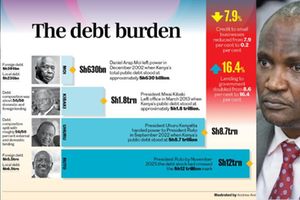
The repayment pressure comes against the backdrop of an expanding loan burden, with the public debt standing at Sh12.3 trillion as of November last year, according to the latest available data from the Central Bank of Kenya (CBK).
The Central Bank of Kenya.
Photo credit: File
As at June 2025, Kenya’s public debt stood at Sh11.8 trillion, meaning it expanded by Sh500 billion within the five months to last November.
The country’s debt has grown rapidly over the past decade, with borrowing used to plug budget deficits driven by infrastructure projects and recurrent spending pressure.
This coincides with modest revenue growth as tax collections struggle to keep pace with expenditure needs, amplifying fiscal pressure and limiting the government’s flexibility in managing competing priorities.
The strain in expanding revenue collection has constrained the ability to scale up spending on priority areas like health and education, even as demand for public services continues to rise.
Growing debt service continues to crowd out project funding, with a development expenditure of Sh167.8 billion in the seven months to January, accounting for just 15.6 per cent of total debt servicing costs.
The government is betting on the sale of public-owned firms to raise funds for infrastructure development and general budgetary spending.
Treasury has opened the sale of a 65 per cent stake in Kenya Pipeline Company in an initial public offering (IPO) that seeks to raise Sh106.3 billion.
The IPO offer, priced at Sh9 per share, was opened on January 19 and runs to Thursday.