The Controller of Budget (CoB) Margaret Nyakang’o wants the government to expand its options for budgetary support, warning that overreliance on the International Monetary Fund (IMF) risks eroding Kenya’s domestic policy-making reforms once the funding programmes end.
Dr Nyakang’o questioned the government’s dalliance with the Bretton Woods institution even as she raised doubts about the establishment of the planned National Infrastructure Fund (NIF) under the Government Owned Enterprises (GOE) Act.
The GOE Act, which mandates that government-owned enterprises operate as commercial entities, for profit, self-financing, and self-sustaining, was part of the IMF-sanctioned reforms' conditionality for the State Corporations funding programme.
Dr Nyakang’o notes that IMF programmes carry significant tradeoffs, “notably, the conditionalities that come with the fund programme requiring rapid fiscal tightening.”
“So, we should not just be puppets, we need to look at this realistically,” the CoB said.
“GOE Act, as we noted, bypasses Parliamentary scrutiny as well as that of my office and therefore, weakens public oversight” Dr Nyakang’o added.
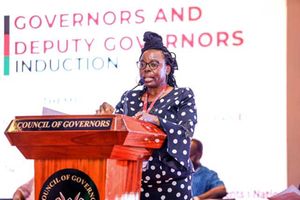
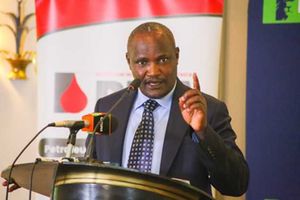
The Controller of Budget Dr Margaret Nyakang'o when she appeared before the National Assembly Committee on Finance and National Planning at Bunge Tower Nairobi on May 14, 2025.
Photo credit: Dennis Onsongo| Nation Media Group
The GOE Act is a key structural reform aligned with the IMF conditionalities, with enterprises under its purview operating as limited liability companies under the Companies Act rather than separate Statutes.
This model bypasses the traditional government bureaucracy and annual budget cycles to provide capital for long-term projects.
The IMF has consistently pushed for structural reforms to reduce the fiscal burden of the loss-making State Corporations, and therefore, the GOE Act serves this purpose.
Consequently, the enactment of the GOE Act was a critical signal to the IMF as Kenya negotiates a successor funding programme following the expiry of its previous Sh464.47billion ($3.6 billion) deal in early 2025.
However, its implementation was on February 2, 2026, and it will stay until February 23, 2026, after the High Court issued conservatory orders following a petition by the Consumers Federation of Kenya (Cofek).
In addition to its commercial functions, the GOE may perform public functions.
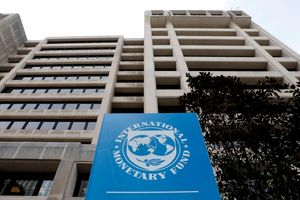
The International Monetary Fund Headquarters in Washington, DC.
Photo credit: Olivier Douliery | AFP
Previously, creating or altering a State Corporation required an Act of Parliament, but under the GOE Act, the cabinet can establish, merge, or dissolve GOEs with minimal direct legislative intervention.
But according to Dr Nyakang’o, while entering the new IMF programme, Kenya needs to address the persistent credibility and implementation gaps that she says constrain social spending while restricting development expenditure and fomenting political resistance when life becomes harder for Kenyans.
“We need to look at the front-loaded austerity that can suppress household welfare and slow economic growth altogether,” says the CoB, adding, “we also need to look at the operationalization of the NIF in particular, to monitor why the fund was established under the GOE Act.
NIF is a specialized investment vehicle established to serve as the "central engine" for financing the country’s large-scale development projects.
Approved by the cabinet in December 2025, its primary mandate is to shift infrastructure funding away from public debt and taxation towards a sustainable, investment-led model.
NIF is mandated with the mobilisation of non-debt capital and has been tasked to raise Sh5 trillion to finance national priorities without escalating the country’s debt burden.
This includes collecting and ring-fencing proceeds from monetization of public assets through privatization or leasing of mature State-owned assets and reinvesting them strictly into new infrastructure.
Kenya Pipeline Company (KPC), a GOE, is currently undergoing privatisation process through an Initial Public Offer (IPO) that is expected to raise at least Sh104 billion.
The government is also seeking to raise Sh204 billion from the divestiture of 15 percent of its 20 percent shareholding in Safaricom, the country’s largest telco.
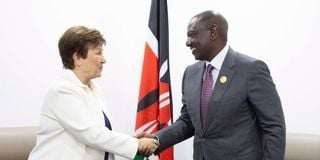
President William Ruto meets with IMF Managing Director Kristalina Georgieva.
Photo credit: PCS
The NIF also aims to act as a catalyst where every shilling invested by the fund is expected to attract up to Sh10 from long-term private and institutional investors, including pension funds and sovereign partners.
“It will therefore be necessary to monitor whether the privatisation or divestiture proceeds are channelled to the fund rather than the Consolidated Fund (CF) and whether this will finance viable, clearly verifiable projects,” says Dr Nyakang’o.
The legal hurdles notwithstanding, GOEs like Kenya Electricity Generating Company (KenGen) have started restructuring their boards to comply with the Act’s requirements for fewer boards of directors and better protection of minority shareholders.