Long before the first bottle bearing the Delik Detergents label rolled off her production line, Elizabeth Wambui had embarked on an entrepreneurial venture alongside her professional career.
Armed with a master’s degree in Project Planning and Management, she established a cleaning and hygiene products business alongside her professional career to diversify her income while building a long-term enterprise. Household cleaning products appealed to her due to steady demand and the potential for a sustainable venture.
“I wanted to focus on innovation within the manufacturing sector, particularly in developing products that address everyday consumer needs,” she says.
She found an industry where technical expertise, regulatory compliance and operational efficiency determine competitiveness.
Delik Detergents emerged from months of research, formulation trials and product testing before being established with an initial investment of approximately Sh20,000 from personal savings. Inside the production room, shelves are lined with bottles of dishwashing liquid, liquid soap and fabric detergent awaiting dispatch. Nearby, containers of raw materials are stacked against one wall, while measuring cylinders, laboratory beakers, weighing scales and protective equipment sit alongside stainless-steel mixing tanks used during manufacturing.
The scent of freshly blended cleaning products hangs in the air as Elizabeth moves between workstations, weighing raw materials, monitoring mixing tanks and inspecting containers before they are labelled and packed for distribution.
“Entering the detergent manufacturing industry required mastering the science behind chemical formulations, understanding production standards and appreciating the commercial realities of competing in a market occupied by well-established brands,” she says.
A bottle of Delik antibacterial liquid hand wash, displayed at the Delik Detergents Ltd outlet in Kahawa Sukari, Kiambu County, on July 2, 2026.
Photo credit: Wilfred Nayangaresi | Nation Media Group
Rather than introducing products immediately, she spent months testing formulations and refining ingredient ratios. Each unsuccessful batch provided new information on how different raw materials interacted and influenced the final product. Elizabeth says that each formulation is developed within defined production parameters, with ingredient ratios, mixing procedures and quality specifications carefully controlled to ensure the product performs as intended and remains stable throughout its shelf life. Working with a team of six, manufacturing begins with treated water, which is purified before being transferred into mixing tanks.
Surfactants are introduced first, followed by builders, stabilisers and other additives in a predetermined sequence, while continuous agitation ensures the mixture remains uniform.
Fragrances and colourants are added after the base reaches the required properties. Samples are then collected for laboratory testing to assess pH, viscosity, appearance and cleaning performance before the batch proceeds to packaging. Approved batches move to the filling line, where they are dispensed into containers of different sizes before being sealed, labelled and coded for traceability.
The finished products are then transferred to the warehouse ahead of distribution to wholesalers, retailers and institutional customers. Delik Detergents manufactures seven products serving households as well as institutional customers, including schools, hospitals, hotels and restaurants. Its portfolio comprises handwash, bleach, dishwashing liquid, toilet cleaner, multipurpose soap, fabric softener and shower gel, supplied in retail and 20-litre pack sizes to serve household and institutional customers, with prices ranging from Sh200 to Sh6,800. Product development is guided by customer feedback, with new formulations introduced in response to changing cleaning requirements and demand from different market segments.
Manufacturing was only one aspect of establishing the enterprise. Securing customers, developing distribution networks, and convincing retailers to stock an unfamiliar brand presented a different set of challenges.
“Launching a manufacturing business meant persuading consumers to purchase a relatively unfamiliar product in a market dominated by multinational companies and established local manufacturers,” she says, adding that maintaining product standards and responding to customer feedback were essential to retaining customers.
Bottles of Delik toilet cleaner displayed on a shelf at the Delik Detergents Ltd outlet in Kahawa Sukari, Kiambu County, on July 2, 2026.
Photo credit: Wilfred Nayangaresi | Nation Media Group
The company eventually reached the market through direct marketing, referrals, exhibitions and social media before gradually expanding its distribution through wholesalers and other trade partners. Elizabeth says repeat orders and referrals from existing customers contributed to subsequent sales, particularly as the products became available across a wider network of household and institutional buyers.
As production volumes increased, the company expanded its operations by strengthening internal systems, refining its branding and upgrading its packaging to support a broader market presence.
Like many small-scale manufacturers, Delik Detergents operates in a sector characterised by fluctuating raw material prices, rising production costs and competition from both established manufacturers and informal producers.
Bottles of Delik bleach displayed on a shelf at the Delik Detergents Ltd outlet in Kahawa Sukari, Kiambu County, on July 2, 2026.
Photo credit: Wilfred Nayangaresi | Nation Media Group
“Access to capital has remained one of the business's biggest constraints, particularly as production expanded. Additional investment was needed to acquire equipment, purchase raw materials, finance packaging and support day-to-day operations,” Elizabeth explains.
She adds that compliance with regulatory requirements has also become an integral part of the business, with product certification involving routine testing, documentation and adherence to prescribed manufacturing standards before products are released to the market. Expanding distribution has presented another challenge. She says supplying new markets has involved building relationships with distributors, retailers and institutional buyers while competing with established brands and lower-priced counterfeit or substandard products.
Alongside managing the business, Elizabeth has also taken on a mentoring role, supporting aspiring entrepreneurs interested in establishing small manufacturing enterprises, particularly in detergent production.
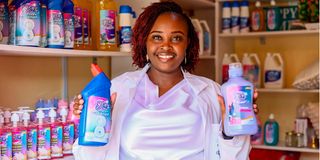
Delik Detergents Ltd founder and CEO Elizabeth Wambui displays some of her company’s cleaning products in Kahawa Sukari, Kiambu County, on July 2, 2026.
Photo credit: Wilfred Nayangaresi | Nation Media Group
“Growing interest from individuals seeking guidance on business start-up and detergent manufacturing led me to introduce structured training programmes covering both technical production and enterprise management,” she says.
The programmes integrate classroom instruction with hands-on demonstrations, exposing participants to formulation techniques, production procedures, branding considerations and the operational requirements of establishing a small-scale manufacturing enterprise.
Elizabeth believes that entrepreneurship should create opportunities beyond the founder, and while the training programmes continue, attention also remains on strengthening the manufacturing side of the business.
“We have plans to invest in additional production equipment to support higher output and reduce manual handling across key stages of manufacturing,” she says, adding that selected processes, particularly in mixing, filling and packaging, are also under consideration for automation to improve consistency and production speed.
The business is also exploring the introduction of new product lines within the household and institutional cleaning segment, with formulations tailored to different user needs, ranging from domestic households to commercial and hospitality clients.
Bottles of Delik antibacterial liquid hand wash, displayed at the Delik Detergents Ltd outlet in Kahawa Sukari, Kiambu County, on July 2, 2026.
Photo credit: Wilfred Nyangaresi | Nation Media Group
Expansion into regional markets forms part of the longer-term outlook, alongside potential entry into export markets, subject to regulatory approval and certification requirements.
Kenya's manufacturing sector continues to present opportunities for entrepreneurs capable of identifying everyday consumer needs and delivering consistently high-quality products. Household cleaning products remain essential commodities, creating a market where innovation, affordability and customer confidence often determine long-term competitiveness. Elizabeth believes locally manufactured products can increasingly compete with imported alternatives if manufacturers maintain consistent quality standards and continuously improve their products to respond to growing consumer needs.
Looking back, she says establishing Delik Detergents has strengthened her view that entrepreneurship can be pursued alongside a professional career, rather than being regarded solely as an alternative to formal employment. While her academic background provided analytical and problem-solving skills, she says building the business has offered practical exposure to manufacturing and enterprise operations.
“Manufacturing is not only about producing goods, but it also requires discipline in processes, consistency in output and continuous improvement, alongside systems that sustain long-term production and value creation,” she says.