Kenya’s beauty and personal care market is worth billions of shillings, with the compound annual growth rate estimated at 7.65 per cent and continues to grow as more consumers demand products that are safe, effective, and locally relevant.
The obsession with healthy skin has led to the emergence of a fast-growing industry that thrives on constant innovation and new solutions. Rising to this challenge is Reulinah Dzala, founder of Yanzi Organics. What is now a beauty brand began humbly as a quiet prayer whispered over glass jars in her kitchen.
With Sh10,000 in capital, borrowed pans and a mother who bought 200 jars as a seed investment in her daughter’s vision, Reulinah started blending creams at home. Today, that leap of faith is now a fully-fledged beauty brand with a growing footprint across East Africa, offering science-backed skincare rooted in African heritage and powered almost entirely by women.
“My mother was my first investor. She bought me the packaging bottles, while my father provided the ingredients and cookware,” she says.
Yanzi Organics has grown steadily, bootstrapped from the start—reinvesting early profits, stretching every resource, and guided by a firm belief in the continent’s potential to lead in skincare innovation.
Sustainable income streams
“We source raw materials from women-led cooperatives across Africa, creating sustainable income streams for rural communities. We also train and employ mothers in packaging and logistics, offering flexible and dignified work opportunities,” she says.
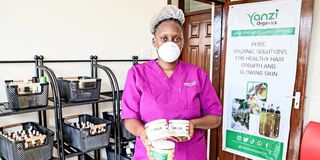
Hair and skincare products at Yanzi Organics production plant in Syokimau, Machakos County, on September 4, 2025.
Photo credit: Bonface Bogita | Nation Media Group
Reulinah adds that they also partner with women-owned enterprises in areas such as photography, design and brand development while providing mentorship to young women interested in pursuing entrepreneurship in the clean beauty sector.
With a lean but impact-driven team, the company’s portfolio now features more than 20 products, ranging from body butters and reparative serums to haircare sprays, masks and toners.
Priced between Sh750 and Sh2,500, the range is designed to meet the skincare and haircare needs of consumers while maintaining a balance of quality and affordability.
“Each product is crafted with natural ingredients, rich textures, and effective results. Clean beauty should not be ordinary—we create products that deliver a premium experience, backed by science and inspired by African skin and stories,” she explains.
Its formulations feature locally sourced ingredients such as shea butter, hibiscus extract, baobab and fenugreek oil, reimagined through modern cosmetic science to deliver the desired results.
While many start-ups race for mass-market retail placement, the company has taken a curated path and is currently available on online platforms and select digital menus, with an official e-commerce website launching soon.
Hybrid distribution model
Offline, the products are stocked in boutique wellness stores and spas in Nairobi and Mombasa, with Kigali on the horizon.
“We have been intentional with our retail footprint,” she says. “For us, it is about preserving the brand experience and building relationships, not just pushing product.”
To support growing demand, the company has adopted a hybrid distribution model that combines centralised in-house fulfilment with external courier partnerships. Using dispatch hubs and batch-based inventory management, it works with courier services to maintain efficiency and strict quality control.
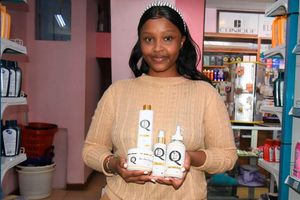
Serum manufactured at at Yanzi Organics production plant in Syokimau, Machakos County, on September 4, 2025.
Photo credit: Bonface Bogita | Nation Media Group
Like many start-ups, the business has encountered challenges. In the early days, limited access to capital forced them to bootstrap operations, stretching every shilling to cover raw materials, packaging, and marketing. Regulatory approvals also posed delays, with stringent product testing and compliance processes slowing time-to-market. Building consumer trust in locally made skincare products was another hurdle in a market long dominated by imported brands.
“Convincing customers that a Kenyan brand could deliver the same, if not better results than global labels took persistence and consistency,” she says. Supply chain disruptions, especially sourcing quality raw materials in bulk, added to the strain.
As the business expands, Reulinah says they are investing in tech-backed inventory systems and exploring regional warehousing to further streamline operations.
Yanzi is also eyeing regional markets. The brand has already begun exports to Rwanda and is targeting Uganda, Tanzania and South Sudan. Beyond East Africa, the company is laying the groundwork for entry into diaspora-rich countries such as the UK, the US and the UAE.
“There is a huge gap in the global beauty market for products that truly understand melanin, the continent’s climates, and cultural skincare rituals. We are building our brand to fill that gap with authenticity, not imitation,” she says.
Their long-term vision is ambitious. Locally, the goal is to become Kenya’s benchmark for clean beauty—trusted, effective, and culturally resonant. Regionally, the brand seeks to lead East Africa’s clean skincare movement by setting high standards in formulation and ethical growth.
Legacy mixer used for mixing body butters, pictured at Yanzi Organics production plant in Syokimau, Machakos County, on September 4, 2025.
Photo credit: Bonface Bogita | Nation Media Group
Globally, it aspires to stand among luxury brands from the continent that are visible and respected on international shelves.
The regional beauty industry is evolving. Consumers are shifting from DIY remedies and imports to local brands that blend effectiveness with purpose. Ingredient literacy is increasing, as is the demand for authenticity. Far from resting on its current success, the company is already working on new product lines and collaborations designed to push the envelope of clean beauty from the region.
Upcoming launches include a men’s grooming line, new clay masks, fragrance-forward body butters inspired by regional botanicals, and travel-sized skincare kits.
“We are also planning a limited-edition line that celebrates femininity through scent, texture, and story,” she shares.
Cross-brand collaborations with other African lifestyle brands are also on the table, signalling a more holistic approach to wellness that goes beyond skin-deep.
“As we chart new territories, expand our product line, and deepen our impact, we want to show the world that brands from Africa can compete not just on packaging or pricing, but on innovation, intention, and impact,” she concludes.