Joan Muthui, a pharmacist, and founder of Beesplash Ltd, a company that sells skin care products.

When Joan Muthui arrived at a Rotary vocational fair in January 2025, she had borrowed Sh500 from her workplace’s petty cash fund to pay for a stand. She had spent the weekend labelling moisturiser tubes on her bed alongside her two sons and had no idea whether anyone would buy them.
By the time the evening session closed, her phone showed Sh9,600 in mobile money receipts.
“What? You mean it’s working?” she recalls thinking. “I have never looked back.”
That evening marked the commercial debut of Beesplash Ltd, an organic skincare brand that Joan had been quietly developing for almost a year while working full-time as a pharmacist and raising two children.
Less than six months later, her beeswax-based moisturisers, lip balms and soaps were appearing on dermatologist prescription pads and in the bags of international Rotary delegates. They were also reaching buyers in the United Kingdom, South Africa and the United States.
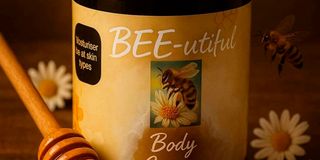
Display of body cream made from beeswax, shea butter, honey and essential oils.
From frustration to formulation
Joan is a pharmacist by training and by practice. For years, she stood behind a dispensing counter and watched patients return, again and again, with unresolved skin conditions. Treatments were expensive.
“Anything relating to the skin is not a one-day thing,” she says. “You take a drug for diarrhoea, and it stops. Skin is a journey, and it can take a year, two years, three years. You see people becoming frustrated with unending issues.”
The frustration became personal when her own children developed eczema. While living in Nanyuki, the family spent months treating the wrong condition before travelling to Nairobi, where a paediatrician friend identified the problem in a single consultation without conducting extensive tests.
“He told us, ‘You have been treating the wrong thing,’” says Joan. “That was our eureka moment—finally, we knew what we were dealing with.”
Joan had long favoured non-pharmaceutical approaches for everyday ailments. It was the combination of her professional and personal experiences that pushed her towards an idea she had been considering for years.
In 2024, Joan enrolled at the Lenana Institute of Beekeeping to study hive by-products. During her studies, she discovered that beeswax, the comb remaining after honey extraction, could be melted down and used as a skincare base.
That same year, she reconnected with a former college lecturer who was now a professor and was already producing his own organic soap.
“When I saw the product he was working on, I thought, ‘This is what I have always wanted to do,” she says. “He relies on alternative methods. That caught my attention.”
Together, they researched formulations and settled on four core ingredients: bees wax, shea butter, honey and essential oils.
Joan secured laboratory access at Mount Kenya University’s Thika campus, where she is an alumni, giving her a sterile and controlled space for production and testing.
The first products, a body moisturiser, a lip balm and a soap, were tested on her sisters and colleagues from the pharmacy. The soap failed. Feedback from parents who used it on their children was blunt: it was too harsh and irritating.
“I gave the professor the feedback: this thing is irritating the skin,” she says.
They reformulated. The second version passed. She registered Beesplash Ltd on her 35th birthday.
“That was my gift to myself,” she says.
The road from formulation to market was longer and more expensive than Joan had anticipated. Obtaining regulatory approvals alone consumed nearly a full year and took a visible physical toll.
She needed approval from two bodies: the Kenya Bureau of Standards and the Pharmacy and Poisons Board.
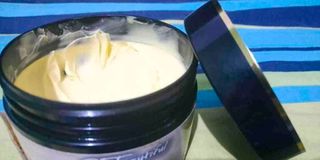
Display of body cream mad from beeswax, shea butter, honey and essential oils.
Scaling globally
As a registered pharmacist, if a substandard product reached the market, it would not just be a business setback—it could end her professional career. In effect, she was betting twice over on her livelihood: the business and the job that was funding it.
The good part, she says, is that she managed to get through without paying a single unofficial fee.
Even after the licences came through, production remained challenging. Beeswax behaves differently across the seasons—the wax from the cold months differs in colour and consistency from the wax produced during the dry season. This means that even when the recipe is unchanged, the appearance of the batches can differ. Customers notice this, and it is not always easy to explain.
“The more you explain, the more you look like you’re covering something up—unless they understand bee farming. But I like it when they ask,” she says.
“You fail one or two times until you perfect it,” she says. “That’s just how it works.”
Joan’s working day begins at 8am, two hours before her pharmacy shift starts. She spends those two hours entirely on Beesplash, doing deliveries, taking supplier calls and attending meetings with potential stockists.
Her pharmacy shift runs from 10am to 6pm. Rotary meetings run from 7pm to 8pm. She is home by 9pm, when she checks homework, counts orders and plans the next production batch.
“I don’t know when I last slept before 1am,” she says. “My body has just adjusted.”
She makes at least one delivery a day. Order volumes range from three to five units on quieter days to boxes containing 30–50 units for bulk buyers. The body butter is her top-selling product, followed by the lip balm and then the soap.
The business has no formal export structure. When senior Rotary members travel to international conventions, they carry Beesplash hampers as gifts. When visiting Rotarians come to Kenya and want a local product to take home, they come to Joan.
“They send me pictures and say, ‘The lip balm has landed in South Africa,” she says. “They tell me, ‘Be on standby—three or four people want your product.”
Two developments made it clear to Joan that Beesplash had moved beyond being a mere side hustle.
The first came through a patient at her pharmacy: a pregnant woman who could not afford the moisturiser she needed. Joan gave her some body butter to try and told her to return it if it did not work. The patient returned to report that the product had stopped the itching from her stretch marks.
Joan then approached gynaecologists directly, pitching the moisturiser as something they could recommend to expectant mothers with skin irritation. Since then, two dermatologists have added it to their prescription pads.
“Seeing my product on a prescription from a dermatologist made me feel so good,” she says. “That is when I knew this was real.”
The second defining moment came at an exhibition when Millie Odhiambo, Suba North MP, walked to Joan’s stand and bought products, at a time when Joan was still struggling with labels that kept peeling off.
“I sat there thinking, ‘Is this really me?” she says. ‘We were still struggling with labels that kept peeling off.”
Joan and her academic collaborator are scheduled to present product research at a scientific conference in Mombasa at the end of July. Two new products, a body lotion and a serum, are in development. She is also weeks away from taking on the presidency of a Rotary club. She is targeting listings with chain pharmacies and is aware that this requires consistency.
“If I don’t visit their offices regularly, someone else will,” she says. “About 90 percent of our feedback is positive. Now we need to document that properly and present it.”
Lessons from the journey
“Don’t wait for the full picture. You know how to get to Mombasa Road; just get there quickly and ask for directions once you arrive. Too much analysis leads to paralysis.”
The extra income has brought about small changes at home..
“There is no greater fulfilment for me than that,” she says. “When I get that feedback from a client, I sell the next one with all the confidence. Even to the president.”
Follow our WhatsApp channel for breaking news updates and more stories like this.