A night falls over Nairobi; the chaotic trading floor of Marikiti Market undergoes its daily reckoning. Tons of overripe papayas, bruised avocados, and softening citrus fruits are swept into heaps, written off by vendors and farmers as financial loss.
But before the inedible produce reaches municipal waste streams, another buyer steps in to collect it for processing. At its manufacturing plant along Kangundo Road in Joska, Touché Kami Industries Limited transforms discarded agricultural biomass into cosmetic oils, body butters, botanical scrubs, shower gels and other personal care products.
Founded by Miriam Mukami in 2023, the enterprise turns food waste from urban markets into beauty products while addressing two challenges in regional value chains — post-harvest losses among vendors and the high cost of imported cosmetic raw materials.
The commercial opportunity lies in securing raw materials at relatively low cost. Through structured procurement of damaged produce, the business buys fruit waste at a fraction of standard commercial prices while creating an additional source of income for market vendors.
“When we look at a crate of overripe avocados or pineapple peels at Marikiti, we do not see garbage or post-harvest loss,” she says. “We see botanical oils, enzymes and essential fatty acids that can form the basis of personal care products”.
For her, what the market trader and farmer consider a financial liability becomes a primary production input.
Touché massage oils displayed at the company’s workshop in Mutalia, along Kangundo Road in Machakos County, on October 18, 2026.
Photo credit: Bonface Bogita | Nation Media Group
Mukami established the venture with Sh94,000 from a funding institution, which she used to set up initial formulation tests, small-scale production equipment, raw materials and regulatory compliance checks. Early production focused on small-batch oil extraction, with the company testing batch stability, shelf life and skin absorption. Limited capital required the business to keep its operations lean, with cash generated from early retail sales reinvested in increasing production and raw materials.
Over operational iterations, the manufacturing process scaled from rudimentary cold-pressing to a structured processing setup.
“Raw fruit arrivals undergo manual sorting, washing and pulp separation. The extracted oils, particularly from avocado and coconut pulp, are processed without synthetic solvents,” she explains.
In addition to processing fruit waste in-house, Touché Kami works with local farmers to source additional plant-based oils. These base inputs are subsequently compounded with natural botanical extracts to manufacture body scrubs, massage oils, baby care formulations, body mists, and specialised aftershave products. The business currently employs three full-time staff in production, quality control, packaging and sales, alongside three casual workers during periods of high market supply. The workforce handles the process from receiving raw materials to packaging finished products.
Offtake spans retail consumers and commercial clients. Individual buyers buy skincare, baby care and grooming products priced between Sh120 to Sh500, while commercial customers, including day spas, massage centres and professional nail technicians, buy products such as massage oils and treatment scrubs in bulk.
“The professional beauty sector in East Africa has long depended on imported products that carry high freight costs and exposure to foreign exchange fluctuations,” Mukami says.
She adds that locally manufactured, plant-based alternatives can give spas and salons more predictable supply timelines while reducing procurement costs.
The business faces several operational challenges, including seasonal fluctuations in raw material supply and the technical requirements involved in preserving products made from agricultural inputs. Unlike synthetic cosmetic manufacturers that rely on standardised, shelf-stable chemical compounds, an agri-cosmetics setup must continuously adjust processing techniques to account for variations in fruit water content, natural oil yields, and seasonal acidity levels. Maintaining product stability without synthetic preservatives also requires careful control of processing and storage conditions.
“We use natural antioxidants, controlled thermal processing and specialised storage to prevent oil rancidity and batch degradation,” she says.
Mukami explains that meeting regulatory requirements involves laboratory testing for microbiological safety, heavy metals and shelf life, adding to the company's compliance costs.
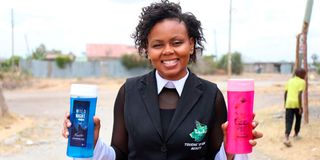
Touché by Kami Beauty's Wild Night body butter for men (left) and strawberry and cookies whipped body butter displayed at her workshop in Mutalia, along Kangundo Road in Machakos County, on October 18, 2026.
Photo credit: Bonface Bogita | Nation Media Group
Supply logistics present another challenge. Produce availability at Marikiti fluctuates with rainfall patterns, transport disruptions from upcountry farms and price changes in major agricultural production areas.
To cushion operations against raw material shortages during off-peak seasons, the business has supply agreements with smallholder farm cooperatives in Kiambu, Murang'a, and Machakos counties, securing direct farm-gate supply when urban market surpluses dry up.
Production runs on a batch schedule, allowing the facility to adjust output according to incoming raw material volumes and seasonal availability. Resource recovery extends past fruit pulp extraction into packaging mechanics, with the enterprise integrating secondary waste streams throughout its retail setup.
It repurposes coconut shells into body scrub, uses recycled glass bottles for beauty products packaging and makes secondary packaging from natural jute fibre recovered from discarded potato sacks.
"Reducing environmental impact cannot stop at product formulation. If an organic product ends up housed in single-use virgin plastic that lingers in landfills for centuries, the environmental balance sheet remains negative," she notes.
The company also offers refill options to returning customers, extending its waste-reduction approach to packaging and product use.
Capital intensity remains a constant challenge as production volumes increase. Upgrading from semi-manual extraction setups to automated, high-throughput industrial centrifuges and automated filling lines requires substantial capital expenditure.
“Commercial bank lending rates for early-stage manufacturing setups remain restrictive, forcing the enterprise to balance cash-flow allocation between raw material procurement, regulatory fees and machinery upgrades,” she says.
Touché by Kami Beauty acetone displayed at the company’s workshop in Mutalia, on October 18, 2026.
Photo credit: Bonface Bogita | Nation Media Group
Market competition is another challenge. The regional personal care market includes established international brands with large marketing budgets and extensive retail distribution networks.
Mukami says overcoming consumer scepticism about locally manufactured organic products requires ongoing educational campaigns on ingredient safety, manufacturing hygiene, and product efficacy. Despite these operational headwinds, financial viability is sustained by accelerating consumer preferences toward natural, eco-friendly, affordable beauty products.
Global and regional demand for clean-label cosmetics is expanding rapidly, spurred by heightened awareness of skin sensitivity, chemical exposure, and environmental sustainability.
To scale, Touché Kami is executing a multi-phase expansion to widen its distribution footprint and diversify its product line. The company plans to upgrade its facility with advanced extraction equipment and an in-house quality assurance laboratory to increase batch sizes and improve testing capacity.
"Our five-year expansion targets scaling our raw material intake to process up to five tons of market fruit waste weekly and expanding our product line," she says.
She adds that the firm is also pursuing distribution partnerships in other East African markets, including Uganda, Tanzania and South Sudan, while developing specialised skincare products using botanical compounds sourced from indigenous African flora.
Geographic expansion plans include establishing procurement hubs in major regional agricultural centres such as Nakuru, Mombasa, Eldoret, and Kisumu.
Mukami says local collection and preliminary processing points near major wholesale markets would reduce transit times, lower logistics costs and reduce post-harvest losses in other urban centres.
For Touché Kami, balancing environmental objectives with financial discipline remains crucial to sustaining margins across its craft and agri-processing lines.
“Converting perishable agricultural waste into higher-value consumer goods provides a practical pathway for industrial import substitution within East Africa’s personal care sector,” Mukami says.
For her, linking agricultural waste recovery with cosmetics production creates an opportunity to retain more value locally as resource constraints and elevated import costs put pressure on regional supply chains.