As consumers increasingly seek alternatives to conventional corn-based snacks, Kenya’s ready-to-eat market is creating new opportunities for processors of traditional grains.
Capitalising on local agricultural value addition, an Embu-based agribusiness is processing locally grown sorghum, rice, wheat and millet into ready-to-eat snacks seasoned with natural flavours.
Kieru Company Limited was founded in 2008 by Gichangi Mahinda and his wife, Lilian, as a small cereal shop in Embu Market before expanding into food processing to capture greater returns from value addition.
Mr Mahinda’s interest in traditional crops long predates his commercial enterprise. His familiarity with indigenous grains stems from childhood, when he watched his mother and grandmother grind millet on a stone mill for family meals.
“Those early experiences shaped my interest in local crops, and I wanted to bridge the gap between traditional farming practices and today’s snacking needs,” he explains.
The defining pivot came in 2013, during a field day when researchers from the Alliance of Bioversity International and CIAT demonstrated processing technologies for indigenous crops.
Seeing millet popped like popcorn revealed an opportunity in the market. Following months of research into processing methods, Mr Mahinda developed popped-grain snacks for commercial sale. Equipped with this insight, he invested Sh300,000 in a specialised popping machine, laying the foundation for the processing venture.
“We work directly with smallholders in Embu and neighbouring counties to source our raw materials locally, supporting growers while adding value to indigenous crops,” he says.
Gichanga Mahinda of Kieru Company Limited operates a popping machine that turns traditional grains into snacks.
Photo credit: Pool
Mr Mahinda adds that there is a whole world of grains that can be popped, yet consumption of popped grains has been limited almost exclusively to maize for years.
“The grains have an outer husk, so under controlled heat they pop, though differently from maize,” he explains, noting that the machine settings must be adjusted for consistent quality.
He adds that each grain pops at a different pressure on his machine. Rice pops at 10 bars, millet and sorghum at 12 bars, maize at nine bars and wheat at 10 bars. The processing workflow begins the moment raw harvests arrive at the facility, where strict moisture management is enforced to mitigate quality risks, particularly aflatoxin contamination.
According to Mr Mahinda, the grains are thoroughly washed and sun-dried for two to three days before being checked to ensure their moisture content is 13 per cent or below.
Using an oil-free, dry-heat method, the enterprise transforms the whole grains into light, crunchy snacks without artificial additives. They are then lightly coated with natural flavourings such as honey, baobab, or ginger before being cooled, packaged, and distributed.
For local growers, these processors provide a commercial outlet for climate-resilient crops that have historically taken a back seat to maize, despite their drought resilience and rich nutritional value.
Mr Mahinda leads by example, cultivating soya beans, sorghum, and millet on his two-acre farm. Breaking into an untested market required grit, as he spent his early days travelling on foot through local towns to introduce sceptical buyers to his novel snack line.
The biggest hurdle was changing consumer perceptions. Most buyers were accustomed to using millet and sorghum primarily as flour for traditional porridge, making the idea of consuming them as popped whole-grain snacks unfamiliar.
“I hawked the product across Embu, Meru, Mwea and neighbouring towns, while also attending agricultural fairs to build brand awareness. Because I saw the long-term business potential, giving up was not an option.”
His persistence eventually opened another chapter for the business. About four years after launching the popped-grain products, Mr Mahinda travelled to Japan for advanced training in industrial puffing and snack processing at Ieda Confectionery Co., Ltd. He says the training expanded his technical knowledge of food processing while also exposing him to new approaches to product development and marketing.
Gichanga Mahinda of Kieru Company Limited operates a popping machine that turns traditional grains into snacks
Photo credit: Pool
The experience also introduced him to a wider range of ingredients. While honey had initially been used to add flavour to the snacks, he began experimenting with ingredients such as mango, hibiscus and baobab, giving him more options for developing flavoured products.
Mr Mahinda says Kieru Company Ltd has contracted more than 300 farmers who supply traditional and underutilised crops used in its products.
“The arrangement provides farmers with a market for their produce and gives us a reliable source of raw materials. Our products have been approved by the Kenya Bureau of Standards and are suitable for people of all ages,” he says.
Supported by a workforce of 10 employees, the enterprise currently processes 300 kilogrammes of grain daily and plans to double its capacity to 600 kilogrammes to meet growing consumer demand.
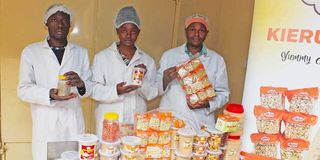
Some of the products made by Kieru Company Limited include grain-based snacks, roasted nuts, soya products, ginger powder and honey.
Photo credit: Pool
Distributed through retail and wholesale channels, including major supermarket chains, the products retail from Sh20 for a 15-gramme pack to Sh400 for 300 grammes.
The company’s expanding portfolio also features roasted cashews, groundnuts, soya drinks, precooked beans, soya flour, ginger powder, and honey.
“I see the commercialisation of traditional and underutilised crops as a way of encouraging their increased consumption. I believe this can contribute to food and nutrition security while creating quality employment,” Mr Mahinda explains.
According to him, there are enormous opportunities in value addition, and agriculture is not just about farming but also includes processing, packaging, marketing and distribution.
To promote the use of these traditional grains, the company conducts structured training programs that have enabled local entrepreneurs to establish independent popping businesses across Kenya.
However, building the processing infrastructure presented significant financial hurdles. Acquiring specialised machinery, he notes, required years of disciplined saving and reinvesting operating profits.
Despite the financial challenges, he maintains that the investment was essential to scaling operations: “Our success belongs to the network of farmers and food innovators we have built together.
The ultimate goal is to make ancient African grains the foundation of healthy snacking—not as a niche product, but as a household staple that people reach for without thinking twice,” he says.
Mr Mahinda plans to expand the processing facility beyond county borders and enter regional markets, while increasing the availability of popped-grain products in mainstream retail outlets.