The biggest question surrounding Kenya’s planned Sh2 trillion oil refinery in Lamu is not how much fuel it will produce, but where it will get the crude oil needed to keep the giant facility running.
The refinery whose groundbreaking is scheduled for tomorrow (Wednesday), will have a processing capacity of 700,000 barrels per day (bpd).
Kenya’s oil output is expected to rise to about 50,000 bpd from 2032, when production from the South Lokichar fields in Turkana County is projected to increase. This means the Lamu refinery will have to rely overwhelmingly on crude sourced from outside the country.
The question of crude supply is therefore emerging as a critical factor in determining the viability of the facility, which is being positioned as a major source of refined petroleum products for Kenya and the wider East African region.
Gulf Energy, the local company tasked with commercially producing crude from South Lokichar, expects output to begin at about 20,000 bpd before rising towards the projected peak of 50,000 bpd.
Even at peak production, Kenya’s crude would meet only a fraction of the Lamu refinery’s 700,000 bpd capacity.
It is not yet clear which countries will supply the balance of the crude or what proportion will come from different markets. That leaves imported crude arriving by sea as the likely critical part of the supply equation, and Lamu's location becomes important as the refinery can potentially tap international crude markets through the port rather than depend entirely on East African production.
On Monday, Energy and Petroleum Cabinet secretary Opiyo Wandayi acknowledged the concerns regarding the crude oil availability.
“Our oil from South Lokichar and what we can get from Uganda will not be enough. So this refinery will be built to process crude from different regions, just like the one in Nigeria,” he told the Nation.
Engineers India Limited (EIL), the company tasked with designing and delivering the Lamu refinery, has indicated that the facility will be capable of processing crude from different markets, giving it flexibility to source supplies internationally.
Kenya could therefore have to tap major crude-producing countries in Africa and beyond to keep the refinery operating at or near capacity.
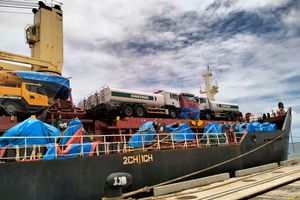
First caller vessel MV DA YANG BAI HE arrives at Lamu Port in Kililana, Lamu West on Saturday, September 26, 2026. The vessel was laden with 2930.295 metric tonnes of project cargo for the construction of the East African Oil Refinery by Aliko Dangote.
Photo credit: Kalume Kazungu | Nation Media Group
Nigeria, South Sudan, Angola, Algeria, Egypt and Libya are among Africa’s major oil producers, while Uganda is expected to join the group when it begins commercial production from the Albertine region that stretches along the border with the Democratic Republic of the Congo later this year.
The sourcing strategy will be particularly important because the refinery is expected to operate for decades and will require a reliable and competitively priced supply of crude.
The experience of Africa’s largest refinery, the Dangote facility at the Lekki Free Zone in Lagos, offers an indication of how such a model could work.
“We see this refinery as critical in that it is going to assure us of fuel availability, even on short notice, like when emergency cargoes are needed. Currently, imported refined fuel is so much pegged on fate, because a lot can happen along these routes, like it is currently happening with the Strait of Hormuz,” Mr Wandayi said.
The refinery sources most of its crude locally from the Nigerian National Petroleum Company, with the balance coming from international markets including Libya, Guyana and the Gulf region. It produces more than 100 million litres of petrol, diesel and aviation fuel every day. The company has built 120km of sea cables to move crude from ships to the refinery.
The Lamu facility is expected to adopt a more diversified sourcing model because Kenya’s domestic production will be insufficient to meet its requirements.
The proposed refinery will have the same 700,000 bpd capacity as the Dangote refinery, making it one of the largest industrial projects on the continent and potentially the second-largest oil refinery in Africa once completed.
Construction is expected to take up to four years, putting the start of operations around 2030.
Beyond securing crude, the refinery raises another major question for Kenya: whether producing fuel locally will translate into lower prices for consumers.
The facility is expected to reduce East Africa’s reliance on imported refined petroleum products and cut some of the freight costs associated with importing fuel from distant markets.
Petroleum Principal Secretary Kello Harsama recently said consumers were likely to benefit from lower pump prices once the Lamu refinery becomes operational.
“Definitely, because of the reduction in the burden of freight charges, we are likely to see a reduction in fuel prices,” Mr Harsama said.
But the experience of the Dangote refinery in Nigeria shows that having a large domestic refinery does not automatically guarantee cheaper fuel.
Prices of petrol and diesel in Nigeria have continued to rise despite the availability of locally refined fuel, with the increases attributed partly to the removal of government subsidies and global oil-market pressures.
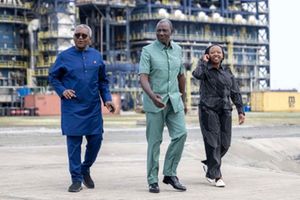
President William Ruto and Dangote Group President and CEO Aliko Dangote during a tour of the Dangote Refinery in Lekki, Lagos State, Nigeria on September 25, 2026.
Photo credit: PCS
“Oil and gas are a global commodity, and what is sold in New York is what is sold here in Nigeria. Again, as long as the crisis in the Gulf region continues, energy prices will remain high,” Nigeria’s Minister of State for Petroleum Resources Heineken Lokpobiri told local media last week.
Refineries generally price their products with reference to international market rates, taking into account crude prices, freight, insurance and other global costs.
This means the Lamu refinery could reduce the cost of bringing petroleum products into the region without insulating consumers from movements in global oil prices.
The issue has become particularly significant following the recent surge in international oil prices linked to the conflict in the Middle East.
In May, Kenya’s diesel and petrol prices rose by Sh40.30 and Sh28.69 per litre respectively. Without government intervention, the increases would have been higher by Sh74.22 for diesel and Sh33.37 for petrol.
Diesel subsequently fell from a record Sh242.92 per litre to Sh217.86, while petrol declined from Sh214.25 to Sh214.03.
Mr Dangote has offered East African countries a 30 percent equity stake in the proposed Lamu refinery, with Kenya, Ethiopia and Rwanda expressing interest in investing in the project.
The investment offer could give regional countries a stake in an infrastructure project intended to reduce dependence on imported refined petroleum products.