Janet Shibonje, founder of CHANF Healthcare Technical Training Institute, during the school's first graduation ceremony on November 7 2025, in Kitengela

When the Covid-19 pandemic struck, resulting in a high demand for medical services, Janet Shibonje, a health practitioner with a background in nursing and health systems management, opened a level three hospital.
The facility helped to ease the health burden that the country was facing at the time, but did not survive beyond Covid-19, due to issues with government approvals and the National Health Insurance Fund (NHIF).
“We could not continue giving services for free, because money was not coming forth from the government,” says Ms Shibonje in an interview with Powering SMEs.
The hospital did not succeed, but her desire to give back to society in some way, an aspiration from her mother, who was also a nurse, did not end there.
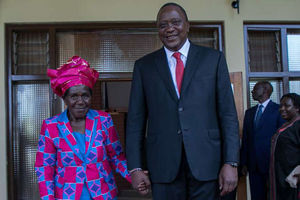
While working in the labour ward and nursery units at the Aga Khan Hospital in 1961, her mother, Fredah Shibonje, midwifed the birth of former President Uhuru Kenyatta.
During his presidency, Uhuru invited Fredah to State House, Nairobi, to express his appreciation for the services which she offered his family, at which point he gave her some Sh200,000.
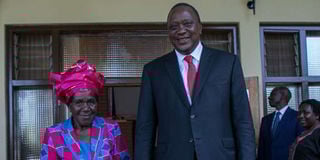
President Uhuru Kenyatta chats with Ms Fredah Shibonje at Kakamega State Lodge on October 20, 2018. Ms Shibonje is a member of the Nursing Council of Kenya and was the midwife on duty the day President Kenyatta was born in 1961.
“Rather than consume all the money, I thought, why not use part of the money to start something that would ensure that her legacy lives beyond her and possibly even us,” says Ms Shibonje.
Caregiving school
Having been accredited by the Directorate of Occupational Safety and Health Services as well as the National Industrial Training Authority to provide training services, Ms Shibonje decided that they should start a caregiving school.
The school, CHANF Healthcare Technical Training Institute, would offer diplomas, certificates, and short courses to people looking to specialise in caregiving and other healthcare professions.
With about Sh100,000 seed capital, they set up the facility in Kitengela, acquired the necessary training equipment as well as licenses, and then began piloting the programme with about 15 students, as permitted by the state.
“Putting up a school is a heavy investment. Initially, meeting the cost of equipment such as mannequins and a skills lab was not easy,” she says.
The cost of acquiring the several licenses required by both county and national governments for them to be able to operate as a training facility was also a bottleneck for the proprietors.
“Sometimes county officials would come to my office asking for extra money for the signage we put up. For the sake of business continuity, we would pay them even though we knew this was extortion,” she says.
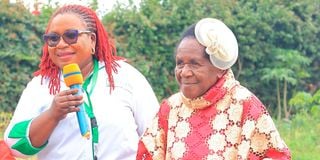
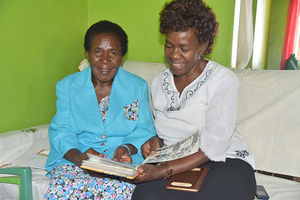
Janet Shibonje and her mother Fredah Shibonje, during the first CHANF Healthcare Technical Training Institute graduation ceremony on November 7 2025, in Kitengela
Despite the resistance that they faced initially, the school managed to grow progressively over time, increasing its workforce from one to seven trainers, due to the high demand for skilled caregivers.
The number of students whom they can enrol at any given time is limited, due to the limited number of training aids at the school.
Last month, the school held its first graduation ceremony for 24 of its students.
According to Ms Shibonje, caregiving is a useful skill that should be made available to as many people as possible.
Not only can it help to promote the safety and comfort of patients, but it can also reduce the burden on hospitals and the people whom patients depend upon.
“If the worker looking after my 88-year-old mother in Kakamega calls me today and tells me she is sick, I will panic and want to rush there. If I cannot afford a flight to Kisumu, I will have to drive,” she says.
Not only would this be dangerous when done in a state of panic. It would also be costly.
However, if the mother had a trained caregiver, she would be able to detect any unusual behaviour and relay the information.
“I, in turn, will call the physician in Kakamega, tell him or her that my mum has been exhibiting certain symptoms, and he will advise on what can be done before an ambulance arrives to take her to the hospital,” she says.
Many families spend too much money out-of-pocket to ensure their loved ones have access to quality healthcare, since many insurance companies are generally hesitant to provide affordable medical insurance to elderly people.
Skilled caregivers can minimise the burden of out-of-pocket medical expenses, which families grapple with, while ensuring that the elderly receive quality care away from the hustle and bustle of the city, which they don’t like.
The skill can also be useful to new mothers, who would learn how to take better care of their children, students going to work abroad, and people looking for work on cruise ships and in health facilities.
“One of my students went to a private hospital as a caregiver, and because of her background in law, she became the hospital administrator. Another one who did economic statistics now works with companies that are distributing drugs,” says Ms Shibonje.
For more people to benefit from the caregiving skill, she says that the relevant authorities need to treat the curriculum with the same respect it is accorded in countries such as the United States, as well as ensure private institutions receive the same support that the public institutions get.
“The Kenya Medical Training Colleges are there, and they are helping people get nursing certificates that are helping them get jobs abroad, but they cannot take everyone. That student who got a D or an E also needs an opportunity to start somewhere,” she says.
“Getting an E today does not define your life. You can still grow stepwise up to the highest level. There is a nurse who went abroad through our programme, now she is pursuing her doctorate,” she added.
Follow our WhatsApp channel for breaking news updates and more stories like this.