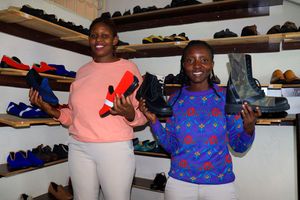
In a warehouse in Baba Dogo, machines hum as rows of shoes, clothing and accessories move through different stages of production, from branding and stitching to finishing and packaging.
Some pieces are completed in-house, while others are produced through a network of external workshops before being coordinated for distribution nationwide.
This forms the operational backbone of Kitu Kali, a Kenyan fashion and lifestyle brand that has, over the years, grown from a footwear start-up into a multi-category retail business.
Long before he understood the language of entrepreneurship, Kushil Lakhani had absorbed its cues — the cut of a suit, the quiet confidence, the authority it conveyed. As a boy, he mimicked his father, unaware he was rehearsing for a role he would later assume.
Those early impressions, though subtle, would go on to shape his approach to business, leadership and personal presence.
A worker operates a sewing machine while crafting footwear at Kitu Kali Limited workshop in Nairobi on April 15, 2026.
Photo credit: Bonface Bogita | Nation Media Group
Founded in 2018 by Mr Lakhani and his co-founders, Kitu Kali began as a footwear-focused venture, with an initial Sh1.5 million capital, partly funded through a successful crowdfunding campaign.
“We exceeded our Kickstarter target, raising 110 percent of the goal, which gave us the foundation to launch and validate the concept,” says Mr Lakhani.
Significant transformation
While the business initially centred on shoes, its most significant transformation has taken place over the past three years. It has since expanded into a full lifestyle offering, spanning menswear, womenswear, kidswear, babywear and a growing range of gifting items.
This expansion has seen Kitu Kali move beyond a single category and extend its offering across a wider customer base.
“Our goal has been to create a brand that reflects modern African identity across multiple product categories, not just footwear,” he says.
The growth has been accompanied by a steady retail footprint, with eight stores in leading malls.
It also maintains a presence in the tourism and hospitality sector, where its products are stocked in more than 50 lodges and hotels across the country, placing the company at the intersection of local consumer demand and the tourism market.
“Each collection is designed to balance contemporary aesthetics with cultural references, aiming to retain authenticity while appealing to a wider audience,” he says.
Although Kitu Kali initially explored international e-commerce, its current strategy prioritises consolidating its presence in Kenya before expanding regionally.
With fashion e-commerce in the country expected to reach $166.8 million by 2025, locally designed brands are increasingly capturing both domestic and tourism-driven demand.
“We have made a deliberate decision to focus on depth in the Kenyan market before moving into regional hubs, including Zanzibar, one of East Africa’s key tourism-driven retail markets,” Mr Lakhani says.
Kitu Kali has also developed a corporate and B2B (business-to-business) segment, working with companies and hospitality groups to supply uniforms and branded merchandise.
This, Mr Lakhani notes, provides a notable source of revenue and positions the company’s products in high-traffic environments such as hotels, offices and events.
A worker operates a sewing machine while crafting footwear at Kitu Kali Limited workshop in Nairobi on April 15, 2026.
Photo credit: Bonface Bogita | Nation Media Group
The brand operates through a distributed production system that engages craftsmen, tailors and makers, as well as self-help groups, across different stages of production.
While these contributors are not directly employed, they remain an integral part of the wider supply chain.
Within the company, a team of around 25 back-office staff oversees functions including finance, marketing, operations, design and logistics, coordinating this network of independent producers.
“We have built long-standing relationships with our partners, which help maintain quality while supporting livelihoods,” he explains.
The brand’s design approach combines African prints, textures and cultural references with contemporary, globally informed silhouettes, producing pieces that are both functional and expressive of identity.
Sustainability is embedded in production, with measures to minimise waste through precise cutting techniques and the use of locally sourced, natural or recycled materials.
To manage seasonal variations in availability and quality, the company works closely with suppliers to stabilise production schedules and maintain consistent standards. It has sold more than 150,000 items to date, with prices ranging from Sh1,500 to Sh10,000.
The enterprise also integrates training and skills development into its operations, providing young people with exposure to design, stitching and allied services such as logistics, printing and packaging.
Mr Lakhani says many trainees have gone on to secure formal employment, developing skills that extend across the wider fashion sector and contribute to the creative economy.
He remains closely involved in design, product development, material sourcing and quality control, ensuring that each item meets established standards while balancing heritage and contemporary design.
As the venture expands, investing in systems to support growth, including inventory management, order tracking and e-commerce analytics, has become essential.
Linking sales data with production planning has allowed the company to anticipate demand fluctuations, reduce inefficiencies, and ensure timely delivery, particularly during peak periods, when volumes and customer expectations are at their highest.
Locally manufactured slippers featuring vibrant African-inspired prints at Kitu Kali Limited workshop in Nairobi on April 15, 2026.
Photo credit: Bonface Bogita | Nation Media Group
Growth, however, has not been without its challenges. “Maintaining production timelines, ensuring consistent quality across multiple workshops and managing cash flow pressures remain ongoing realities,” he notes.
“Balancing these demands while keeping craftsmen and designers fully engaged requires constant attention,” he adds, with systems in place to safeguard quality across all production channels while supporting expansion.
The East African fashion sector has seen a surge in homegrown labels over the past decade, with international buyers increasingly sourcing locally crafted products.
Consumers are showing greater interest in brands that combine cultural identity with functional, contemporary designs.
In a competitive market, labels differentiate themselves through design authenticity, quality, and the ability to scale without compromising heritage aesthetics.
Kitu Kali plans to grow organically, with new retail locations, complemented by ongoing development of products and production processes.
“We are strengthening our retail footprint and refining operational systems to balance growth with stability, maintaining a solid base in Kenya while exploring opportunities across East Africa,” says Mr Lakhani.