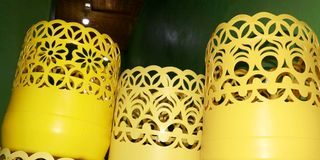
For many years, plastic jerrycans used for packaging cooking oil have mostly been reused in homes for fetching water. However, in Oruba Royal Estate in Migori town, Mr Nixtone Ambiche, a 33-year-old pharmacist, is redefining this concept by transforming plastic jerrycans into decorative items and baskets.
Every Friday, his day off, he travels from Kisumu, where he works, to Migori County to make items such as flower pots, baskets, household containers and ornaments.
For many, this type of art is seen as a hobby or a way to relieve stress. But for Ambiche, it is a calling as well as a livelihood, particularly given the high cost of living.
“My monthly salary as a pharmacist averages Sh30,000, so I had to find an alternative source of income,” explained Ambiche.
His was inspired by a friend who sympathised with him when he was unable to raise money for his tuition fees to join a medical training college.
“I stayed at home for more than three years until a friend encouraged me to start this art. He reminded me to use my talent of art, which he had noticed since our days in primary school, to raise my fees,” Ambiche said.
Serviette and tissue holders at Oruba Royal Estate in Migori town on September 5, 2025.
Photo credit: Fridah Okachi | Nation
He started with a simple trial using a two-litre plastic container, and has now grown a thriving business that turns waste into functional art.
That encouragement from his friend fuelled his motivation and pushed him to experiment with larger 20-litre containers. With a vision, patience, and determination, Ambiche shows that true art is not just about beauty, but also money.
“Art is something I was born with and isn’t easy when you have no capital to start. However, the purpose, patience, and the courage will always push you to see value where others see waste and eventually succeed,” he said confidently.
“Transforming those containers boosted my confidence, although it took me about three hours to make my first flower pot. The first time I sold it, I earned Sh400.”
That breakthrough enabled him to enrol at the Kenya Medical Training College (KMTC) in Meru County in 2022.
When they relocated to Meru, his wife encouraged him to scale up his business, as many customers appreciated his craft.
“The first flower vase she saw, she praised me for it. She told me it was a good job and that I should not give up. That gave me motivation. Even my friends kept calling daily to ask about my progress,” Ambiche said.
With that support, he invested more energy into his craft until he completed his pharmacy course and secured employment in Kisumu County. Still, he chose to continue the art business in Migori County.
Glasses on the second stage before decoration at Oruba Royal Estate in Migori town on September 5, 2025.
Photo credit: Fridah Okachi | Nation
He transforms 10 and 20-litre plastic jerrycans into laundry baskets, storage containers or flower pots for both natural and artificial flowers. Five-litre jerry cans are repurposed into paper holders, onion and carrot storage containers, or food carriers for students. “I want people to see that art is not just about decoration. It can be functional,” Ambiche explained.
He often buys the raw materials cheaply from his customers. Sometimes hospitals sell them at low prices, especially when the jerrycans lack lids, which reduces their usefulness.
Today, Ambiche has expanded his range of innovations to include glass waste as well as plastics. He transforms them into drinking cups, bowls, paper holders, flower vases and glasses for beverages. His unique, customisable designs attract a growing clientele.
“As for bottles, I usually collect them from hotels. They give them to me for free since they don’t know where else to dispose of them,” he explained. “In two months, I can collect up to 14 sacks of glass, each weighing about 90 kilogrammes. What others see as useless waste is raw material waiting to be transformed.”
Between 2022 and 2024, he has inspired many young people. While living in Meru County for two and a half years, he taught three young people how to make products from plastic and glass.
Now, in Migori County, he mentors young people who produce household glass items.
“All of them are under 30 and jobless. Instead of sitting idle, I decided to teach them something meaningful,” explained Ambiche.
To him, art is not just about survival; it's about empowering others with income-generating skills.
Despite juggling pharmacy work with his art business, Ambiche’s dream remains clear: to establish a company dedicated to recycling plastics and glass. “I believe one day I will set up a company. This is not just art, it's about protecting the environment too,” he said.
His vision is to merge art, sustainability, and entrepreneurship in order to create jobs for young people and reduce environmental pollution.
On average, the entrepreneur earns about Sh15,000 or less per month from his art. Though this may seem small, to him it is proof of hidden potential. Every cup, basket or glass tells the story of how waste is transformed into value and how challenges can lead to hope.
“Art lives in me. Even with my busy pharmacy schedule, I can’t stop creating. Whatever little I earn, I share with my teammates who stay behind working from Saturday through Thursday,” he said with a smile.
Most of Ambiche’s customers come through referrals and social media, particularly TikTok, where his work has attracted buyers from as far away as Nairobi County.
“Recently, a customer ordered 10 items. I sold each at Sh350. The market here in Migori is different from Meru County. I remember Mondays, Fridays, and month-ends were the best for sales in Meru. In Migori, customers appear randomly, but the demand remains steady,” he explained.
However, he faces challenges, particularly when collecting waste materials, as it takes time to prepare them manually without machinery. The carving process also poses a risk of injury. “While working, you can cut yourself or your finger can be trapped inside a jerrycan. But I am very careful,” he added.
Another challenge is the lack of finishing materials. Paint would greatly enhance the value of his products, but for now, Ambiche sells them unpainted and at lower prices. He hopes to be able to get paint to make his products more attractive. “Some customers see my work as just a jerrycan instead of appreciating the creativity behind it.”
His major obstacle with glass is disposing of leftover shards, since he lacks a machine to melt them. This forces him to stockpile them and later sell them cheaply to customers from Nakuru and Nairobi.
“If I had a melting machine, I would convert the glass waste into strong fence posts or flower pots,” he said.
As Kenya continues to grapple with unemployment and environmental pollution, Ambiche’s story serves as a reminder that solutions can be found in the most unexpected of places, such as discarded plastic jerrycans and bottles carelessly thrown away in the environment in which we live.