The promise of e-commerce once seemed simple and unassailable. All it took, conventional wisdom held, was a good product, a social media presence and someone willing to deliver goods to customers’ doors.
Initially, this approach seemed sufficient, but as digital commerce expanded across East Africa, online selling became increasingly complex and demanding.
Technology, logistics and customer expectations now intersect at every stage, and business owners must navigate each element carefully to keep pace with a fast-changing market.
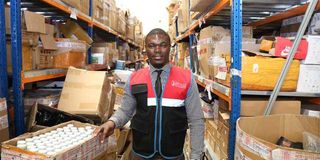
The hum of delivery vans, the ping of dispatch notifications and the efficiency of busy warehouses, illustrate how operational precision now drives success in online retail.
“Today’s consumers expect more than timely deliveries. They want real-time tracking, seamless returns, instant notifications and confirmation of stock availability before placing an order,” says Brian Omondi, founder and Chief Executive of Boxleo Courier and Fulfilment Services.
“Customers want to be in control of their orders from placement to delivery, and any gaps in that process can quickly erode trust and loyalty,” he says.
Traditional courier models focused on simple pick-up and delivery are no longer sufficient. Today’s businesses need integrated systems that efficiently manage orders, returns and customer communication.
Mr Omondi observed significant strains as online trade in the region expanded, identifying gaps in warehousing, last-mile delivery, inventory management and overall logistics operations.
These challenges, he notes, have created opportunities for solutions that combine technology, operational expertise and local knowledge to meet market demands.
Online businesses faced numerous fulfilment challenges, from high shipping costs to complex order management.
Boxleo Courier and Fulfillment Services Limited warehouse with parcels ready for delivery on March 11, 2026.
Photo credit: Bonface Bogita | Nation Media Group
In response, Boxleo Courier and Fulfilment Services was established to streamline the supply chain from order placement to final delivery, offering full insurance coverage for goods in its custody.
With a background in computer science and mathematics from Maseno University, as well as experience in IT governance, risk management and operations, Mr Omondi recognised how technology could enhance efficiency and visibility.
“When we started Boxleo in 2019, our vision was to give businesses and customers greater transparency and control,” he says.
He notes that many courier services were structured for basic pick-up and delivery, at a time when online retailers increasingly required integrated tracking, faster processing and clearer communication with customers.
Most small and mid-sized e-commerce businesses, however, lacked the internal capacity to manage these processes independently. The company has since expanded across the region, establishing operations in Uganda and Tanzania.
This growth signals a broader realignment in East Africa’s online trade, where fulfilment now plays an increasingly strategic role.
“Efficient logistics and reliable supply chains are now key differentiators for online businesses, competing for the attention and loyalty of a digitally savvy customer base,” he explains.
Kenya remains the most mature online retail market in East Africa, with revenues approaching $1 billion in 2024, and projections indicate continued growth as mobile penetration and digital payment adoption expand. Uganda and Tanzania are following a similar trajectory, with online trading increasing as connectivity improves and more consumers embrace mobile money.
Industry projections suggest that Uganda could become the second-largest online market in the region by mid-decade, driven by evolving consumer behaviour and rising confidence in digital shopping.
Despite these positive trends, managing logistics for online businesses across East Africa remains a complex challenge.
Roads outside urban centres are often unreliable, customs and border processes can delay cross-country shipments, and digital payment adoption remains uneven, particularly in rural areas.
Boxleo Courier and Fulfillment Services Limited founder and CEO Brian Omondi (right) with warehouse officer Fredrick Achieng' at the company’s warehouse in Nairobi on March 11, 2026.
Photo credit: Bonface Bogita | Nation Media Group
“Logistics is not just about moving parcels. It involves coordinating warehouses, dispatch teams, drivers and tracking systems while ensuring clear communication with customers,” he says, adding that every touchpoint matters because a single delay can impact a business’s reputation.
Advanced systems now enable businesses to track orders, manage inventory and communicate in real time. However, implementing integrated logistics systems independently can be costly and technically complex.
Boxleo provides a platform that connects online stores directly with its fulfilment infrastructure, serving small and medium-sized enterprises, corporate clients, and e-commerce platforms.
The company supports online sellers who prefer not to invest in physical storage or shop space by providing warehouse facilities, pick-and-pack services, and last-mile delivery.
“Our integration system enables businesses to track orders, monitor stock levels, manage returns and process payments, while leaving operational complexities to us. This allows them to focus on running and expanding their businesses,” he says.
The pricing model is volume-based, with higher order volumes attracting lower rates, while lower volumes are charged standardised but competitive market prices. Cost efficiency is further enhanced through a green approach, including the use of electric motorbikes for deliveries.
Boxleo prioritises transparency throughout the fulfilment process, tracking orders from confirmation to dispatch and final delivery, with returns managed through the same system.
“Customers expect to know exactly when an order will arrive, and meeting those expectations is essential for business survival,” he says.
This visibility is supported by a blend of technology and human expertise. The company’s 474 locally hired team members manage warehousing, pick-and-pack, cash-on-delivery processing and last-mile deliveries across East Africa.
“Technology provides efficiency, but local knowledge ensures effective responses to real-world challenges,” says Mr Omondi.
Boxleo expanded regionally after focusing on operations in Kenya, using data to determine warehouse locations, delivery routes and resource allocation before entering neighbouring countries.
This method has been instrumental in mitigating risk and managing the practical challenges of cross-border logistics. Operational challenges around fulfilment continue to pose a significant hurdle for online businesses in the region.
Delegating logistics to specialised providers enables companies to focus on product development and customer engagement without being hindered by delivery complexities.
Maintaining oversight through technology while automating routine processes helps ensure orders are processed accurately and punctually. Transparency and reliability in operations contribute to customer trust, while local knowledge is essential for navigating challenges that technology alone cannot address.
“Digital commerce is no longer purely digital. It is a hybrid of technology, operational processes and human insight. Businesses that fail to recognise this will struggle, regardless of how strong their product offering is,” he says.
The East African e-commerce market is expanding rapidly, driven by rising mobile phone penetration, broader adoption of digital payments, and a growing number of online shoppers.
At the same time, higher transaction volumes are placing pressure on providers to improve delivery speed, maintain order accuracy, and keep customers informed. Building on this growth, the company plans to expand beyond East Africa into additional African markets.
Mr Omondi says the expansion is not merely geographical, but sets new standards for operational reliability and service excellence.
His leadership has earned continental recognition, including being named a winner of the Forty Under 40 Africa Awards in the Transport and Automobile (Freight & Logistics) category.
As competition intensifies across the region, companies are increasingly investing in regional distribution networks and integrated supply chain systems to support cross-border operations.