Bathed in soft golden evening sunlight, a Swahili woman dressed in a vibrant blue, brown and green floral dress tends her mangrove nursery garden in a small and quiet Matondoni village in Lamu County.
She wears an orange headscarf tied neatly around her hair and holds a small watering can in her hand. Tiny green mangrove seedlings, also known as propagules, are arranged in neat rows all around her, catching the evening dew.
With efficient, practised movements, she pours water at the base of each small plant, her face peaceful as she nurtures new life. This is 45-year-old Swabra Mohammed Musa. Ms Musa, together with 14 other members forming the Matondoni Tarazak Women Group, have since 2019 been in the business of nurturing mangrove propagules and selling them to government agencies, non-governmental organisations (NGOs), community-based organisations (CBOs) involved in conservation efforts, individual restorers, as well as visiting tourists and guests.
Today, their mangrove seedling growing activity has become a significant income-generating venture for them. According to Ms Musa, who is the secretary of the Matondoni Tarazak Women Group, the group makes over Sh500,000 annually from the sale of mangrove propagules alone.
She adds that in a good season, each member can earn as much as Sh31,000 per month, especially when the group is approached to supply seedlings for large-scale restoration projects across Lamu County and beyond. The group sells a single mangrove propagule strong enough for planting at Sh50.
Ms Musa, a mother of four, says that nurturing mangrove seedlings has today turned into a real business venture for them.
“We’re comfortably earning a living just through the sale of the seedlings. Our typical buyers include the World Wide Fund for Nature-Kenya, Kenya Forest Service, the Kenya Marine and Fisheries Research Institute among others,” said Ms Musa.
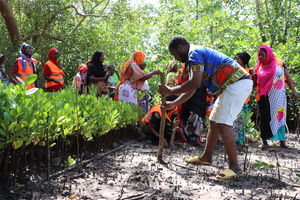
A section of the mangrove seedlings (propagules) nursery garden belonging to Swabra Mohamed Musa and colleagues in this photo taken on May 3, 2024.
Photo credit: Kalume Kazungu | Nation Media Group
She says that in June 2025, one of their regular buyer organisations visited their mangrove nursery garden located on the outskirts of Matondoni Village and bought 10,000 propagules for planting in some of the Lamu archipelago’s depleted sites.
Apart from the money generated from the sale of the propagules, each member of the group was also hired by the organisation at Sh1,750 per day for four days and deployed to the targeted mangrove-depleted sites to conduct restoration work through seedling planting. This increased their monthly earnings.
The sites that benefited from the restoration work included Manda-Tita, Njia Ya Ndovu and Kililana. Since the commencement of the venture in 2019 to date, the group has sold more than 60,000 mangrove seedlings, earning them substantial income.
“We established the mangrove nurseries in 2019 but started releasing mature propagules for planting in 2021. For the past five years, we’ve sold more than 60,000 seedlings. Currently, we have 17,250 mature propagules which are ready for outplanting in our nursery garden,” said Ms Musa.
Ms Jamila Omar, a member, said she does not regret engaging in mangrove seedling rearing, terming it a viable commercial venture. Ms Omar said since its commencement, the idea has continued to provide reliable financial opportunities in addition to stable employment.
“Most of us, the members here, view mangrove nursery and seedling nurturing as a job like any other. We’re self-employed. We’ve created for ourselves a stable and reliable income. Through the money generated from the sale of mangrove propagules, we’ve been paying school fees for our children in secondary schools, colleges and universities, constructing permanent houses for ourselves and our families and enjoying many other benefits,” said Ms Omar.
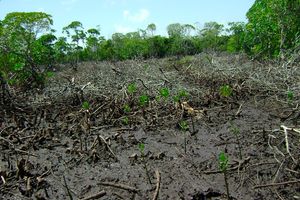
Fresh mangrove seedlings at Faza area in Lamu East on May 3, 2024.
Photo credit: Kalume Kazungu | Nation Media Group
Ms Fatuma Bwanamzee, the chairperson of the Matondoni Tarazak Women Group, noted that the venture is consistently profitable. This has encouraged them to continue growing mangrove seedlings for sale.
Ms Bwanamzee said they have set specific days of the week when they go to the forest to collect mangrove propagules and mud. They then germinate, raise and tend the seedlings in small black paper bags filled with soil or mud.
They also have specific days and hours when they water the seedlings. This process continues for about three to four months, after which the propagules are ready for transfer and permanent planting in the forest.
“We don’t spend much to nurture the mangrove seedlings. Mostly, only our time and energy is spent in preparing and placing the seedlings in the nurseries. No money is used. Even the water we use to water the seedlings is fetched directly from the Indian Ocean, which is adjacent to our mangrove nursery garden,” said Ms Bwanamzee.
She added, “The venture is indeed profitable because the total revenue generated always exceeds its total costs by almost three times.”
They include Mkoko (Rhizophora mucronata), Mchu (Avicennia marina), Muia (Bruguiera gymnorrhiza) and Mkandaa (Ceriops tagal).
Apart from generating livelihoods for the women, the venture has also contributed significantly to ecosystem restoration across Lamu County.
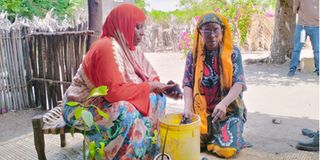
Swabra Mohamed Musa watering mangrove propagules in a nursery at Lamu's Matondoni village May 3, 2024.
Photo credit: Kalume Kazungu | Nation Media Group
“You can grow those seedlings and wait for months before a customer shows up. Some seedlings end up dying in our nurseries before being sold. Government agencies and NGOs are our key clients. They buy the seedlings in large quantities. Our high seasons are between May and July when it’s raining,” said Ms Bwanamzee.
The Lamu women have called on the government to recognise their efforts and to consider prioritising the purchase of seedlings from their nurseries during national events and celebrations such as Mazingira Day, meant to support the Kenyan Government’s 15 billion tree planting initiative.