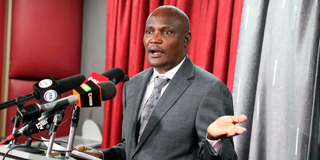
On Tuesday, videos of National Treasury Cabinet Secretary John Mbadi visiting various electronics shops in Nairobi's Central Business District (CBD) to explain proposals contained in the Finance Bill, 2026, trended on social media.
Mr Mbadi was explaining a proposal in the Bill that seeks to introduce a 25 per cent excise duty on every mobile phone activated in Kenya, a measure that has sparked debate among traders, consumers and political leaders.
According to Mr Mbadi, the opposition has misinterpreted the provision, particularly to young people, by claiming that mobile phone prices will rise if the proposal is passed by Parliament.
“This provision is simply meant to streamline taxation by removing multiple tax layers currently paid by those selling phones. In fact, if it is passed in its current form, it will make mobile phones cheaper, not more expensive, contrary to what people are being told,” Mr Mbadi said.
Mr Mbadi explained that mobile phone importers currently pay cumulative taxes and levies amounting to 55 per cent when bringing phones into the country.
“What we are now doing through the Bill is consolidating all levies, including import duty, VAT and others, into a single 25 per cent tax. Is that a good thing or a bad thing?” he asked.
He added: “If you genuinely import phones into this country, then this proposal is for you because it will make phones cheaper. Tell me why young people should be told to reject this proposal.”
Cabinet Secretary for the National Treasury and Economic Planning John Mbadi.
Photo credit: File | Nation Media Group
Treasury takes campaign to the public
Although his explanation triggered further debate on social media, direct engagement with the public has become part of the Treasury's strategy to counter what the Kenya Kwanza administration describes as misinformation being spread by the opposition about the contents of the Bill.
Mr Mbadi has also been meeting young people in universities and holding town hall sessions to explain various provisions of the Bill. Recently, he held a public baraza at Jevanjee Gardens in Nairobi. This is in addition to posters circulated on social media by Parliament and pro-government bloggers.
The Nation has also learnt that the Treasury is planning to release short videos, each lasting one to two minutes, explaining different provisions of the Bill. The videos will be posted on Treasury platforms and produced by technical staff.
The Cabinet Secretary will also address the media weekly to clarify reports that may have been misrepresented during the week.
“I have gone this route because issues of fuel and the economy have ceased to be purely professional matters; they are now political. I have to lay bare the politics because I understand it,” Mr Mbadi said.
The CS told the National Assembly's Budget and Appropriations Committee that part of his role as a policymaker is to communicate policy decisions to the people who will be affected by them.
“Part of my role is to communicate. How do you design policy for people you do not interact with? I have to meet people everywhere and anywhere, even in villages. It cannot just be about sitting on the 14th floor of the Treasury building,” Mr Mbadi said.
National Treasury and Economic Planning Cabinet Secretary John Mbadi when he appeared before the National Assembly Finance and Planning Committee at Bunge Tower in Nairobi on April 2, 2026.
Photo credit: Dennis Onsongo | Nation Media Group
Parliament joins fight against misinformation
In Parliament, the National Assembly is also taking steps to counter what it views as misinformation about the Bill.
Still mindful of the Gen Z protests of 2024 that culminated in the invasion of Parliament, the House has adopted a strategy of providing explanations whenever what it considers inaccurate information is circulated in public.
According to the plan, a dedicated team monitors social media and statements by opposition leaders regarding the Finance Bill, 2026. The team identifies information it considers inaccurate and provides clarifications.
On Friday, the head of the team told the Nation that, starting next Tuesday, Parliament will issue explainers on various provisions of the Bill to help the public better understand its contents.
Photo credit: Nation Media Group
“We will not wait until the last day to provide information. Going forward, you will see us communicating more about the Finance Bill, 2026,” the source said.
The team also disclosed that as the Departmental Committee on Finance and National Planning moves to counties next week for public participation on the Bill, at least 200 copies of the document will be distributed. Members of the public will be guided through the contentious clauses, with explanations provided by technical officers.
Parliament has also been producing short videos, narrated by its media team, to explain the Bill's provisions.
In the House, leaders have also taken time to correct what they describe as misleading statements made by their counterparts in the opposition.
Row over land ownership claims
On Tuesday, National Assembly Speaker Moses Wetang'ula dismissed claims by Wiper leader Kalonzo Musyoka that the Finance Bill, 2026 contains punitive provisions on land ownership.
“You cannot amend the Lands Act through a Finance Bill. The Finance Bill is not a Statute Law (Miscellaneous Amendments) Bill,” Mr Wetang'ula said.
Minority Leader Junet Mohamed urged leaders to read the Bill before commenting on it in public forums.
Suna East MP and National Assembly Minority Leader Junet Mohamed during an interview at Parliament Buildings in Nairobi on January 15, 2025.
Photo credit: Sila Kiplagat | Nation Media Group
“Some of the issues you see being discussed today by the opposition are purely meant to incite people, nothing else. There is a group that has run out of content and now wants to incite Kenyans using the Finance Bill, just as happened in 2024,” Mr Mohamed said.
“Kenyans should not believe the disinformation and propaganda circulating on social media,” added Majority Leader Kimani Ichung'wah.
Addressing concerns about the Finance Bill, 2026, Mr Mbadi said there is no provision in the Bill dealing with leasehold land.
“Mr Musyoka is a Senior Counsel. It surprises me that he can speak about things that are not even in the Bill. Can Kalonzo tell the people of Kenya which clause in the Bill talks about taxation of land? I have read the Bill published by Parliament from cover to cover and have not seen any such provision,” Mr Mbadi said.
Speaking on May 24, 2026, at ACK St Stephen's Cathedral in Kenol, Murang'a County, Mr Musyoka urged citizens to scrutinise the Bill during public participation, arguing that it would quietly introduce financial mechanisms detrimental to ordinary households and small-scale landowners.
“Reject Finance Bill 2026/27 as it is because it is going to quietly introduce leases that will be difficult for people from the Mt Kenya region,” Mr Musyoka said.
Mr Mbadi, however, said he has no problem with anyone raising genuine concerns about the Bill, urging critics to submit their proposals to the Departmental Committee on Finance and National Planning, which is currently conducting public participation.
“If you are genuinely opposing the Bill, then provide a solution because we all want our country to prosper,” Mr Mbadi said.