In Gitwamba, Kiambu County, soft afternoon light filters through clear polythene onto long, shallow wooden beds arranged inside a humid, timber-framed greenhouse.
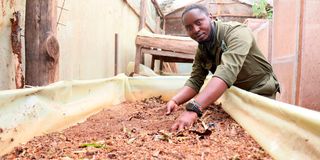
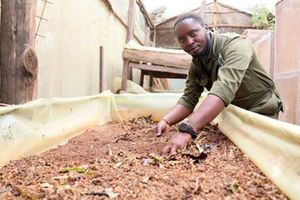
Here, surrounded by the earthy scent of decaying biomass, George Muturi bends over a coarse metal mesh, carefully sifting dark, crumbly matter while inspecting thousands of wrigglers.
To an untrained eye, the beds appear as little more than writhing invertebrates mixed with decaying market remnants.
But to Muturi, the founder of Comfort Worms and Insects, these organisms are biological engineers driving a precision agri-waste recovery process.
On his holding, he has developed an integrated bio-conversion system that transforms municipal organic waste and farm refuse into nutrient-dense vermicompost, high-protein animal feed, and liquid foliar bio-inputs.
His operation uses circular agriculture practices, including biological soil amendments and alternative animal feeds, to reduce input costs and rehabilitate depleted agricultural soils.
Shortly after finishing secondary school, Muturi spotted a lucrative gap in organic poultry production and approached his parents with a proposal.
"I requested permission to construct a small poultry and rabbit unit on a neglected patch of our land, stocking my first batch of indigenous chickens using savings from my pocket money," he says.
High input costs quickly exposed the vulnerabilities of the unit, placing his enterprise on fragile footing. Without formal training in animal nutrition, he knew that relying on fortune was a recipe for failure.
"I was completely new to agribusiness and initially relied on chance, but I soon realised that guesswork is a blind alley," he notes.
He turned to online research to investigate better options out of a determination to secure feed that offered rich, balanced nutrients rather than just bulk filler.
In 2014, he established Comfort Worms and Insects, an agri-tech organic farm with the initial objective of breeding earthworms as a protein supplement for his flock while transforming farm waste into compost for the soil.
However, the early phase was marked by continuous technical hurdles. Red earthworms alone could not meet his entire feed quota, forcing him to spend nearly three years testing different biological systems to keep his venture afloat.
Recognising its potential, he reached out to the International Centre of Insect Physiology and Ecology (ICIPE) to secure his initial supply of black soldier fly eggs. He constructed a ten-square-foot greenhouse and established breeding beds using locally available materials.
Integrating the insect larvae into his flock's diet reduced his reliance on commercial feeds by 40 per cent. By 2018, having demonstrated the technical and economic viability of combining BSF, red worms, and aquatic plants, he officially registered the business.
Muturi’s enterprise now operates as a closed-loop biorefinery, where nothing is discarded. This process relies on a versatile organism valued for its ability to rapidly convert organic waste into usable biomass.
"These larvae act as biological processors, converting low-value refuse like vegetable scraps and livestock manure into high-grade animal protein and bio-fertiliser within a short cycle," he notes.
The larvae feed on organic waste collected daily by Muturi and his five employees from trading centres and school kitchens around Kagaa village, converting it into insect biomass for animal feed within days.
Black soldier fly larvae pictured at George Muturi’s farm in Gatwamba, Kiambu County on October 23, 2025.
Photo credit: Bonface Bogita | Nation Media Group
While BSF larvae process a range of organic materials, earthworms require more carefully selected feedstock. At his farm, the worms are fed organic materials such as cow dung and crop residues, which they break down to produce vermicompost for crop production.
To make efficient use of his limited space, he designed wooden troughs arranged in rows inside the vermicomposting facility, where red wigglers break down the organic matter.
"For this process, we utilise farm-level organic matter like cow dung and crop residue. We avoid processed or cooked food entirely. The worms require six to eight weeks to complete decomposition, after which we harvest and sieve the finished product," he explains.
During this period, the red wigglers continuously aerate the beds as they digest the substrate, yielding a stable, pathogen-free compost with a neutral pH.
"When we speak of vermicomposting, we are referring to using these earthworms to convert agricultural residue into organic fertiliser," he says.
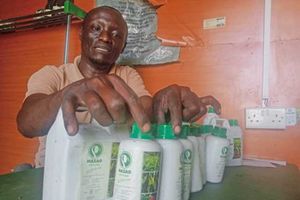
The finest granulated portion is packaged as high-grade compost, while any coarse, unrefined material returns to the troughs for further breakdown. To create liquid foliar spray, they ferment the compost extract into an organic solution that enhances crop resilience against common pests and diseases.
The scientific foundation of Muturi’s venture aligns directly with the severe ecological challenges confronting East African agriculture. Decades of heavy synthetic chemical use, continuous monocropping, and inadequate organic inputs have severely depleted arable soils across the region.
Independent ecological surveys reveal that roughly 75 per cent of Kenya's agricultural soils suffer from dangerously low organic carbon levels, according to a 2025 report by the Heinrich Böll Foundation.
Furthermore, a 2023 World Bank assessment revealed that land degradation affects 64 per cent of arable land, causing severe compaction, accelerated erosion, and crop yield drops of up to 50 per cent in key regions like the Rift Valley and Central Kenya.
When organic carbon drops, soil loses its structural integrity and water retention capacity, becoming dense, acidic, and biologically inert. Vermicompost directly counteracts this decline.
"There is a huge difference between the vermicompost from this process and raw cow, sheep, or goat manure in terms of nutrient composition, pH balance, organic matter, and carbon-to-nitrogen ratios," he notes.
Red worms pictured at George Muturi’s farm in Gatwamba, Kiambu County on October 23, 2025.
Photo credit: Bonface Bogita | Nation Media Group
"It also makes a major difference in terms of safety on the farm. Worms act as biological cleaning agents, breaking down pathogens or harmful elements in raw manure to give us a clean, high-grade compost for the soil."
As the worms process organic substrate, they transform it into nutrient-dense castings that restore soil structure, improving aeration and root penetration in compacted fields.
His operation yields about 12 tonnes of vermicompost each month, while his team processes roughly three tonnes per week of organic inputs across its insect and vermiculture production lines.
The farm packages the organic fertiliser in 10, 30, and 50 kilogram bags, retailing at Sh600, Sh1,500, and Sh2,500 respectively. Their primary client base includes organic growers, seedling propagators, and commercial horticultural exporters dealing in flowers.. "Demand is growing steadily through direct farm-to-farmer sales rather than retail distribution. Before making a purchase, most growers choose to participate in our site training so they fully grasp how these biological inputs revive exhausted soils,” he says.
Never one to rest on a single innovation, Muturi expanded his alternative feed research in 2017 to include Azolla, a free-floating aquatic fern renowned for its rapid growth rate and high protein content.
Vermicompost fertiliser pictured at George Muturi’s farm in Gatwamba, Kiambu County, on October 23, 2025.
Photo credit: Bonface Bogita | Nation Media Group
"Azolla thrives on water surfaces. We constructed shallow ponds to replicate those natural conditions, introducing the initial crop so it can reproduce continuously," he explains.
Constructing artificial ponds roughly 30 centimetres deep and enriching the water with organic bioslurry or cow dung created an optimal cultivation environment.
Following the initial introduction, the aquatic plant matures within three weeks, after which it is ready for routine harvesting.
"From that point onward, we harvest weekly, though daily collection is possible depending on the surface area of the pond. Rich in crude protein and essential minerals, Azolla serves as an economical feed supplement that significantly reduces costs for poultry farmers,” he notes.
To scale their impact, the enterprise established a digital media unit to publish educational content, raise public awareness, and market their bio-inputs online.
While the farm already maintains regional organic certification, Muturi is pursuing international organic compliance to unlock global export opportunities.
"Observing natural cycles and enlisting the power of these small organisms allows us to turn agricultural waste into economic value, offering a practical model for climate-resilient farming across Kenya," he concludes.