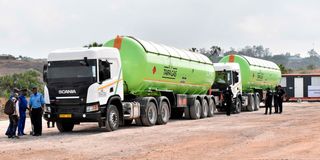
Taifa Gas LPG trucks at Dongo Kundu Special Economic Zone in Likoni, Mombasa County on February 24, 2023.

Kenya now targets to kick off bulk imports of liquefied petroleum gas (LPG) through a competitive tender by December 2025, as part of a strategy aimed at cutting consumer prices of the commodity.
The Cabinet in October 2024 approved the importation of cooking gas via an open tender system where local companies bid for imports, with the lowest firm or winner holding the rights to ship in products on behalf of all other oil marketing companies (OMCs), ensuring they all purchase at the same price.
“We will roll out (the OTS system on LPG) before the end of the year….We are already putting in the legal and regulatory framework and are engaging stakeholders, including suppliers. We have to get OMCs to sign up to the open tender system agreement,” Daniel Kiptoo, Director General of the Energy and Petroleum Regulatory Authority (Epra) said on Wednesday.

Energy and Petroleum Regulatory Authority (Epra) Director General Daniel Kiptoo Bargoria.
“We have to work on a proper transition plan because we recognise that there have been imports coming in privately. The legal framework is already in place, and the OTS arrangement has already been negotiated with the industry,” he added.
Importation under the OTS system is backed by the Petroleum (Importation) Regulations of 2023, which list LPG among petroleum products to be brought in through the mechanism alongside super petrol, jet fuel/kerosene, diesel, fuel oil, and bitumen. The OTS agreement lists terms and conditions, including effective date and duration of the agreement, conditions qualifying OMCs to enter the system, shipment, and the pricing basis.
The system processes start at the invitation to tender and run through stages including tender closing and opening time, validity of offers, and disqualification.
The bulk importation of LPG under the regulator’s guidance comes in the backdrop of increased consumption of liquefied petroleum gas against rising prices.
Consumption of cooking gas has maintained a steady rise in the past few years, with 413,960 tonnes used in 2024, marking a 14.8 per cent rise from 360,590 tonnes consumed by homes, businesses, and institutions the previous year.
The Budget and Appropriation Committee of the National Assembly questioned higher LPG prices, which were against recent interventions, including exemptions from the import declaration fee and the railway development levy.
The retail cost of LPG has increased by 55.7 per cent from Sh2,047.28 per 13-kilogramme cylinder in 2020 to Sh3,188.34 as of 2024, according to observations of the budget committee.
“The sustained upward trend in LPG prices presents challenges to household affordability, particularly for low-income consumers and poses a barrier to the widespread adoption of clean cooking energy solutions,” the committee observed.
Epra has made a raft of policy changes to make LPG affordable and safe. For example, investors are required to have a minimum of 30,000 cylinders as a prerequisite for a LPG dealership, in new changes aimed at weeding out cartels and middlemen from the sub-sector.
Previously, an investor required a minimum of 5,000 LPG cylinders to enter the business, but Epra now seeks to raise this sixfold to help deal with complaints by a section of industry players that some middlemen were hijacking their equipment to profiteer.