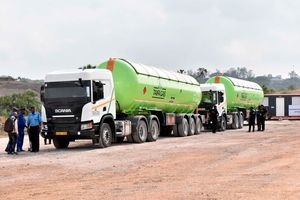
Security Personnel during the commissioning of cargo discharge from MT Barumk Gas Vessel at the Lake Gas Limited, a Liquified Petroleum Gas (LPG) Terminal in Vipingo, Kilifi County on June 4, 2025.


A cooking gas cargo imported by Lake Gas last month has been declared unfit for use, adding to the controversy surrounding the company’s efforts to penetrate the local market, at both importation and retail ends.
A letter seen by the Nation shows that the Kenya Bureau of Standards (KEBS) declared the undisclosed tonnes of LPG unsafe, due to low levels of ethyl mercaptan – an odorant which is used to detect leakage in LPG containers.
The Tanzanian oil firm imported 12,000 metric tonnes of LPG early this month, being its maiden shipment to be handled at its recently completed 22,000-tonne facility in Kilifi County.
The Oil firm, through its General Manager Morris Mutiso, however, told the Nation that there is no cause of alarm saying they will address the issue of the smell on Saturday.
“The cylinder is okay, it is only lacking the smell which we will work on today then KEBS will come to test them again and everything will be okay,” Mr Mutiso said.
Lake Gas is facing a lawsuit over lack of adequate public participation for the facility in Kilifi while senior marine pilots at Kenya Ports Authority (KPA) recently also questioned the timing of the maiden shipment.
“The confirmatory tests conducted in your in-house laboratory witnessed by Mr Emmanuel Rakua, KEBS inspector, confirmed that the ethyl mercaptan levels is still below the required limits specified in KS 91:2022 Kenya Standard Liquefied Petroleum Gas-Specification,” Hilda Keror, the KEBS manager for inspection in-charge of the Coast region, says in the letter dated June 12, 2025.
“Consequently, the entire consignment stands rejected until and when it will be confirmed through independent testing by KEBS that the odorant level is within the limits specified in KSN 91:2022.”
Lack of the required levels of ethyl mercaptan in the entire consignment would have made it difficult for consumers to detect any leakages while using the gas, exposing them to risks such as deaths and serious injuries in case of a faulty container.
Mr Mutiso, however, explained that the reason the gas docked in the country without the smell is that some vessel owners do not load cylinders with the smell.
“Usually, when loading the gas, it has no smell while some vessel owners allow a gas to be loaded with the smell while others don’t,” Mr Mutiso said.
He added: “There is no cause for alarm, this happens everywhere. Some products miss certain parameters but once added, it will be okay. There is no problem with our product, it’s just the smell.”
Ethyl mercaptan has a smell and is used to reveal a leaking LPG container, making it critical in ensuring consumer safety amid a surge in use of cooking gas.
“Immediate corrective action is essential to restore proper functionality and ensure compliance with safety standards,” Ms Keror adds in the letter to Lake Gas.
KEBS’s order has temporarily put on ice plans by Lake Gas to release the shipment to the local market and kick start its ambitions to upstage Africa Gas and Oil Limited (AGOL), the dominant player in the importation of the commodity.
Approval of Lake Gas to set up the facility has been challenged in court and its environmental permit was revoked by a tribunal in April over lack of inadequate public consultations with the local community.
Shipment of the maiden cargo by Lake Gas came despite warnings by senior marine pilots at Kenya Ports Authority (KPA) who cited the intense ocean currents between May and September. The currents significantly hamper navigation and mooring safety of approaching vessels.
Lake Oil is betting on its new facility to take on AGOL, which is owned by Mombasa-based tycoon, Mohammed Jaffer. AGOL handles nearly 90 percent of Kenya’s LPG imports at its 25,000-tonne facility in Mombasa.
Consumption of cooking gas hit a record high of 413,960 tonnes last year, which was a jump of 14.8 percent from 360,590 tonnes used in 2023, as more households, institutions and businesses turn to LPG as their preferred cooking fuel.
Lake Gas is one of the firms that the government is banking on to help lower the handling fees of LPG at the port of Mombasa, which will in turn help lower retail prices of the commodity and further drive its uptake.