Kenya’s air passenger traffic rose one per cent to a record 13.1 million in the year to June 2026, defying a global slowdown as rising demand and improved affordability boosted domestic travel.
Preliminary data from the Kenya Airports Authority (KAA) shows that roughly 145,000 more passengers travelled through Kenyan airports during the period, lifting total air traffic to 13.1 million from 12.955 million in the year to June 2025.
This defied a global decline in aircraft movements and passenger traffic, occasioned by the Middle East conflict that led to the shutdown of the global aviation gateway and suspension of flights to and from the Middle East.
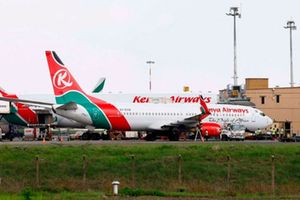
A KQ plane on flight. PHOTO | FILE | NATION MEDIA GROUP
KAA Managing Director Moses Wekesa said that though the Middle East conflict also affected Kenya’s international air passenger traffic, growth was supported by rising domestic travel.
“Most of the growth was because of local travel. We saw a lot of growth in domestic air traffic, but we also felt the impact of the Middle East war in international traffic,” he said in an interview.
“We also saw a rise in aircraft movements, but this was also mostly domestic.”
He did not reveal how much of the traffic was actually domestic, but past data reveals that domestic air travel now accounts for about 41 per cent of total air traffic, with 5.32 million local air travellers in the year to June 2025.
Data on aircraft movements are also yet to be disclosed, but the figure has been rising since 2021, hitting 375,065 in the year to June 2025, a record high after the global slump in 2020 and 2021.
A Kenya Airways liner in flight.
Photo credit: File | Nation Media Group
During the year to June 2026, national carrier Kenya Airways recorded higher demand as Middle Eastern airlines remained grounded, helping drive the surge in Kenya’s air traffic.
In March, shortly after the war broke, KQ disclosed that its load factor on flights to major European, American, and East Asian destinations had improved by an estimated 29 per cent, from about 70 per cent to an average of 90 per cent.
This was the result of increased use of the carrier by international travellers previously captured by giant Middle Eastern carriers, and Nairobi rose as an international transit hub due to the war.
Globally, air traffic slumped in March, April, and May due to the shutdown of the Middle East transit hub, the surge in air fares due to jet fuel price hikes, and rerouting of aircraft around the Middle East.
According to the latest data by the International Air Travel Association (IATA), in May, international air travel demand fell by 1.6 per cent globally, while capacity fell by 2.4 per cent. Domestic demand fell by 3.1 per cent while capacity dropped by 2.1 per cent year-on-year. It continued a trend seen in March and April. June figures are yet to be published.