The quantity of Kenya's fish imports declined by 11.4 percent to 9,960 tonnes worth Sh921.1 million in the year to December 2024, giving more room for local fisheries to grow their sales.
Data from the Kenya Fisheries Service (KeFS), shows that Kenya's fish imports fell from 11,252 tonnes worth Sh1.65 billion the year before. The imports in the review period indicate that the average fish prices had declined substantially, benefitting traders and consumers.
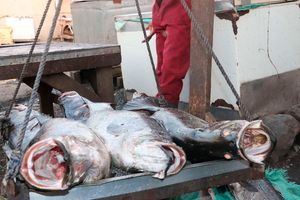
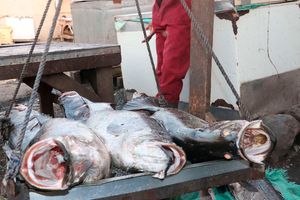
The majority of the imported fish came from Tanzania, accounting for 65 percent of the total. This was followed by China (12 percent), South Korea (four percent), and Taiwan (three percent). The imported fish consisted mainly of tilapia, mackerel, Nile perch, tuna and salmon.
The lower imports are attributed to increased production from marine fisheries and cage culture, reducing the country's dependence on foreign suppliers and stabilising the domestic market.
“Fish farming (aquaculture) recorded a five percent increase in production to 33,423 tonnes of fish harvested in the year 2024 compared to 31,767 tonnes in 2023,” said KeFS.
“The fish production from cage culture continues to increase steadily, accounting for about 76.4 percent (25,547 tonnes), while land-based freshwater aquaculture and mariculture along the coast produce 7,742 tonnes and 134 tonnes, respectively.”
Workers at Rio Fish Farm harvest fish from a cage at Rasira Beach in Suba South.
Photo credit: George Odiwuor| Nation Media Group
Cage farming involves creating a netted enclosure in a lake to raise fish fingerlings, with a harvesting cycle of about one year per cage. It has gained popularity in Lake Victoria, especially on the Kenyan side, where over 5,000 cages operate, mostly owned individually, although companies like Victory Farms are also involved.
There are however, calls for increased regulation due to concerns about sustainability and ecological impacts. The Kenya Marine and Fisheries Research Institute emphasises that strict husbandry practices are essential to avoid ecological degradation and changes in water quality.
Meanwhile, Kenya exported 8,616 tonnes of fish and fishery products in 2024, valued at Sh5.876 billion. While this is lower than the 10,707 tonnes worth Sh6.8 billion exported in 2023, it indicates market realignment and diversification of export outlets. The main destinations for these exports were China, the Democratic Republic of the Congo (DRC), Italy, the Netherlands, Spain and Portugal.
The DRC became Kenya's second-largest fish export market after China, with 3,497 tonnes of fish and fish products valued at Sh774.89 million exported in the review period.
This surpassed Italy and the Netherlands, which purchased fish worth Sh645.11 million and Sh507.69 million, respectively. China remained the top buyer at Sh1.86 billion. The main exported products included dried Alestes, Labeo, tilapia, Nile perch, octopus, lobsters, crabs, and marine ornamental fish.
Despite these developments, however, Kenya still produces less than the national demand of 510,000 tonnes of fish.
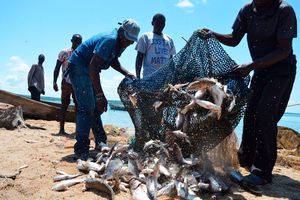
Women clean Tilapia fish captured from Lake Victoria.
Photo credit: File | Nation Media Group
The value of fish produced in Kenya increased by 10.3 percent to Sh39.6 billion in 2024, while total fish production reached 168,424 tonnes —a 4.4 percent increase on the 161,307 tonnes produced in 2023.
“Most of the production was from inland capture fisheries, amounting to 86,527 tonnes with an ex-vessel value of Sh. 14.5 billion. The fish production from marine and aquaculture was 48,474 tonnes and 33,423 tonnes worth Sh.18.6 billion and Sh9.9 billion, respectively,” KeFS said.