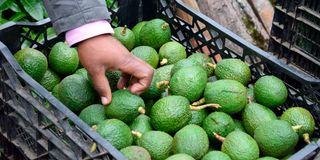
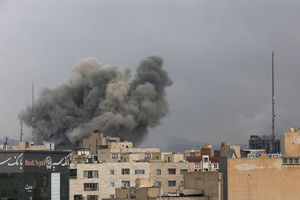
Perishable goods exporters in Kenya are counting losses amid delayed shipments as the raging US-Israel war with Iran has affected key global sea routes.
Traders dealing in avocado, tea, coffee, other horticultural products, and meat exports who depend on sea freight have raised fears of loss of quality due to logistical challenges.
Agayo Ogambi, the CEO of the Shippers Council of Eastern Africa, said that vessels are taking longer to reach the port of Mombasa due to diversion away from Red Sea routes. This adds at least 10–20 days to transit times for exports, the official said.
Top shipping lines are avoiding the Suez Canal and Strait of Hormuz until further notice to avoid attacks by the Iran-backed Houthis in Yemen. The Strait of Hormuz is a crucial maritime corridor that handles about 20 percent of global trade. The shippers are forced to divert their vessels through a longer Cape of Good Hope route.
Shippers Council of Eastern Africa CEO Agayo Ogambi addresses the press in Mombasa in 2024.
Photo credit: Kevin Odit | Nation Media Group
Kenyan meat exporters, who are banking on peak meat demand in the Middle East during Ramadhan season, are counting losses of billions of shillings as stocks pile up due to the disruption of both sea and air travel.
By Monday this week, over 300 tonnes of meat were stuck in storage facilities, according to traders.
"Out of any meat that we slaughtered about two weeks ago, only a small percentage left the country, and we are expecting a huge loss as cold rooms fill to the brink,” the Kenya Meat Livestock Exporters Industry Council (KEMLEIC) CEO, Nicholus Ngahu, said.
Last week, Mr Ngahu said that in two days, they recorded more than Sh1 billion loss as the consignment did not leave the country.
Coffee and tea dealers had already decried delays earlier in their shipments due to congestion at the port of Mombasa. The escalation of the conflict in the Middle East has now placed key maritime routes under pressure.
An employee cleans a sheep inside MV Banyas 1 Lome Vessel at the Port of Lamu on October 15, 2022. The vessel will transport livestock for export to Oman.
Photo credit: Kevin Odit | Nation Media Group
Agricultural firm Sasini last week revealed that it is scouting for new markets for its avocados and macadamia nuts in China and India, as its fruit exports to the traditional markets in Europe and the US face headwinds as a result of the escalating Middle East crisis.
“Global supplies have been affected by the war in the Middle East, and that war is going to get worse. We think in our estimation this year is a write off in terms of going through the Suez Canal, and the Hormuz trade in Iran is another problem,”the group’s managing director, Martin Ochieng, told shareholders during the company’s annual general meeting (AGM), which took place virtually on March 5.
“The mitigation is to use routes or pursue markets that don’t rely on the Suez Canal, and that is why you hear us talking about China specifically, and there is a very good demand for macadamia and avocado there, which we want to pursue this year to ensure that we reduce our reliance on Europe.”
Kenya tea traders have also expressed uncertainty due to the raging Iran war, which now risks disrupting supplies to key international markets as well as payments from buyers abroad.
“The tea prices at the auction remained firm with over 80 percent auction absorption this week, but the Iran war and the Middle East geopolitical conflict could make Kenya lose over 20percent of the Middle East export market,” George Omuga, Managing Director of the East African Trade Association (EATA), which runs the regional auction, said in an interview with Nation.
Elsewhere, the Port of Lamu has received a boost after a motor vehicle carrier diverted from its Middle East route and docked at the facility with hundreds of European-manufactured cars.
MV Grande Auckland, a 9,000-capacity Pure Car Carrier (PCC) with an overall length of 199 metres, made a maiden call at the Port of Lamu on Tuesday, discharging 469 brand new vehicles.
The cars were destined for the Port of Jebel Ali in the United Arab Emirates, before the vessel was redirected because of escalating conflict in the region.
Speaking at the Lamu Port in Kililana, Chartering and Business Development Manager Africa for Nisomar Group, the official agents for Grimaldi Shipping Line in East Africa, Munir Minas Hussein, said the vessel left Europe about a month ago and had been scheduled to sail to the Persian Gulf.
However, heightened tensions in the Middle East, including US-Israeli strikes against Iran and security concerns in the Red Sea, forced shipping planners to look for alternative ports within the Indian Ocean.
Mr Minas said MV Grande Auckland arrived at the Port of Lamu carrying 1,200 vehicles. Of these, 469 will remain temporarily at the port under strict security for about one or two months until the situation in the Middle East stabilises.
The remaining units will be transported to Mumbai in India and other destinations once the vessel departs Lamu Port, possibly on Wednesday afternoon.
Mr Minas said the Port of Lamu stood out as the most suitable option due to its security, operational efficiency, and proximity to the Middle East compared to other ports within the Indian Ocean region.
Sheep bound for export in Lamu County. Animals that show nervous signs should be slaughtered and inspected for maggots in the brain.
Photo credit: File | Nation Media Group
He said the decision to choose Lamu Port was also because of the efficiency of cargo discharge, economic savings, and proximity to the Middle East and the Persian Gulf.
“We’re happy to have made a maiden call to Lamu Port as a Roll-On-Roll-Off vessel. We hope more will follow suit. Once the hinterland infrastructure of East Africa is well built and lit, we will be able to discharge more vehicle cargo and others destined for Kenya and neighbouring countries like Ethiopia and South Sudan,” said Mr Minas.