Treasury Cabinet Secretary (CS) John Mbadi struck a delicate balance while delivering the 2026/27 budget yesterday, targeting the youth and rural folk with goodies to keep them close in the final year of President William Ruto’s first term in office.
During the budget speech, which lasted more than three hours, CS Mbadi made pronouncements targeted at the youth, small businesses and village elders, even as he took a swipe at former President Uhuru Kenyatta’s government over the pace of implementation of specific initiatives.
The Sh4.82 trillion budget is the biggest so far and will see the government borrow Sh1.146 trillion by the end of June 2027.
The government plans to collect Sh2.9 trillion from taxes and Sh645 billion from offering public services, then spend Sh750 billion on development projects.
Mr Mbadi’s speech revolved around initiatives the government has already implemented to benefit the youth and small businesses, while announcing other measures lined up for the coming year.
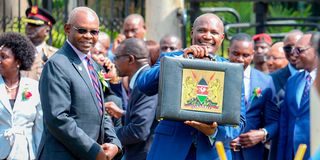
Treasury CS John Mbadi delivers the FY 2026/2027 Budget Highlights at Parliament Buildings, outlining the government's fiscal policy direction and priority spending areas for the coming financial year.
Photo credit: Dennis Onsongo | Nation Media Group
They included the rollout of the National Youth Opportunities Towards Advancement (Nyota) programme, where at least 91,253 youths have received business start-up grants, while some 51,604 youths across 26 counties have benefited from on-the-job experience.
The CS also said 72,623 youths have benefited from subsidised Sexual Reproductive Health services in Nairobi, Kisumu and Mombasa under the Vijana Vuka na Afya (ViVA) Project.
“To further empower the youth, the Government, in partnership with the United Nations Development Programme, has developed the NextGen.Ke Initiative, which will provide recently graduated youth with paid internship opportunities in the private sector, enabling them to acquire practical workplace experience and market-relevant skills. To support this intervention, the Government has committed an initial allocation of Sh2 billion towards its implementation,” the CS said.
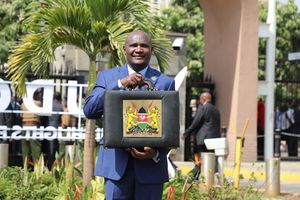
National Treasury and Economic Planning CS John Mbadi pose for a photo with a briefcase containing the 2026/2027 budget statement at Parliament Buildings, Nairobi, on June 11, 2026.
Photo credit: Lucy Wanjiru | Nation Media Group
The pronouncements targeted at the youth were in addition to measures the CS announced with an eye on small businesses, ranging from lowering taxes and improving access to credit to settling pending bills.
He proposed a Sh68 billion budget allocation for payment of pending bills owed mainly to small enterprises, noting that targeting the smaller players would have the highest multiplier effect on economic activity.
Since being formed in May 2023, the pending bills verification committee has analysed 91,911 pending bill claims valued at Sh637.6 billion, recommending payment of 29,885 claims valued at Sh235.6 billion.
“In the FY 2026/27, the National Treasury proposes a budgetary provision of Sh68 billion to settle the verified bills to suppliers and contractors owed by the Government for amounts of up to Sh100 million,” the CS said, adding that part of the allocation would also settle suppliers owed more than Sh100 million.
Treasury believes that prioritising businesses owed smaller figures will settle 99 per cent of the verified pending bills, with the remaining Sh88 billion in bills set to be addressed “through other budgetary provisions and instruments”.
Its focus on small businesses appears to be a strategy to appease thousands of suppliers running small businesses who have been owed billions of shillings by public agencies during a crucial year ahead of next year’s elections.
In the mitumba sector, the government has also proposed the removal of Value Added Tax (VAT) on domestic sales of the clothing, with traders expected to pay the tax once at the point of entry.
“This means that mitumba traders selling to everyday Kenyans will not be burdened with VAT obligations,” CS Mbadi said.
Treasury has also proposed exempting mobile phones from VAT, as multiple other taxes currently in existence are replaced with a single excise duty at the rate of 25 per cent.
Other reforms in taxation include a proposal for pre-population of tax returns to ease the filing of taxes for Kenyans, and the introduction of a one-month deadline for filing nil returns, as workers will now be required to file by the end of April every year.
He also proposed a Sh3.9 billion allocation for stipends to village elders, a move perceived to be targeted at warming the hearts of rural folk months before the start of campaigns for the 2027 elections.
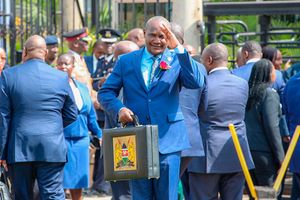
Cabinet Secretary for the National Treasury and Economic Planning John Mbadi, flanked by Central Bank of Kenya Governor Dr Kamau Thugge (left), displays his briefcase before reading the 2026/27 budget at Parliament Buildings, Nairobi, on Thursday, June 11, 2026.
Photo credit: Lucy Wanjiru | Nation Media Group
The debate on whether to pay village elders has been going on for several years, but this will be the first time there has been an actual budget allocation, with the elders expected to earn Sh3,000 monthly.
In the pension sector, Treasury also says it has automated the pension management system, and agencies will now be required to initiate pension claims nine months before the retirement of public workers, a move targeted at appeasing the public service workforce that has endured delays in pension payments due to bureaucracy and underfunding.
“To ensure this reform delivers a lasting impact, Ministries, Departments and Agencies are now required to initiate pension claims at least nine months before a public officer’s retirement date. This will facilitate the resolution of late or incomplete submissions of pension claims ahead of the retirement date for our employees,” the CS said.
He also wooed teachers with a proposal to allocate Sh4.9 billion for the conversion of 20,000 intern teachers to permanent and pensionable terms from January 2027, as another 24,000 newly recruited intern teachers will be hired on permanent terms in July 2027.
CS Mbadi reads Sh4.8 trillion election year budget
The CS indicated that public agencies would not be allowed to make any procurements outside the electronic government procurement (eGP) system from July 1, 2026, after the majority of them gave the system a wide berth and bypassed it.
Only 8,000 tenders were issued through the eGP in the current fiscal year, out of more than 35,000 tenders awarded across government annually.
Treasury also says it is working to extend the rollout of the Treasury Single Account (TSA) to county governments, a step that would overhaul their procurement by ensuring that requisitions and payments are justified through budgets.
The CS said that since the rollout of the TSA for ministries and national government agencies, Treasury has sealed loopholes previously used to siphon public funds, leading to a 61 per cent fall in reliance on Central Bank overdrafts by the national government.
In the budget speech, delivered over more than three hours from 3pm, CS Mbadi also took moments to take a swipe at former President Kenyatta’s administration as he sought to boast about the achievements President Ruto’s government has made since 2022.
In the education sector, for instance, he said the government has employed 100,000 teachers, averaging 20,000 annually, while the previous government failed to hit half that number.
Treasury has allocated Sh784.5 billion to the sector, an increase of 53 per cent from the budget of Sh511.7 billion in 2021/22, the last full fiscal year of Mr Kenyatta being in office.
In the agriculture sector, the CS also praised the government’s fertiliser subsidy for boosting productivity, as he took credit for higher yields in several food and cash crops.
While announcing a Sh18 billion allocation to the subsidy, he said maize production has nearly doubled from 34 million bags to 67 million bags between 2022 and 2025, while the production of paddy rice rose by 58 per cent to 303,724 tonnes over the same period.