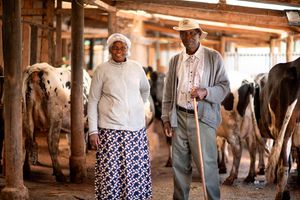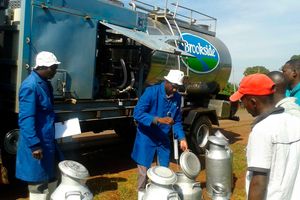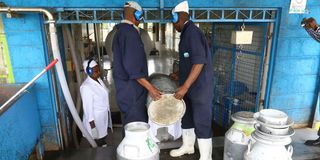
Farmers prepare milk for collection at Kangui Trading Centre, Nyandarua County, on May 23, 2025.

Annual formal milk intake by processors has crossed the one-billion-litre mark for the first time ever, signalling improved supply into the regulated market as farmers respond to good weather, better prices and rising demand for processed dairy products.
Fresh data from the Kenya Dairy Board shows formal milk intake rose 11.6 per cent to 1.01 billion litres in the year ended December 2025, up from 908.4 million litres the year before.
The reported volumes extend a steady rise in dairy deliveries to processors, reinforcing the shift of milk sales from informal channels into the formal chain as buyers intensify collection and compliance measures. KDB acting managing director William Maritim attributed the increase to improved production and supply of raw milk following favourable weather.
In a text response to this publication, Maritim said stable pricing by milk processors and other buyers also supported the higher volumes, with KDB data showing milk prices averaged Sh49.8 per litre in last year.
“The increase is attributed to enhanced regulation, organisation and formalisation of the dairy industry, as well as increasing demand for processed milk and milk products by consumers,” he said.
The country’s formal milk intake volume recorded last year is the highest single-year quantity since KDB started recording the data in 2001. Over the years, the 2002 calendar year recorded the lowest sales volume to formal processors at 143.6 million litres, marking a 5.8 per cent drop from the 152.4 million litres sold in 2001.
With an approximated 1.8 million smallholder farmers who make up around 80 per cent of the producers, it is estimated that about 80 per cent of Kenya’s milk is marketed informally.
KDB estimates production, including formally and informally marketed milk, is about 5.2 billion litres annually.
The informal market includes direct sales to consumers, traders and small-scale vendors, channels that often offer quick cash but limit the flow of milk into regulated processing systems.
In its 2024–2027 strategic plan, KDB targets a sharp increase in national production and a major expansion in exports, pointing to ambitions to build Kenya into a stronger regional dairy supplier.
The agency has said key interventions to raise output include improving feeding and breeding, strengthening disease control and expanding farmer training to lift productivity per cow.
“To double production, interventions to enhance feeding, breeding, disease control, and farmer extension services will be implemented to increase productivity per cow from five to 10 litres per day,” KDB said.
Follow our WhatsApp channel for breaking news updates and more stories like this.