New coffee growing zones have emerged in North and South Rift, Coast as well as Western Kenya as investors flattened farms in previously key producing areas such as Kiambu and Murang’a to pave the way for better rewarding real estate projects.
These new areas were traditionally tea-growing and sugarcane-growing zones, but they are gradually picking up coffee farming.
“In terms of production, area versus productivity, we see an expansion but also a loss of some coffee farms, especially around towns,” Elijah Gichuru, the director of the Coffee Research Institute (CRI) said.
The official said that areas such as Narok (Narok-Bomet border), Trans Mara, Kisii, North Rift, Nyanza-Lake Basin, Mt Elgon, West Pokot, Elgeyo Marakwet, Baringo, and Laikipia are suitable for coffee production, and farmers are embracing the crop.
“Interestingly, some of these are arid and semi-arid land (ASAL) regions. With technological advancements such as irrigation, we can increase coffee production in Kenya,” says Dr Gichuru.
In areas experiencing drought, farmers are not only adopting irrigation systems but also changing field technologies.
A report from the New Kenya Planters Cooperative Union (New KPCU) shows that Kericho contributes about 10 percent of Kenya’s coffee production.
New KPCU is a government miller agency tasked with marketing coffee beans and processed coffee both locally and internationally.
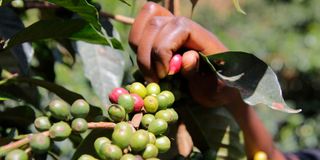
Coffee cherries at a farm in Nyeri town on October 26, 2022.
Photo credit: Joseph Kanyi I Nation Media Group
“Looking at Nandi, it has recorded about 500 percent growth, Kericho 265 percent and Baringo about 100 percent. This growth presents significant opportunities to increase coffee production,” said Muhia Murigi, the New KPCU deputy director in charge of agriculture extension.
Kenya exports 95 percent of its coffee, leaving only five percent for local consumption.
Mr Murigi states that the five percent represents an increase from the previous three percent, thanks to initiatives by the government and private sector players to promote local coffee consumption. The country’s coffee is much sought-after by roasters and blenders, and international prices are used as a benchmark for the local price at the Nairobi Coffee Exchange.
However, due to sustained mismanagement of the value chain which has over the years given rise to low returns, many farmers have ditched the crop over time in favour of more lucrative crops.
As a result, domestic production of coffee has dwindled from a peak of 128,637 tonnes in 1988 to just 48,700 tonnes in 2023.
Apart from competition from real estate, coffee is also under pressure from alternative crops such as Macadamia and avocado.
“In Murang’a, Nyeri, and Kirinyaga, coffee is facing competition from other valuable crops such as macadamia and avocado. Some farmers opt for these crops due to their efficient market dynamics,” says Mr Murigi.
A farmer Evageline Wabeti drying Coffee Mbuni at Kabati in Muranga County.
Photo credit: File| Nation
Data shows that the value of coffee sold on the Nairobi Coffee Exchange increased by 93.4 percent in the first seven auctions of the 2024-2025 marketing season, driven by higher volumes. Coffee buyers took up cherries worth $22.8 million (Sh2.94billion).
This was nearly double the $ 11.8 million (Sh1.52 billion) purchases in a similar period of the previous year. The higher earnings were primarily due to a 41.7 percent jump in sold volumes to 4.38 million kilogrammes, up from 3.09 million in the previous window.