Kenya’s public debt has shot up by more than Sh1 trillion in eight months, underlining the growing burden on taxpayers as the Treasury faces the domestic market for more loans.
Data from the National Treasury shows that from January to the end of August, the public debt grew by Sh1.04 trillion, raising the overall public debt stock to Sh11.9 trillion.
This is the second time in five years that the debt has grown by more than Sh1 trillion over a similar period, though the Sh1.38 trillion growth recorded in 2023 was largely on account of depreciation of the shilling.
“The total nominal public and publicly guaranteed debt stock at the end of August 2025 was Sh11,968.95 billion (67.4 percent of GDP1) equivalent to $92.61 billion,” Treasury says in the August debt bulletin.
Debt has shot up by more than Sh1 trillion in eight months, underlining the growing burden on taxpayers.
Photo credit: File
The Treasury data shows that domestic debt accounted for two-thirds of the growth, reflecting the growing focus by the government to borrow more from the domestic market.
Domestic debt grew by Sh697.4 billion while external debt increased by Sh346.3 billion, the trend seeing domestic debt continue to dominate.
“Domestic and external debt stock accounted for 54.9 percent and 45.1 percent of total debt stock, respectively,” Treasury said.
Last week, Treasury Cabinet Secretary John Mbadi said the government has been borrowing more from the domestic market due to low interest rates.
Treasury Cabinet Secretary John Mbadi.
Photo credit: File | Nation Media Group
The CS said high depreciation of the currency, which came at huge costs in debt service, discouraged the Treasury from borrowing more on the external markets, but noted that the situation is beginning to calm down.
“We actually moved towards domestic more as opposed to external when we had the challenge of the currency. You know external debts may sound or appear cheap when the currency is strong, but by the shilling depreciating from about 128 to 165, we increase our external debt stock by 1 trillion without taking any shilling,” CS Mbadi said.
Between January and August 2023, the Kenyan shilling depreciated from an exchange rate of 123.37 units to 145.4 units against the US dollar.
Over the same period, the public debt stock increased by Sh1.38 trillion, with external debt growth accounting for more than two-thirds (68.3 percent) of the growth.
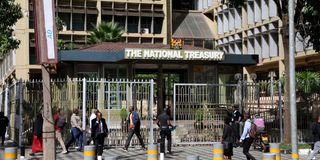
The National Treasury building.
Photo credit: Dennis Onsongo | Nation
Treasury says it avoided borrowing heavily from external markets for fear of a recurrence of the same.
“That puts a strain on us in terms of interest payments. So, we reduced the external debt, especially commercial borrowing, because the market rate was very high. If we have options to get money from multilateral and concessional loans from multilateral lenders, then we will move more percentages from domestic to external,” CS Mbadi says.
Last year, the public debt stock reduced by Sh405 billion between January and August, as the exchange rate cooled down to settle at around 130 units, cutting external debts.
In a recent report to Parliament, the Treasury indicated that it borrowed four loans valued at Sh95.5 billion over four months to the end of August.
The four loans included a Sh16.4 billion facility from the International Fund for Agricultural Development to enhance integrated natural resources management, increase resilience to climate change, and improve beneficiaries' livelihoods, particularly for women, youth, and other vulnerable groups.
“The loan will be repaid in 40 equal semi-annual repayments of $3,170,000 from June 15, 2030 through to December 15, 2049. The interest rate of the loan is 1.41 percent, and a service charge of 1.39 percent will be fixed for the life cycle of the loan and payable semi-annually,” Treasury said.